Stainless steel shotgun is start-up’s first project

Clay shooting is a popular global activity as well as being one of the 42 Olympic disciplines and, as in any sport, the quality of the equipment is paramount. One enthusiast who is determined to manufacture a range of affordable yet high-quality shotguns and bring them within the financial reach of a wider market is Christopher Iaciofano, who set up RIMD in Fleet Marsden, near Aylesbury, in January 2021.

To produce metal parts for the guns, he has installed a Hurco five-axis CNC machining centre and a Dean Smith and Grace (DSG) 6.5-tonne manual lathe that was specially adapted in-house to enable the highly accurate deep-hole drilling of barrels. The first gun will be marketed as the ‘Chiltern’ later this year through an established manufacturer of traditional hand-crafted shotguns.

The rationale for establishing the venture was Iaciofano’s identification of a gap in the engineering marketplace for a company capable of undertaking the functions needed to launch a new product – research, innovation, manufacturing and development (RIMD). The company says it is able to remove some or all of these elements from a customer’s activities and inject a high level of expertise to achieve a superior end product and accelerate time-to-market. There is a special focus on R&D, which is generally the first area to be neglected in favour of day-to-day activities.

Having gained a BSc in mechanical engineering at Bournemouth University, Iaciofano subsequently worked in the oil and gas sector. He was responsible for designing and manufacturing chemical injection equipment capable of withstanding pressures up to 3000 bar utilising a diverse range of exotic materials, which he became expert in machining.

With that knowledge and having an antipathy towards the mild steel parts on his own shotgun rusting, he decided to design and construct a new version from a special blend of PH17-4 hardened stainless steel. This material is particularly difficult to machine, as it is sticky and requires very sharp cutters, yet has a hardness of 38 HRc and above, which tends to wear the tooling quickly. To make matters worse, very small drills are involved in production, as well as milling cutters down to 0.6 mm in diameter.

Hurco offers two main styles of integrated five-axis vertical machining centre, one with a swivelling trunnion supporting a rotary table, and the other with a B-axis spindle and a horizontal rotary table. Neither design was suitable for RIMD, as it would have been impossible to mill the outside of the one-piece shotgun barrel from a 76 mm diameter, 900 mm long billet without buying an excessively large machine.

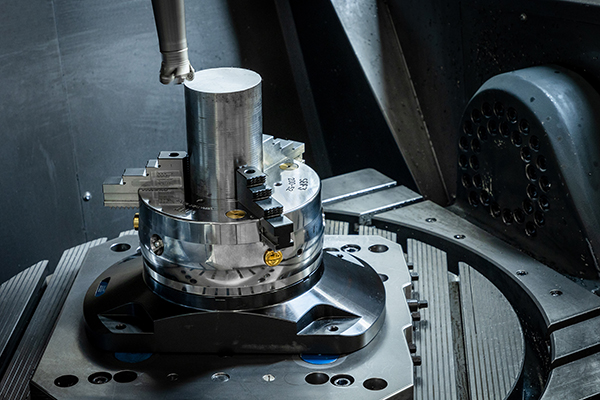
The answer was to purchase a Hurco VMX42HSi three-axis VMC equipped with a Kitagawa two-axis compound rotary table positioned at the far right-hand side of the machining area. The latter enables the 900 mm barrel billet, which has already had the two bores roughed and finished on the DSG, to be fixtured by picking up on the bores and rotated. It is then possible to mill the entire outside along its length using the VMC’s 1000 mm X axis. In the process, the barrel reduces to about 1.2 mm wall thickness and 1.4 kg, just 5% of the original billet weight of 28 kg.

The machine is equipped with an 18,000 rpm spindle, so very high surface finishes are possible. Linear scales provide ultra-precise feedback of the orthogonal axis positions to the control. In addition, the table feeds its rotary positions back to the proprietary Hurco WinMax CNC, which is capable of controlling all five axis motions simultaneously. Many such programs help produce components for the Chiltern gun, all of which come off the Hurco in one operation to within 5 µm dimensional accuracy on all critical features.

Most of the remaining cycles are 3+2, with the rotary axes positioned and clamped to present the part to the spindle in convenient orientations, thus maximising machining efficiency. All programming takes place using either SolidCAM or GibbsCAM, rather than directly at the WinMax control, although the latter conversational software remains a convenient option for future projects.

Iaciofano concludes: “Our immediate business plan is to complete the shotgun venture through to series production and take on another couple of projects. They will be either the cradle-to-grave development of a new product of our own design, or manufacturing support for a third party’s project to relieve them of some of their work.

“It is also a target to take on smaller projects from individuals with great ideas but without the means to bring them to market, and to offer free development and manufacturing for a share of the company,” he adds. “Our intention is to more than double our factory space to 4500 sq ft by expanding into an adjacent unit.”

For further information
www.hurco.co.uk

New work-holding products on display

On Stand F27 in Hall 3, Roemheld is launching a modular, sensor-based system that digitalises zero-point clamping by enabling digital recording of its status. STARK.intelligence enables the integration of data on workpiece loading and unloading directly into an automated manufacturing process. Information is also available on the condition of the clamping equipment to aid scheduled maintenance. Each fixture features its own sensor box to measure position, temperature and pressure in real time. It is possible to combine STARK.intelligence with various STARK zero-point clamping systems.

For further information
www.roemheld.co.uk

Soraluce presents #MadeForYOU live

Soraluce is presenting its #MadeForYOU client-oriented approach by showcasing its latest generation of machining solutions on Stand D06 in Hall 3. Among the highlights is the presentation of Soraluce’s PMG portal gantry milling machine. This model has a longitudinal traverse of 10,000 mm, a cross traverse of 4000 mm, a vertical traverse of 1500 mm and is fitted with a step-less universal head of 0.001° x 0.001° at 7000 rpm. In keeping with the company’s #MadeForYOU philosophy, it is possible to customise the new portal model in line with specific requirements. Ward CNC is the UK representative for Soraluce.

For further information www.wardcnc.com

More flexibility and productivity

On Stand D01 in Hall 4, Schwäbische Werkzeugmaschinen GmbH (SW) is presenting solutions designed for highly productive medical component manufacturing. Many standard medical procedures were postponed during the pandemic and they must now be made up. This situation has given rise to an enormous need for implants made of titanium alloys and other alloys.

Medical part manufacturers can quickly increase their quantities with SW’s BA W02-22i twin-spindle machining centre featuring linear and torque motors, as well as integrated automation. On just 4 sq m of installation area, the BA W02-22i can machine complex workpieces with high precision. Direct drives in the feed axes ensure positioning accuracy, even at the highest possible machining speeds, with a guaranteed deviation of less than 0.006 mm.

For further information
www.sw-machines.com

Better non-destructive inspection of large parts

Nikon Metrology’s industrial microfocus X-ray CT inspection solutions are now enhanced with a new offset CT reconstruction algorithm to deliver high scan speed and image resolution.

When using X-ray CT (computed tomography) for the non-destructive quality control of larger components like aluminium castings or battery modules for electrical vehicles, the challenge is to shorten inspection cycle times without compromising resolution. One prerequisite for meeting this goal is high X-ray intensity, or flux.

In Nikon Metrology’s range of X-ray CT systems, a rotating target can already triple the flux for a given focal spot size and the flux can be further increased by motorised FID (focal spot to imager distance), which brings the detector closer to the source at the push of a button.

With the release of a new offset CT reconstruction algorithm in the latest version of the manufacturer’s Inspect-X software, not only is it possible to scan larger components, but it can also be performed at higher geometric magnification. The Offset.CT module is available on all Nikon Metrology X-ray CT systems from 180 through to 450 kV.

With this combination of the latest Rotating.Target 2.0, adjustable FID and Offset.CT, which Nikon says cannot be found in any competitive industrial CT system, cycle times are reduced and better resolution is achieved, even when processing large and complex components.

Bigger parts with complex geometry, such as castings and additively manufactured components, benefit in particular from industrial X-ray CT solutions from Nikon Metrology. The inspection of battery modules for electric vehicles, in which individual battery cells requiring high-resolution imaging are encapsulated in a larger protective unit, is a an especially good fit for this inspection technique.

For further information
www.nikonmetrology.com