
Snowbird Technologies integrates Meltio Engine Blue

Snowbird Technologies and Meltio have unveiled a next-generation containerised hybrid manufacturing system designed to produce and repair critical components directly at the point of need for defence applications.

The solution combines Snowbird’s deployable SAMM Tech platform with the Meltio Engine Blue, creating a ruggedised manufacturing cell that integrates additive and subtractive processes within a transportable container. Designed for rapid deployment, the system enables military personnel to manufacture, repair and replace components in remote and austere environments, reducing reliance on traditional supply chains.

Compatible with existing military logistics infrastructure, the platform is engineered to operate in challenging land and maritime conditions. It supports a wide range of industrial metals, including aluminium, titanium and marine-grade bronze, allowing the production and repair of structural and functional components essential to defence and naval operations.

The hybrid system combines metal and polymer processing capabilities while providing the safety, reliability and flexibility required for deployed environments. By bringing manufacturing closer to the point of use, it helps reduce lead times, minimise material waste and improve operational readiness.

The collaboration builds on proven field experience. Snowbird’s technology has already demonstrated its value during naval operations, including the repair of a reverse osmosis pump aboard a US Navy vessel, restoring freshwater generation capabilities within hours and avoiding an early return to port.

“This collaboration further validates the role of laser-wire directed energy deposition technology in demanding defence environments,” says Scott Morse, chief executive of Snowbird Technologies. “By integrating the Meltio Engine Blue into our next-generation SAMM Tech platform, we can deliver reliable hybrid manufacturing where traditional infrastructure is unavailable.”

Gabriel Ortiz, Americas Channel Manager at Meltio, adds: “Defence organisations require manufacturing solutions that are reliable, flexible and deployable. This collaboration demonstrates how additive manufacturing can strengthen operational readiness in the field.”

More information www.meltio3d.com

Stratasys helps Subaru cut 50% from tool development time

Stratasys reports that Subaru of America is accelerating automotive tooling development using the new T25 High Speed Head for the Stratasys F770 3D printer, cutting development times by more than 50% while reducing costs.

Among the first companies to adopt the technology, Subaru’s engineering teams use the T25 high-speed head to support the development of accessories and installation tooling. By bringing more production in-house, the automaker has reduced overall prototyping and tooling costs by 70%, while a 36-inch tool can now be produced almost twice as fast compared with the standard print head.

The increased throughput has enabled Subaru to consolidate tooling production on its Stratasys F770 platform, improving repeatability and part quality while providing a faster response to urgent manufacturing requirements.

“Being able to get the enhanced throughput with the F770 has made for a more reliable and robust operation,” says Matt Daroff, project engineering manager at Subaru of America. “Getting parts to our internal customers earlier gives them an opportunity to identify things we may not have caught in development, helping us make corrections sooner and minimise wasted time and material.”

Subaru’s experience highlights the potential of the T25 high-speed head, which delivers print speeds up to 2.3 times faster on large-format components while maintaining the quality required for industrial applications. The technology is designed to help manufacturers accelerate tooling production, shorten lead times and improve flexibility across prototyping and production workflows.

It also offers an alternative to traditional tooling methods, which can involve lengthy lead times, high machining costs and reliance on external suppliers.

“Our customers want the ability to move fast without sacrificing quality or incurring unnecessary costs,” says Rich Garrity, chief industrial business officer at Stratasys. “The T25 High Speed Head delivers exactly that.”

More information www.stratasys.com

High-speed 3D printer built for continuous production

UltiMaker, a global specialist in industrial desktop 3D printing, has launched the Factor 4 Plus, an industrial-grade platform that delivers up to twice the speed of the standard Factor 4 while maintaining the reliability and quality required for continuous production. Designed for manufacturing and defence applications, the system supports the production of jigs, fixtures, spare parts and end-use components using high-performance materials, including PPS-CF composites that offer excellent heat and chemical resistance.

A key feature is UltiMaker TRACE (Technical Reporting And Certification Engine), which automatically validates every print by recording critical process data and generating certification reports. This gives manufacturers the traceability and quality assurance needed to deploy additive manufacturing in production environments with confidence.

“When I talk directly with customers, one message comes through consistently: speed is important, but proving part quality is the real challenge,” says Arjen Dirks, CTO at UltiMaker. “TRACE provides the validation and traceability needed to scale additive manufacturing into true production.”

The Factor 4 Plus has also been adapted for defence applications, with a ruggedised gantry system designed to maintain accuracy and reliability in harsh or remote environments. Combined with its straightforward set up and minimal training requirements, the platform is well suited to field deployment and rapid production of mission-critical parts.

Performance improvements are driven by UltiMaker’s Cheetah motion planner and compatibility with new AA+ and CC+ high-flow print cores. Together, these technologies enable faster printing while maintaining dimensional accuracy across materials including PLA, ABS and PPS-CF.

“The Factor 4 Plus is focused on solving real production challenges,” adds Andy Middleton, SVP EMEA and global marketing. “It delivers the speed, traceability, resilience and affordability customers need to scale additive manufacturing in demanding environments.”

More information www.ultimaker.com

3D printing entrepreneur secures two King’s Awards

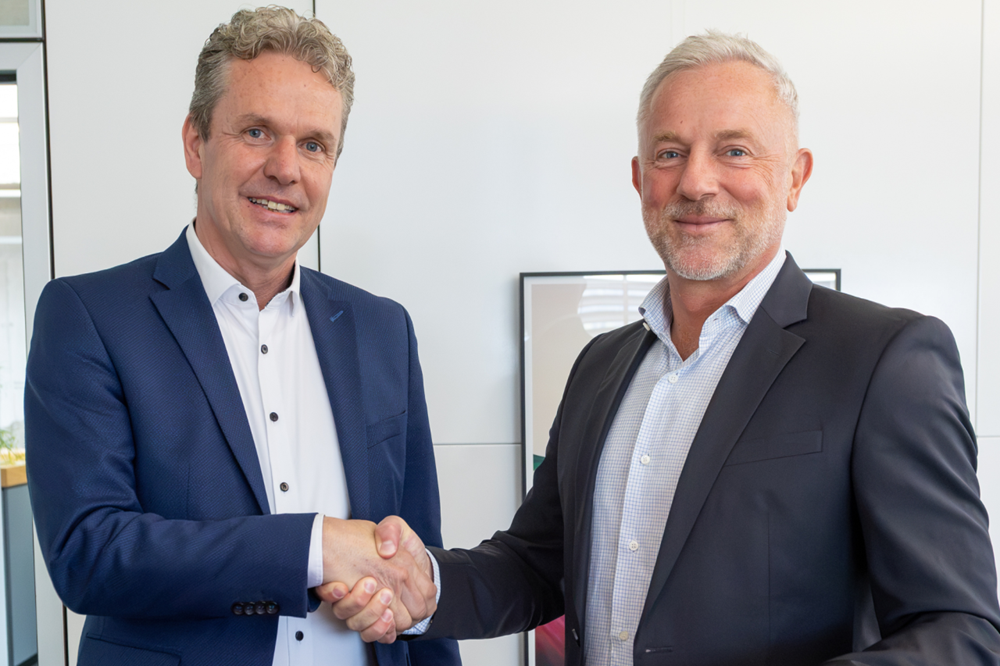
A Warwickshire entrepreneur who once replaced his mother’s dishwasher with a homemade 3D printer has become one of the youngest recipients of two King’s Awards for Enterprise. Mitchell Barnes (pictured), founder of Shipston-on-Stour-based RYSE 3D, launched the business in 2017 after recognising the potential of additive manufacturing (AM) to move beyond prototyping and into production.

Today, the company supplies high-performance components to 23 hypercar projects worldwide, while also supporting customers in the aerospace, defence and energy sectors. Its growth has helped drive annual turnover close to £5m, with international sales accounting for almost half of revenue.

That success has now been recognised with a King’s Award for International Trade, following the company’s King’s Award for Innovation in 2024.

“To win one King’s Award is special, but to receive a second for growing our business overseas is incredible,” says Mitchell, who runs the company alongside his brother Cameron. “When we started, we wanted to prove that AM could be used for series production. Today, we’re supplying complex components in volumes ranging from thousands to tens of thousands, while exporting UK-developed technology to customers around the world.”

Over the past three years, RYSE 3D has invested more than £1m in new equipment, R&D, advanced materials, and the launch of its UK-engineered LANDR 3D printer. The workforce has also grown to 18 employees.

The company’s scalable production process requires no tooling investment and uses widely available engineering polymers, helping manufacturers reduce costs, increase flexibility and strengthen supply chains.

While automotive and motorsport remain important markets, RYSE 3D is increasingly applying its expertise across aerospace, construction, energy, medical and defence applications as demand for production-ready additive manufacturing continues to grow.

More information www.ryse3d.com

New production centre for AM and subtractive machining

Offering laser deposition welding (DED), machining and inspection in a single set up, DMG Mori says its new LaserTec 65 DED hybrid 2 provides a cost-effective solution for producing complex components, repairing worn parts and applying highly durable surface coatings.

Combining additive and subtractive manufacturing in one platform, the machine integrates milling, drilling, turning, grinding, laser pre-heating, powder-based additive manufacturing and 3D scanning. The result is improved process integration, higher productivity and greater process stability, helping to bring additive manufacturing into series production environments.

A key development is DMG Mori’s latest MultiJet nozzle, which enables five-axis material deposition with consistent powder distribution regardless of orientation. The innovation increases build rates by 35% compared with the previous generation, while a 170% larger build volume accommodates workpieces up to 840 mm in diameter and 350 mm high.

In addition to infrared laser technology, the machine can be equipped with a blue laser source, expanding processing capability to reflective materials such as copper. This enables graded material transitions and the production of highly functional components. For example, copper can be selectively deposited to enhance cooling performance in injection moulding and die-casting tools, while hard-facing materials above 60 HRc can be applied without subsequent heat treatment.

Comprehensive process monitoring is provided through cameras and sensors that track temperature, powder flow, melt pool behaviour and nozzle positioning. AM Evaluator software creates a time-sequenced digital twin, mapping process data directly onto a 3D model of the component.

Built around DMG Mori’s rigid monoBLOCK platform, the machine delivers positioning accuracy of 4 microns. Wide access doors simplify loading, unloading and future automation integration, supporting efficient operation in demanding manufacturing environments.

More information www.dmgmori.com