

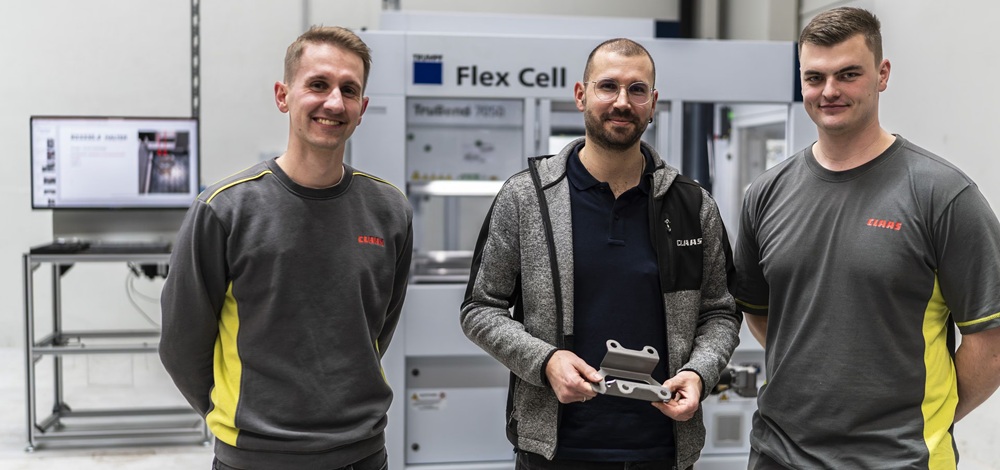
Claas is using automation not only in its state-of-the-art forage harvesters, but also in manufacturing, where two Trumpf bending machines are helping the company improve flexibility, ergonomics and productivity.
At its Bad Saulgau site, Claas produces components for harvesting machinery and forage-harvester attachments in lot sizes of 50 to 200. Parts range from simple bends to complex components with up to 13 bends, often requiring tolerances of just ±0.25°.
“Automation should not be an end in itself,” says Marco Schwab, head of sheet metal Processing at Claas in Bad Saulgau. “It has to be a good fit for our components, our lot sizes and, above all, our employees.”
The company replaced an older press brake with a Trumpf TruBend 5000 featuring the ToolMaster automatic tool changer. This technology eliminates the physical strain associated with repeatedly handling tools up to 3 m long, while also removing a previous production bottleneck. Claas can now manufacture large components in parallel on two machines, improving planning flexibility.
The bigger step towards automation came with a TruBend 7050 equipped with Trumpf’s FlexCell. The flexible, retrofittable system can be connected or disconnected in just a few steps, allowing the machine to operate as either an automated bending cell or manual press brake.
This flexibility enables Claas to process larger batches automatically, including unattended production during off-peak and night shifts, while retaining manual operation for complex parts or short-notice capacity requirements.
The investment has also delivered financial benefits. With the TruBend 5000, Claas has reduced production from three shifts to two. Further automation projects are already being evaluated, demonstrating the company’s pragmatic approach to adopting technology where it improves productivity, quality and working conditions.
More information www.trumpf.com