
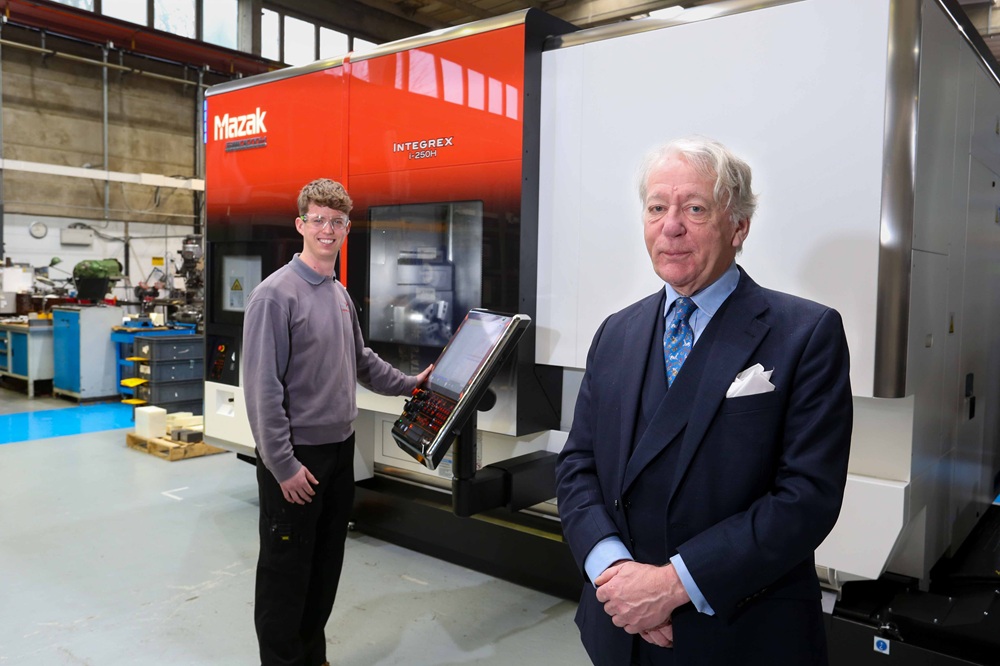
26,000 attend MACH 2026

MACH 2026 organiser, the Manufacturing Technologies Association MTA, has revealed the UK’s national event for inspiring, innovating and connecting manufacturing attracted around 26,000 visitors across five days in Birmingham last month. Day three (Wednesday) was officially recognised as the event’s busiest day. MACH, which will next take place on 3-7 April 2028, welcomed His Royal Highness The Duke of Edinburgh on the Thursday.

James Selka, CEO of the MTA, said: “Our core focus was to ensure this year’s show guided and supported manufacturers in navigating challenges such as rising operational costs, skills shortages, supply chain disruption and geopolitical uncertainty. I believe we achieved that, and more, with 26,000 attendees seeking ways to remain competitive in the current challenging and uncertain environment in which we operate.”

More information www.machexhibition.com

MANUFACTURERS URGE GOVERNMENT TO SUPERCHARGE THE ‘SOVEREIGN CAPABILTY’ PUSH

UK manufacturing is ready to meet the call for more sovereign ‘production’ capability
according to a new survey, but industry will need government help to make it a reality.
The findings, which were discussed at the launch of last month’s MACH 2026 exhibition in
Birmingham, reveal that thousands of firms are keen to support the national mission to
reduce the UK’s manufacturing dependence on international partners, especially in the
wake of recent global conflicts and economic uncertainty. Some 74% of the 358
manufacturers questioned said they would be willing to do more to build up capacity in key
sectors like defence, energy and transport, but only a quarter of these can meet demand
straight away. The others said it would take up to six months to be able to help, which
reveals a potential bottleneck in the supply chain if action is not taken now.
Manufacturing bosses said the biggest barrier was access to funding (34%), followed by lack
of space (28%), cost of financing (27%) and economic uncertainty (24%). They called on
government to help the ‘sovereign push’ by providing grants (59%), greater tax incentives
(50%) and more support for training.
“To coincide with the UK’s national manufacturing and engineering show, we felt it was the
right time to take the temperature of firms when it comes to building ‘sovereign’ capability
and reducing our critical overseas reliance,” explains James Selka (pictured), CEO of the
Manufacturing Technologies Association (MTA), which hosts MACH every two years. “As you
can see from the findings, there’s a real appetite from industry to meet the challenge, but
the message from our community is that it needs to be supercharged by the powers that be
at Number 10 and the Treasury.”
He continues: “Immediate access to finance appears to be the pivotal issue. With this in
mind, it might be an idea for government to look at how they could support investment in
critical sectors to help accelerate their expansion and access to capacity.
“We believe that this survey shows that there is a case for a ‘sovereign capability fund’ to
support companies involved in defence, aerospace, med tech and energy for instance. This
is where the British Business Bank could step-up and support more of UK manufacturers to
make vital components here. Germany’s Deutschlandfonds, which will lever in €130bn, is a
great example of what can be done if a national government is prepared to work closer with

industry to encourage investment. As a nation, we need to ambitiously step up and act now,
or suffer the consequences.”
The MTA’s snap survey also delved into early views of the much-anticipated Industrial
Strategy. Feedback from the shop floor suggests progress has been limited, with over half
(55%) saying it has had no impact on their business and that they could not “see any way in
which it would in the future”.
When asked about what the Government says it is delivering, the most meaningful benefit
to manufacturers would be “lower energy prices” (57%), with UK firms battling some of the
highest costs in the world. A targeted skills package was the second most popular answer,
with greater “investment in zero emissions vehicles manufacturing through grants and R&D
support” third.
“We’re approaching the first anniversary of the Industrial Strategy, and it’s clear from our
survey that industry, at best, remains unconvinced that it will deliver what is required,”
state Selka. “It came as no surprise that help with energy came out as the area where most
support is required. This is what our members are telling us every day, and the impact of
rising costs is making the UK uncompetitive against international rivals who enjoy far
cheaper prices. Importantly, this is a message that must be heard and acted on. Our firms
are feeling the pinch now and can’t wait five years for a raft of sustainable energy
improvements to kick in.”
Set over five days at the NEC last month, MACH 2026 is the biggest week in the UK’s
industrial calendar, attracting around 30,000 people from the manufacturing community
and more than 500 companies. Figures are still being counted, but over £250m of business
is expected to result from the show, where some of the country’s most innovative firms
unveiled new technologies and machines designed to boost productivity and global
competitiveness.
MACH, which has a huge focus on sustainable manufacturing and carbon reduction through
its six Knowledge Hubs and 14 Technology Zones, is also a big attraction for young people
looking for a career in industry. Around 4000 students (aged between 12 and 18) attended
the recent edition.
MACH 2026 also saw a packed CPD certified seminar programme, with topics including ‘how
AI is reshaping manufacturing’, ‘strategy for technology adoption’ and ‘unleashing the
power of automation’.
James Fudge, head of operations at the MTA, concludes: “We designed MACH 2026 to guide
and support manufacturers in addressing threats to business prosperity, such as rising
operational costs, skills shortages and supply chain disruptions, enabling them to remain
competitive in an evolving marketplace. This is reinforced by a visitor survey, revealing that

68% of attendees actively sought new technologies and services during their planned visits.
There’s no other event like it in the UK industrial calendar.”

MACH is owned and organised by the Manufacturing Technologies Association (MTA), which
also encompasses a cluster of organisations, including Engineering Supply Chain UK (ESCUK), Additive Manufacturing UK (AMUK) and MTA Training.

More information www.machexhibition.com

Software maximises tube and wire inspection productivity

Hexagon has released a major update to its BendingStudio XT, introducing new capabilities designed to cut cycle times in series production and support the manufacture of electric vehicle components. The latest version also adds integrated support for handheld 3D scanners, extending tube and wire inspection capabilities to a wider range of metalworking operations.

At the heart of the enhanced offering is Hexagon’s TubeInspect system, a purpose-built inspection cell delivering near-instant, non-contact measurement directly on the shopfloor. High-speed optical inspection provides precise results within seconds, enabling manufacturers to maintain tight tolerances in demanding production environments. The system is designed to deliver repeatable accuracy even in oily, dusty or high-temperature conditions through advanced temperature compensation and ISO 17025-certified calibration.

The updated BendingStudio XT introduces simultaneous multi-part measurement, allowing operators to inspect several identical components at once for faster batch processing and improved quality assurance. Immediate pass/fail feedback simplifies quality control, while direct integration with production systems enables real-time correction data to be fed back to bending machines, helping reduce waste and improve consistency.

To support growing demand in the electric vehicle sector, Hexagon has also added dedicated correction reports for electric motor hairpins, enabling manufacturers to achieve higher precision when producing complex EV components.

The software now supports Hexagon’s ATLASCAN Pro and HYPERSCAN handheld 3D scanners, providing flexible inspection options for manufacturers measuring large pipework, exhaust systems and installed tube assemblies.

Christoph Dold, senior product manager at Hexagon, says the update helps manufacturers address skills shortages while improving productivity, adding that the company remains focused on turning “bits and bytes” into practical value on the shopfloor.

More information www.bit.ly/4wcBAXk

Equator X dual-method gauge: The future of metrology

Renishaw showcased its advanced manufacturing technologies and championed engineering careers at the recent MACH 2026 exhibition in Birmingham. Visitors could find solutions to improve process control, productivity and long-term competitiveness on the company’s stand, where demonstrations included the new Equator-X dual method gauge with intuitive MODUS IM software.

The set up showed how the system measures parts on the shop floor and delivers immediate feedback to production teams. Designed for high-speed shop floor gauging, the Equator-X system supports inspection at the point of manufacture, reduces scrap and enables fast, closed-loop adjustments to maintain part quality.

Renishaw’s new Equator-X dual-method gauging system brings added capability to the shop floor with its dual measurement functionality:‘absolute’ and ‘compare’. Users can select the optimum inspection mode for their process challenge, effectively deploying two systems in one.

In ‘absolute’ inspection mode, the Equator-X gauge performs as a high-speed production CMM, providing fully traceable inspection results (ISO 10360-2 = 2.1 μm + L / 300).Rapid measurement at scanning speeds of up to 250 mm/s, without the need to maintain master parts, is particularly useful for manufacturers withhigh part variation, low-to-medium production volumes and/or high frequency of inspection.

When used in ‘compare’ mode, the Equator‑X gauge delivers ultra-fast, highly repeatable inspection with scanning speeds up to 500 mm/s and ±2 μm repeatability across a wide temperature range. This is particularly useful for high volume manufacturing of parts, where throughput is key and environmental temperature changes are a challenge.

The Equator-X system is capable of absolute scan speeds of 250 mm/s and comparator speeds of up to 500 mm/s, far higher than conventional three-axis CMMs.

More information www.renishaw.com

ActionPlas enters F1 sector and secure future growth

Design and contract manufacturing firm ActionPlas Group has upgraded its quality control department with the purchase of an Altera M 20.12.10 co-ordinate measuring machine (CMM) from LK Metrology. The subcontractor specialises in machining and fabricating mainly plastic, but also metal, components and assemblies for sectors including automotive, food and drink, pharmaceutical, and power generation.

The new CMM supports pre-delivery inspection of high-value, complex machined and additively manufactured parts, including critical components for a Formula 1 team. The project formed part of a £1m investment programme focused on the F1 customer, where increasing component complexity and tight tolerances demanded enhanced inspection capability.

ActionPlas technical director Jonathan Wray says: “Previously we were struggling to measure these components, which feature complex geometry and demanding tolerances, using an ageing CMM from another manufacturer. Components used in F1 race cars must fit correctly first time, as failure at the racetrack is simply not an option.”

He continues: “We need to specify the exact form, orientation and location of features such as bores, aerofoils and wall thicknesses, with typical part-to-CAD tolerances of 10 microns.”

The Altera M 20.12.10 offers a working volume of 2.0 x 1.2 x 1 m and was supplied withRenishaw’s SP25M Scanning Probe Kit 2 for both high-speed scanning and touch probing. The package also included LK CAMIO 2025 R2 software, training and consultancy services.

LK supplied the machine from stock just two weeks after order placement. The CMM is now in daily use across ActionPlas’ R&D, quality control and production departments, helping the company secure increasingly complex and higher-value work.

More information www.lkmetrology.com