Alternative American rock band REM once had a hit with ‘Shiny Happy People’. That song
would be the perfect anthem for Karl and Ros French, the founders of Metallic Elephant.
Working out of a secluded set of farm buildings in the village of Frating, Essex, this husband-
and-wife team – along with the company’s employees – says it has become the benchmark
in the manufacture of hot-foil presses. Producing these machines, along with the supply of
associated equipment, allows everybody from UK greeting card manufacturers to multi-
national corporations to emboss and deboss a wide range of materials.
Introduced to engineering by a teacher at school, Karl French embarked on a career where
his desire to learn as much as he could saw him end up effectively running his employer’s
business. Upon Ros’s suggestion, they decided to go it alone and began the journey of
Metallic Elephant by firstly refurbishing hot-foil presses.
These presses use a die, usually manufactured from brass but sometimes magnesium,
heated to between 90 and 110°C. The heated die pushes (against coloured foil and a backing
material) up to a back plate for a few seconds. When released, the result is the coloured
shiny initials or logo of the die embossed (or debossed) on the backing material.
The big break for the business came when a well-known fashion house, famous for its iconic
check/tartan patterns, visited Metallic Elephant with the intention of purchasing 10 presses
that would allow the personalisation of items purchased in-store. The customer requested
that the Metallic Elephant badge located on the side of the press was removed but, against
Ros’s wishes, Karl stuck to his guns and refused to remove the manufacturer’s identification.
The company still got the order, which meant its product was seen in major high streets.
However, with such a large order, manufacturing the presses had to take place from scratch.
Discussing the journey from refurbishment to full manufacture of new presses, Karl says:
“When we started out things were tight. We didn’t have a great amount of capital but
needed to manufacture parts when we were refurbishing presses. Outsourcing proved to be
an issue for several reasons. A manual turret mill and pre-war manual lathe were all we had,
and it was amazing what we produced on these machines but a visit from the Health and
Safety Executive put a stop to us using this equipment.”
He continues: “It was time to reinvest. We knew the guys were comfortable using manual
machines, but our volumes had increased, so CNC was an option we had to investigate. It
was at this point we were introduced to XYZ Machine Tools and the Proturn range of flat-
bed lathes. They sounded perfect for our requirement because when we needed a 10-off
batch, we knew every part would be identical. Importantly, we could also use the machine
in manual mode for the odds and sods that we manufacture. We purchased the SLX 355 and
it’s proved to be a gamechanger for the company.”
The business now has a range of XYZ machine in its shop. Alongside the original SLX 355
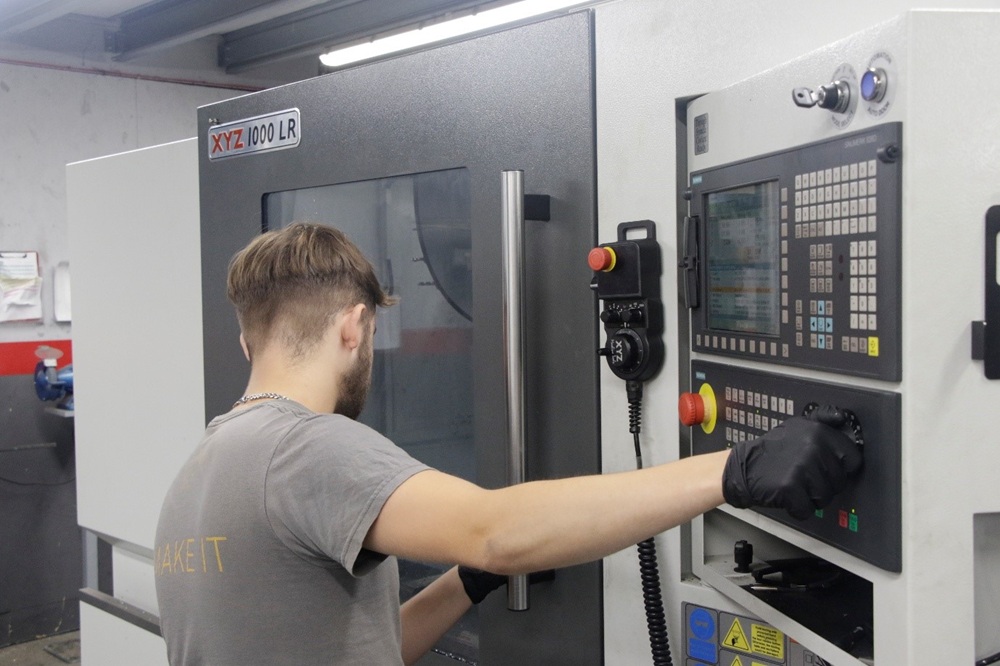
stands an RMX 2500 CNC bed mill with ProtoTRAK 15” touchscreen control, three 1000 LR
vertical machining centres with Siemens 828D controls and a CT 65 LTY turn-mill lathe –
again with Siemens control.
“Because XYZ delivered on their promises with the SLX 355 and the support that was
provided in our early days of using a CNC machine, it made sense for us to return to them
when we needed to increase our manufacturing capability,” says Karl. “As demand
increased, we needed to be more efficient, so we needed automatic tool changing
machines. The capacity that the 1000 LR offers along with the 24-station arm-type tool
changer accepting BT40 tooling means we can walk away from the machine during the cycle
and partake in other activities in the shop.”
He adds: “To aid our efficiency and one of the reasons we went for the 1000 LR machines
rather than take a smaller footprint machine from XYZ’s LR range was that we can easily fit
three vices on the bed. Although the materials we machine are not tough, the 15 kW spindle
with 8000 rpm is more than adequate for manufacturing the parts needed for the press
bodies.”
As the 1000 LR machines started to make an impression, attention shifted to turned parts.
Due to the automatic feeding system of the foil on the presses, there was increased demand
for rollers and pins. Again, efficiency was important for the business going forward, so the
XYZ CT 65 LTY was installed in the workshop.
Offering a maximum turned diameter of 220 mm and a turning length of 490 mm, the rollers
could be tackled with ease. The Sauter 12-station driven-tool turret allowed for both static
and driven tools to be loaded into every station, providing the opportunity to not only turn
parts but also carry out milling, drilling and tapping in one set up.
“Making this investment moved us on from the original Proturn machine, which is still an
important part of our machine shop,” explains Karl. “It allowed us to reduce the need for
two or three operations on our rollers – but with its 17 kW spindle, driven tools and barfeed
pushing bar up to 65 mm – we could produce multiples with greater ease.”
The machinists that Metallic Elephant employ are full of praise for the CNC systems fitted by
XYZ. Levi Battiste previously worked at a large multi-national company that had a range of
different machine tools.
“Coming to Metallic Elephant I was a little unsure about using the Siemens control,” he says.
“To be honest, I was more a G-code type of programmer but, it’s been a pleasure to use the
ShopMill and ShopTurn conversational software fitted to our 1000 LR and CT65LTY
machines. I’ve been impressed with how simple it has been to produce our parts, while the
construction of the machines has given me the confidence to push our tooling and produce
more in less time”.
Jack Marciniak visited Metallic Elephant as part of his school’s work experience programme.
This encounter was the catalyst for him to join the company when he finished full-time
education.
He says: “I never dreamt that after this short time I would be programming and running CNC
machines. The Siemens control has been intuitive and easy to learn. With the support of the
company and XYZ, I have learnt so much in such a short amount of time.”
More information www.xyzmachinetools.com