Production rate grows at Ideal Boilers

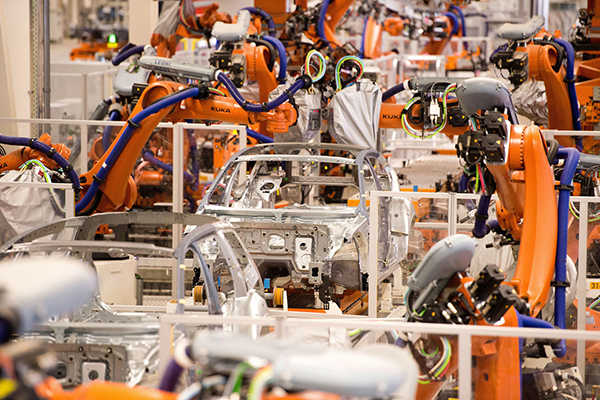
Hull-based Ideal Boilers has increased its rate of production for domestic boiler chassis ever since a fully automated and highly efficient process designed by AP&T was implemented in 2018.

Ideal Boilers’ new production line for manufacturing boiler chassis; automated by AP&T.

Over 400,000 boilers leave the factory in Hull every year for households and commercial properties all over the UK. In order to meet growing demand for the company’s products, Ideal Boilers decided to investigate the possibilities for increased automation and streamlined production. A technology partner was sought that could take on full responsibility and supply a turnkey solution for the fully automated manufacturing
of boiler enclosure parts.
After a careful selection process, Ideal Boilers chose AP&T to be its partner. “With the customer’s two new link-motion mechanical presses as the starting point, we designed a fully automated tandem line with short set-up times and the potential for fast tool changes,” says AP&T account manager Christian Wright. “The rate of production has at least doubled compared with previously, when the parts were handled manually. Since it needs to be possible for up to 10 different products to be manufactured during the course of a working day – some formed in both presses, others only in one – achieving an optimised and flexible process was challenging.”
AP&T’s front/back transfer plays a major role in the line, which went into production in November 2018. This stable and flexible solution takes care of high-speed feeding into and out of the press, and enables fast tool changes.
“The professionalism, technical expertise and support shown by AP&T from the outset of the project have been second to none,” says Joanne Lilley, Ideal Boilers’ engineering innovation manager. “I would have no hesitation in choosing AP&T again for any future projects.”
For further information www.aptgroup.com

Remote CNC training from Mazak

Yamazaki Mazak has expanded its CNC training programme to include remote sessions at customer sites, enabling both new and existing users to unlock the benefits of Mazatrol Smooth CNC technology while social distancing remains in place.

The remote training programme involves Mazak delivering two full-size CNC control panel simulators and accompanying training material to a customer’s site, and then running a series of live interactive tutorials over the following days via Microsoft Teams. The simulators are then collected, cleaned and delivered to the next booking.
For further information programtraining@mazak.co.uk

Lotus to build technology centre

Lotus is set to create a dedicated and specialist advanced technology centre that will also be home to a new headquarters for the company’s engineering consultancy.

Located on the University of Warwick’s Wellesbourne Campus, the new facility is established in partnership with WMG, a specialist in collaboration between academic research, teaching, training and industry. The substantial facility will consist of offices, workshops and laboratory space with ample opportunity for expansion. Initially, 130 engineers will move in, complementing the 500-strong engineering team at the home of Lotus Cars in Hethel, Norfolk.
“This is a big step forward for Lotus and our engineering consultancy,” states Matt Windle, executive director – engineering, Lotus Cars. “The new space, facilities and job opportunities at Wellesbourne will be in great demand as we rapidly build our portfolio of external projects.”
For further information www.lotuscars.com

Capability enhanced at Iron Mason

Iron Mason was founded six years ago by Chris Mason, who had worked in the film industry as a model maker and animatronics specialist.

The Derby-based company now provides engineering, fabrication and finishing services to a diverse customer base, including his old sector, film making.
Mason had recognised a lack of metal skills within the film industry so took the decision to ‘go freelance’. Diversification from the movies brought in work from classic car enthusiasts, as well as aircraft build and restoration projects.
“Basically, I will take on anything that comes through the door, I just have to be honest with myself and ensure it is within my capabilities,” he says. It was this notion that highlighted the need for CNC machining capability.
“Initially I was looking at a CNC vertical machining centre, but a customer beat me to it and made a purchase of their own, so I moved my focus to turning. My view was that, as a turning centre was a bigger investment, the competition
for available capacity in the local area would be less. I did my research and asked around, and settled on the CT65 Compact Turn from XYZ Machine Tools.”
Two of the key factors in the purchase decision were the build quality and control system.
“It was obvious that the CT65 was much more robust than other machines on the market thanks to its cast-iron base and box slide-way construction. I’m finding that it holds tolerances very well and repeatability is superb. The Siemens 828D ShopTurn Control is also very intuitive.”
Such is the intuitive nature of the control that Mason can adapt programs ‘on the fly’ and, in one case, reduced cycle time from
16 minutes to just six.
For further information www.xyzmachinetools.com

3D-printed bike helmets now a reality

3D-printing specialist EOS has been supporting London-based HEXR with its technology and providing expert consultancy since 2015.

With the introduction of the HEXR fitting app, the company is now offering a complete scan-to-product solution for high-quality, safe, 3D-printed cycling helmets. An app-based head scan allows customers worldwide to begin the bespoke cycling helmet creation process at home. The helmet is then 3D printed with EOS technology in a 100% plant-based polyamide material. A black dye is added before final inspection for structural integrity and finish quality.
For further information www.eos.info