Tool manufacturing around the clock

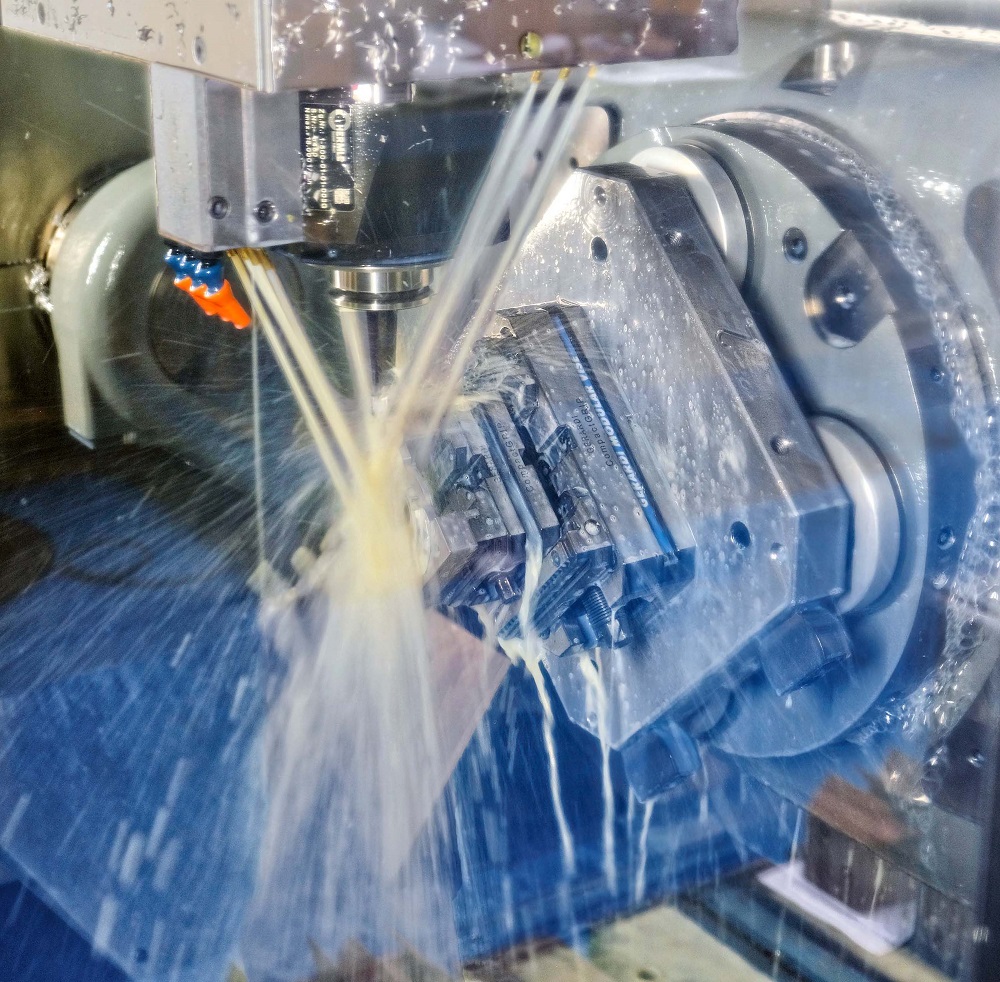
Based in Lower Bavaria, Huber GmbH CNC-Präzisions-Werkzeugschleiferei is a user of sharpening machines from Vollmer, with a VGrind 360S grinding machine the most recent arrival. Huber is using the Vollmer machine and its 24/7 automation capability to boost the production of semi-standard milling tools for the machining industry.

Manufacturing standard and special tools, resharpening circular/bandsaw blades and supporting customers with reliable services – this is how Huber generates a profit of around €2.7m a year.

“Our latest VGrind 360S grinding machine with chain loader enables production around the clock, seven days a week, allowing us to fulfil our high order volume quickly and with high precision,” says Christoph Ziegler, production manager at Huber GmbH. “As such, the Vollmer machine is a perfect match for our guiding principle and self-imposed goal to deliver the best possible quality and precision ‘despite’ the high speed of our processes.”

Alongside automation, the decisive factor for Huber was that the VGrind 360S is suitable for ensuring consistently high-quality machining thanks to the wear-free linear induction motors in the X, Y and Z axes, as well as reducing maintenance costs. With two grinding spindles situated one above the other and the grinding wheel set positioned at the C-axis pivot point, the VGrind 360 tool grinding machine enables efficient multi-level machining. The company can reduce machining times thanks to the shorter travel distances of the linear axes, which is also beneficial in terms of the speed promised by Huber.

As a final point, a plate heat exchanger cools both the machine’s spindles and motors to increase thermal stability and improve both the precision and performance of the grinding process.

More information www.vollmer-group.com

Unipart acquires Formaplex Technologies

Unipart, a supply chain solutions and performance improvement technologies partner, has acquired Formaplex Technologies, a lightweight components manufacturer serving customers in the automotive, aerospace, motorsport and healthcare sectors.

Formaplex Technologies was established two decades ago, initially as a specialist tooling partner in the Formula 1 sector. Major customers include McLaren, which is fully supportive of the acquisition and remains committed to working with the business. Unipart will integrate the operations into its existing manufacturing portfolio, ensuring continuity and maintaining the high operational and safety standards that both companies deliver. Formaplex has already been rebranded as Unipart Polymer and Composite Solutions.

More information www.unipart.com

DOWPER MC COMBINED WITH THE RIGHT MACHINE BRINGS HIGH CLEANING PERFORMANCE

Alloy Heat Treatment, the UK’s first and only specialist in the heat treatment of aluminium alloys, has been offering the heat treatment of aluminium to industrial manufacturers, especially aerospace companies, since the 1970s.

Over the past few decades, the hardening process has continued to evolve. Nowadays, the hardening services that Alloy Heat provides are highly bespoke to the needs of its customers. The company also has a highly skilled rectification department whose job is to examine and rectify any part distortion after heat treatment. The increasing complexity and demands placed on heat treatment necessitate higher cleanliness standards for components.

“We cannot apply any of our heat treatment processes for aviation-related operations without our degreaser – it’s a very important piece of kit for our operation,” explains HR director Frank Butler. “Bad or insufficiently cleaned parts can seriously affect heat treatment treat results. Once oil becomes baked on to parts, it’s very hard to remove.”

For a long time Alloy Heat Treatment was using trichloroethylene in a semi-closed cleaning machine, with the results always satisfying the company’s quality checks.

Due to EU legislation, however, trichloroethylene in parts cleaning is only allowable under authorisation after the sunset date of 21 April 2016. As the existing cleaning machine at Alloy Heat did not satisfy the machine type required for authorisation, the company decided to replace trichloroethylene with Dowper MC, virgin-grade perchloroethylene from Safechem.

While the cleaning result with Dowper MC was great, its existing machine would often break down since it was not built to operate with perchloroethylene. The frequent downtime not only led to process disruptions but also a great loss of time and money. To Butler, it was evident that the old cleaning machine, in combination with the solvent type, was the cause of the problem because their business acquaintance, Chris Arrowsmith, owner of Midland Deburr & Finish, was telling a rather different story.

Located just three miles away from Alloy Heat, Midland Deburr & Finish is a provider of outsourcing services to companies in component degreasing, deburring, mechanical finishing and general surface improvement. The two businesses have known each other for a long time, with Alloy Heat commissioning work to Midland Deburr in the past. Arrowsmith is particularly aware of the increasing demands placed on parts cleanliness these days.

“In the past, people were more ready to accept ‘dirty’ parts,” he says. “Nowadays, quality requirements are increasing and we’re getting many more enquiries from companies with cleanliness specifications such as maximum particle size, or weight of particles per square metre.”

Similar to Alloy Heat, Midland Deburr had been using trichloroethylene for its cleaning and degreasing operation previously. The company has two EVT machines at its site, with the first machine operational since 2007 (Model Gigant with two baskets each offering capacity of 1250 x 800 x 800 mm) and a second machine coming into service since 2013 (Model Gigant/2S with capacity of 1300 x 500 x 600 mm). With the second Gigant machine, Midland Deburr had made an additional investment in an inline vacuum distillation unit that removes oil from the solvent ensuring pre vapour degrease wash. The unit is highly effective and helps further reduce solvent losses in the waste stream.

In October 2020, when legislative authorisation for trichloroethylene in parts cleaning applications finally expired, Midland Deburr subsequently switched to Dowper MC – and the transition has been nothing but smooth. Since its two existing EVT machines can operate with both trichloroethylene and perchloroethylene, Midland Deburr does not experience any machine issues.

According to Arrowsmith, parts cleaning quality with Dowper MC is on par with trichloroethylene. If anything, operating costs have come down. At the same time, stabiliser consumption for Dowper MC has remained very stable since 2020, with less than a litre required per month.

Encouraged by Midland Deburr’s positive experience, Alloy Heat decided to invest in an EVT Gigant to replace its old machine in 2021. During the eight months of construction and customisation of the machine, Alloy Heat outsourced its parts cleaning process to Midland Deburr. Although Alloy Heat had considered the potential of water-based cleaning, the idea was quickly dismissed.

“Some of our customers insist on us using solvents for parts cleaning,” states Butler. “Of course, having used trichloroethylene for so long, we know very well how good solvents can clean. Perchloroethylene is also known for its long solvent lifespan and high degreasing ability. Most importantly, many of our aerospace prime customers request the use of different cleaning agents. Since Dowper MC is approved by all primes, it’s a no-brainer.”

Alloy Heat does have a small water-based cleaning machine on-site which it uses occasionally for certain applications. However, the cleaning quality is not up to standard.

“Since the parts are not sufficiently cleaned, when they are in the furnace, it starts smoking badly,” reports Butler.

In February 2022, a new EVT Gigant machine arrived at Alloy Heat Treatment. Not only is the cleaning quality with Dowper MC comparable with trichloroethylene, but the cleaning results also remain repeatable and consistent.

“It’s almost like a one-to-one replacement for trichloroethylene,” says Butler.

To ensure safe transport, storage and handling of Dowper MC, the solvent arrives in the Safe-Tainer system, a closed loop solvent risk management measure.

“Since the solvent transfers from the Safe-Tainer system to the cleaning machine directly, there’s virtually no human contact with the solvent, which is brilliant,” says Butler.

Within the ensuing 11 months following machine commissioning, no new solvent top up has been necessary. Compared with the previous time period, solvent consumption has reduced from 3 tonnes to virtually zero, giving Alloy Heat an operational saving of over 50%. It is easily possible to monitor and test the acidity and alkalinity of the solvent on-site using simple Maxicheck solvent test kits once a week. So far, no addition of stabilizer has been necessary, a testament to the high stability of Dowper MC.

As part of the new machine’s deployment, Alloy Heat has also signed up to Complease, a tailored chemical leasing package from Safechem. This offering covers not only the supply of fresh solvent and take back of used solvent in the Safe-Tainer system, but also associated service elements including test kits, stabilisers, lab services, solvent training, and technical service and consultancy to ensure an efficient and optimal solvent cleaning process – all for a fixed monthly cost.

“Complease is one of the best things we’ve done,” says Butler. “We have a fixed cost every month and can get all the services we need. It just makes perfect sense.”

As shown by Alloy Heat Treatment and Midland Deburr, optimal cleaning depends on the right combination of machine technology, cleaning agent and application technology. When done properly, it is possible to transform this critical cleaning process into a value-adding step that drives operational and resource efficiency as well as significant time and cost savings.

More information www.safechem.com

CBE+ celebrates five years of excellence

CBE+, a multi-disciplinary subcontractor specialising in precision engineering, celebrated five years of engineering excellence with a recent open day at its 100,000 ft² manufacturing facility in Chesterfield. The event offered an exclusive opportunity for customers, prospective customers and suppliers to explore CBE+’s capabilities. More than 30 attendees witnessed the advanced manufacturing processes that position CBE+ as a major supply chain provider within the engineering industry. The business was born out of the 2017 acquisition of BG Engineering by Marie Cooper and Chris Brown.

More information www.cbeplus.com

Ceratizit makes bespoke step drill for Volz

Rochdale-based Volz Engineering is a subcontract machining company that services the
automotive, aerospace and agricultural industries. With six CNC machines running 18 hours
a day, Volz sends out more than 500 parts a week.
Constantly looking for process improvements, a standout example of a tooling
recommendation which had tremendous impact was for a bespoke step drill. Required for a
job needing the drilling of one hole at different diameters at depths, Volz previously used

multiple inserts. However, swapping tools throughout the process reduced the overall
reliability and accuracy of the finished product, making it difficult to achieve the critical
tolerance of 0.02 mm. The machine process, with the necessary changes to tooling, took a
total of 26 minutes. This is where Ceratizit identified an opportunity to optimise the process.
Purposefully created to fulfil Volz’s exact specifications, Ceratizit designed and
manufactured a unique step drill. After installation, the total machine process time reduced
by more than 50% to just over 10 minutes. Moreover, using step drill requires just one
machine process to achieve the different diameters.
“The step drill was a game changer,” states James Alletson, operations manager at Volz
Engineering. “Not only did the time taken to machine each part dramatically decrease, but
with no machine interruptions we could achieve a greater level of precision. Since using the
step drill we haven’t had to replace it yet, despite the 500 parts a week it’s drilling.”
Impressed by the initial results of Ceratizit tooling, Volz began to switch out more tooling.
Indeed, a Ceratizit vending machine arrived on the shop floor around 18 months ago.
More information www.ceratizit.com