

Sawing nickel alloys three times faster

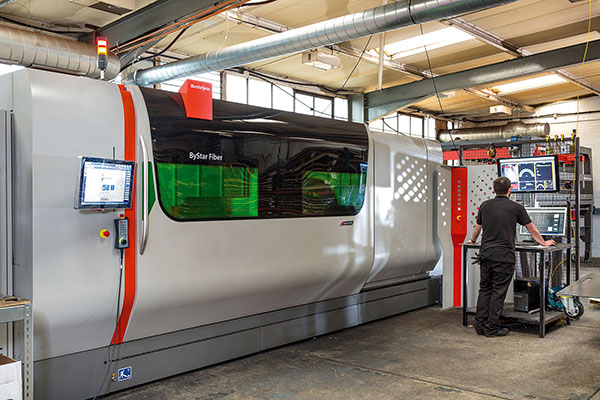
A specialist stockholder serving the oil and gas industry, Howat Group, perhaps better known by its trading names AMS, ESS and Ancon, has installed a 14th Kasto bandsaw – a KASTOwin pro AC 5.6 – at its new centre in Barnsley, which opened at the end of 2018. The facility represents an investment of more than £2m by owner Malcolm Howat, and has been timed to coincide with the oil and gas sector’s nascent emergence from a downturn that started in 2014.

Half of the sum went on acquiring a freehold, 60,000 sq m property on Cortonwood Drive in the Dearne Valley area of Barnsley. The remainder was spent on infrastructure, materials handling equipment, two further Kasto bandsaws and refurbishment of all the older models, some of which have been in service since the 1990s and still cut accurately.
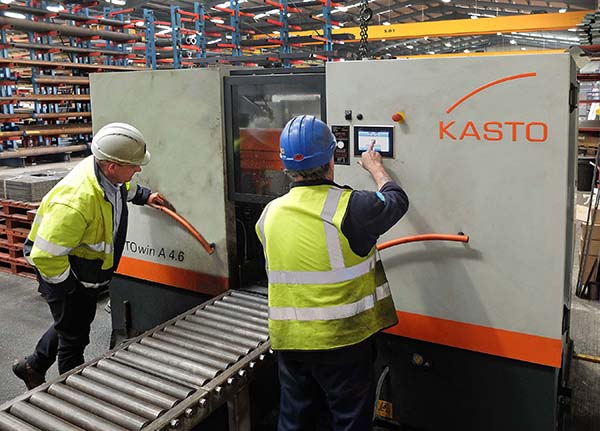
The German-built KASTOwin pro, supplied ex-stock from the manufacturer’s UK subsidiary in Milton Keynes, is a competitively priced machine designed for cutting tough nickel, titanium and stainless steel alloys up to 560 mm in diameter using a tungsten carbide-tipped (TCT) blade. However, the machine also allows economical cutting of low-alloy steels when the blade is swapped for a high speed steel (HSS) bi-metal type.
Howat’s operations director Emma Parkinson says: “We have four dedicated carbide cutting bandsaws on site which include KASTOtec AC5s and now the KASTOwin pro, which is even more capable. They are ideal for cutting our Inconel 625, 718, 725, 825, 925 and K500 stock. Our latest investment was to increase our overall cutting capacity but also to improve efficiencies around nickel alloy cutting specifically. The remainder of our sawing machines with capacities up to 800 mm diameter are intended for bi-metal cutting, but can also use TCT blades with offset teeth.”
She adds: “The advantage of the latest KASTOwin pro saw, apart from its ability to use either type of blade economically, is its high productivity, which is down to fast cutting speeds and quick set-up using the new touchscreen control.”

Programming is fast with the Kasto EasyControl, as cutting parameters for any given material, size and cross section are determined automatically by a built-in database, so all that is needed is to enter the cut length and number of pieces required, and press start.
The productivity benefit is most pronounced when cutting nickel alloys. Formerly, the company was sawing Inconel 718 with a TCT blade at 3 to 4 cm2 per minute, but on the KASTOwin pro that has risen to an average of 12 cm2 per minute. So, for example, a 200 mm diameter bar that would previously have taken up to 90 minutes to cut can now be processed in less than half an hour.
Parkinson explains that she was familiar with the benefits of the latest German-built bandsaws compared with the performance of the legacy machines, having worked with this make of saw when previously employed at another stockholding company.

So when Howat Group, one of the largest stockholders in the UK, needed more capacity to cope with an increasing number of high volume orders for nickel alloy billet and low-alloy steels, the KASTOwin pro was a logical choice. The large batch sizes frequently ordered make it economical to spend time changing from an expensive TCT blade to bi-metal, to extend the life of the TCT teeth.
A feature of the automatic KASTOwin pro is its electro-mechanical down-feed via two ballscrews, each with a servo drive for precise, infinitely variable control. The positive motion allows smaller tolerances to be set, typically -0 / +0.5 mm for most stock, minimising material wastage. There is a retraction unit for separating the blade from the material to protect the cut surface when the saw head moves back, which also helps to minimise tool wear.
The band is driven by an 11 kW motor, delivering infinitely adjustable cutting speeds from 12 to 150 m/min, and providing plenty of capacity for TCT sawing. Helping to dampen vibration and lower noise during operation are ‘Trum’ guides mounted at the return side of the blade, inside the top of the saw head guarding. These guides suppress vibration on the side opposite from the cutting action, prolonging blade life and promoting high squareness accuracy and good surface finish.
Partly due to larger orders being received, and because of the high value of nickel-based metals, Howat Group’s monthly turnover trebled within a few months of the stockholder opening its new facility. Key to maintaining growth is providing customers with a high quality service in terms of prompt delivery of material that is within tolerance.

Parkinson concludes: “It is for this reason that we have more or less standardised on Kasto sawing equipment and see the supplier as a partner to our business. We regard the manufacturer as a premium brand whose rigid and technologically advanced bandsaws maximise blade life and cut accurately for decades, despite heavy use.”
For further information www.kasto.com

Low-deformation clamping and fast set-up

Clamping devices have a significant influence on precision and cost-effectiveness when undertaking the manufacture of gearbox components. For maximum flexibility and efficiency in production, Rollstar AG has invested in a large, six-jaw pendulum compensation chuck with a quick-change jaw system and rapid adjustment mechanism. According to Schunk, the solution minimises set-up times and delivers results faster and more economically than conventional clamping solutions.

The Schunk Rota NCR 1250 six-jaw pendulum compensation chuck, which Egliswil, Switzerland-based Rollstar uses to manufacture gears on a Pittler PV 1600 vertical turn-mill centre, is a large-dimensioned chuck with novel features.
Was it a worthwhile investment? “Definitely,” says Christian Märki, purchasing manager and member of the extended management team at Rollstar. “Due to the machine design, including the clamping devices, we were able to reduce set-up times by half while decreasing the reject rate by 75%.”
The investment pays off especially for thin-walled components and high-quality materials. Here, the company’s aim was to achieve the necessary quality levels, reduce throughput times and lower the overall costs of producing deformation-sensitive parts in two operations, while ensuring process reliability.
Thanks to the Schunk Rota NCR, parts that were previously manufactured on another machine in a three-jaw chuck with a two-pressure clamping system are now being produced faster, more precisely, and with greater process reliability.

“In the past, when we clamped a ring gear, or a ring with a finished diameter of 820 mm, in a three-jaw chuck, the circularity or cross-sectional tolerance was higher than 0.1 mm,” explains Märki. “However, if we clamp the same component in the Rota NCR, we achieve cross-sectional tolerances of 0.02 to 0.03 mm. This precision increases the service life of our gearboxes even further because the rolling bearings are subjected to completely uniform loads.”
The upshot is that the gearboxes can be used much longer without any maintenance works, and sudden failures are extremely unlikely. Rollstar gearboxes are valued for their extreme reliability in tunelling and mining applications, where unplanned downtime is very costly.
The clamping concept has been developed in close co-operation between Rollstar, Pittler and Schunk lathe chuck specialists, whereby the necessary range of components, design requirements, and set-up times were systematically taken into account. According to Rollstar, the decisive factor in choosing Schunk was the combination of six-jaw chuck, quick-change jaw system, rapid jaw adjustment and Schunk’s ability to deliver quickly. Finally, the testimonials of other clients, which Rollstar visited, helped seal the deal.
The Schunk Rota NCR six-jaw pendulum compensation chuck consists of a central chuck piston carrying three inner pendulums aligned at 120°. Each pendulum is connected to two base jaws. This configuration ensures workpiece centring between six contact points, adjusted in pairs. As the clamping forces are directed towards the chuck centre, optimum centring is achieved without distortion of the workpiece. The chuck adjusts to the workpiece with its oscillating jaws.
Standard jaws can be used to replace elaborate system jaws and special solutions on the Rota NCR jaw interface, which saves time, cost-intensive special mechanisms, and reduces set-up costs. An integrated quick-change jaw system minimises set-up times on the idle machine.
“We use two sets of base jaws and set up the top jaws outside the machine; in other words, while machining is still in progress,” explains team leader Daniel Fierz. “The set-up process for the second operation then takes only 20 minutes, including cleaning.”
Here, the base jaws are pushed open, before they automatically lock in place and are secured with a quarter-turn of the torque wrench. Due to the quick jaw adjustment, the base jaw position can be adjusted easily in just a few simple steps.
“The quick adjustment feature allows me to set the clamping range in defined steps,” explains machine operator Willy Ummel. “The system works flawlessly and is easy to clean.”
In the past, up to two hours of machine downtime were required for a conventional set-up process of such workpiece sizes. Now it takes Ummel less than 30 minutes. Top jaw sets with hard chuck jaws and claw inserts are available for raw part clamping, and sets of soft top jaws are already bored in the different diameters for machining the part from the other side.
One of the main goals of the investment was for the machine to run as smoothly as possible with only minimum interruptions,” says Fierz. “The lathe chuck is so precise that we can use jaws again and again without re-boring. After exchanging the jaws, we achieve a run-out of 0.02 mm without any additional adjustment.”

The vertical position of the spindle also plays a role here. Maximum freedom of movement and, therefore, optimum centring, are assured because the components are put on to surface-ground pillars and not on the chuck jaws, as is the case with horizontal spindles.
“The vertical machine allows for significantly better oscillation than machines with a horizontal spindle, where the friction between the component and the jaws restricts the pendulum effect,” emphasises Fierz.
When finish-machining or clamping rough-turned surfaces, Ummel can clamp the Rota NCR’s pendulum in the centre position so that all six jaws move concentrically. Use of the lathe chuck has had a welcome side effect: the reject rate has fallen by around 75% since implementation. This reduction is due to dramatically less deformation, the high precision of the jaw change process and the improved flat work surface of workpieces. The reduced reject rate results in considerable savings, especially with high-quality materials such as the ferritic castings frequently used by Rollstar.
According to Märki, a decisive advantage of the clamping solution is the flexibility that Rollstar has gained in production: “Even though we typically manufacture in batches of 10, we can now squeeze in rush orders at any time without losing efficiency.”
This flexibility has allowed the company to reduce stock levels without compromising its service level. In the near future, Rollstar plans to use the chuck for machining components with diameters between 400 and 1600 mm.
“It’s easy to clean, a breeze to adjust and extremely easy to load thanks to its horizontal position,” concludes Märki.
For further information www.schunk.com

Alphacam “vital” for orthopaedic implant expert

Jointmedica Ltd, based in Worcestershire, produces Class 3 implants in the orthopaedic sector and has, in its product portfolio, an innovative mobile bearing knee replacement, as well as development activities relating to hip resurfacing and the manufacture of custom-made devices for specific patients created directly from CT scans.

High-level development activities can now be undertaken in-house at Jointmedica’s facility in Hallow, utilising Alphacam software. As well as allowing the company to take advantage of the intellectual property available via the company’s founder, Professor Derek McMinn, Alphacam assists the design team to further explore these innovative new designs and incorporate new materials, driving the advancement of orthopaedic hip and knee replacement surgery. As a result, exacting controls and the highest quality, are paramount.

Technical director Roger Ashton says: “If we consider the hip resurfacing market in isolation, several years after the procedure began, a small number of patients suffered physiological problems due to hypersensitivity to various metals. The end result was that a small percentage had bearing-related failures. This led to a sharp decline in the use of metal-on-metal articulations in the resurfacing context. It is Jointmedica’s purpose to work with alternative bearing materials, such as ultra-high molecular weight polyethylene, using the successful resurfacing methodology to generate a product that will re-establish the hip resurfacing market. In terms of our surgeon team, we are privileged in being associated with the most experienced hip resurfacing designers and surgical innovators in the world.”
When the company brought its manufacturing research and development in-house, the need for investing in a suitable machine and CADCAM software became apparent.
Ashton says: “It was clear we were going to have an interesting combination of 2D turned profiles and surface machining with milling, drilling and slotting, and we were conscious that we had a lot of complex geometries with which to contend. As a result, we needed a CNC machine tool and software that could manage all of our milling and turning requirements, including in sometimes more than three axes.”
He says that the company’s Brother Speedio M140x2 five-axis CNC machining centre fit the bill perfectly: “Many products require a combination of three-axis and four-axis machining, plus turning operations, so Alphacam will always be an integral part of our manufacturing process from now on.”
Generating custom implants at Jointmedica begins the moment the patient’s CT scan is received, which allows the company to start modelling the bespoke product. Jointmedica uses two CAD systems to design the solid models, mainly Creo and, occasionally, SolidWorks. The files are usually sent in XT, STEP or DXF format for the turning cycle in the lathe software.

Jointmedica uses Alphacam Ultimate Mill and Standard Lathe to machine the finished product, with the Brother machining centre capable of performing both turning and milling operations.
Oliver Clayton, manufacturing engineer at Jointmedica, says: “I take Alphacam’s 3+2 system and incorporate it into some of the bespoke custom devices, and then an easier three-axis and turning program definition on the cutting paths for a simpler, axisymmetric product. In the turning program I mainly use the CAD side in drawing the geometry and applying the tool path. That’s extremely useful because I can incorporate not only the model, but draw my own tool paths in there with the geometry.”
As an example, the materials for a ball and socket type bearing, which work well when implanted in the body as a hip replacement, can include ultra-high molecular weight polyethylene of differing formulas, and a counter face of cobalt chrome, ceramic or other material.
“Through accurate machining driven by Alphacam, material wastage is kept to a minimum, and we can also ensure the final, bespoke product is suitable for the patient,” says Clayton, who adds that it is of utmost importance that the implants are of the highest precision.
“When we come to CMM measurements they must be dimensionally correct, and Alphacam ensures we get the right results every time. When considering our prototyping expectations, we are comfortably achieving the industry standard tolerances, and a bearing surface finish of 0.8 Ra for one-offs. We know that future production capability will significantly exceed these figures, and we’re confident in the solution afforded by the Brother CNC driven by Alphacam.
“Due to Alphacam’s accuracy, I can be totally confident that the software guarantees the product will be right first time, every time,” he continues.
For Jointmedica, a particular challenge facing the manufacturing process was manipulating the tool path to get the quickest machining time for a particular component. Here, Alphacam’s ability to define the best cutting tools and tool paths allows these to be manipulated to set the quickest timescale with the best path for the device to be manufactured accurately.

Clayton concludes: “When I refer to accuracy, I don’t just mean the speed and accuracy of a geometric tool path I put over a CAD model that’s come into Alphacam; I mean combining a number of different types of operations – the accuracy and ease of Alphacam coming in and picking up at a point that I’ve designated on the software, at a later stage on the product with an alternative type of machining method. It picks up accurately, as verified with our CMM equipment, and it is always within the specified critical dimensions. This is a huge benefit.”
For further information www.alphacam.com

University installs seven machine tools

After Birmingham City University took the decision three years ago to switch its engineering courses to the new globally accepted CDIO (Conceive – Design – Implement – Operate) educational framework, the need to update its School of Engineering and the Built Environment became paramount. A budget of over £7 million was authorised for the refurbishment of the workshop facilities, of which £1 million was designated for capital equipment that included seven machines from XYZ Machine Tools.

“The CDIO framework is much more practice-based, with students developing through logical steps and being exposed to design for manufacture throughout their time at the university,” says Tony Hayward, programme leader mechanical engineering at Birmingham City University. “This exposure to real-world manufacturing means that we need the facilities to meet their needs, and the workshop investment and exposure to the XYZ machines are all part of that.”
The XYZ machines – a manual lathe, two XYZ ProTURN SLX 355 lathes, two XYZ SMX ProtoTRAK mills, an XYZ 1060HS vertical machining centre and an XYZ CT65 LTY turning centre – were procured after what Hayward describes as an “intense tendering process”.

“Due to the size of the investment, we had to put the machines out to full tender, meaning a large number of potential suppliers could put forward proposals,” he says. “However, the complex nature of the tender, which can be an 18-month process, saw many fall by the wayside pretty quickly. In addition to meeting the technical requirements of the tender, we also needed a supplier that would work with us to develop a relationship – in effect becoming part of our team. XYZ Machine Tools met that requirement.”
Another advantage offered by XYZ is the fact that it has a dedicated educational sales director, John Aspinall, who focuses entirely on supporting schools, colleges and universities. This understanding of the sector’s needs has played a major part in the growth witnessed by XYZ Machine Tools in the segment, with 2018/19 looking to be another record-breaking year. Beyond the initial tender and order, XYZ Machine Tools is also able to provide the ongoing support needed through training for academics and technicians.
Among the key elements of the university’s tender document was the need for the machine control systems to be user friendly.
“The machines will be used by workshop technicians, academics and students alike, so straightforward operation is important,” says Dr James Pring, technical manager at the School of Engineering and the Built Environment. “The commonality of the ProtoTRAK control system across the lathes and mills allows users to switch from machine to machine without any complications. Students have very little time to familiarise themselves with the machines and controls, and they tend to come along needing large numbers of parts to be produced in a very short space of time, so ease-of-use is vital for efficiency.”

Versatility is also highlighted by the ‘TRAKing’ facility on the SLX ProTURN lathes. This functionality allows users to work through a program by winding the electronic hand wheels, with the speed and direction of rotation controlling the movement of the cutting tool through the machining path.
“TRAKing takes the ProtoTRAK control to another level,” says Pring. “It gives us the reassurance that the student is not going to crash the machine due to some potential programming error.”
When the students progress through the course, their work becomes increasingly involved, leading to projects such as designing and manufacturing compressed air powered engines. To reflect this progress, the students then move to machining parts on the XYZ 1060 HS vertical machining centre with its 12,000 rpm spindle, and the XYZ CT65 LTY turning centre with its 70 mm Y-axis configuration.
Once again, ease-of-use was paramount to the university, and here the use of the Siemens 840DSL ShopMill and 828D ShopTurn control systems provide the straightforward, conversational programming capability required.
“The overall package supplied by XYZ Machine Tools, from pre-sale through to delivery, training and ongoing support, provides us with the capacity, capability and confidence to deliver to the new CDIO curriculum,” says Hayward. “In addition, we were provided with tooling vouchers that we can spend as and when needed with Ceratizit UK & Ireland to further enhance the performance of the machines, without drawing on our existing budgets.”
Adds Aspinall: “This project is a great example of how we at XYZ Machine Tools can partner with educational establishments to deliver a solution that meets everyone’s needs. Under our ‘XYZ for Education’ initiative we work with schools, colleges and universities to provide not only machine tools at favourable prices, but the ongoing support that lecturers, teachers, technicians and students require to ensure the workshop functions smoothly.”

The School of Engineering and the Built Environment is a major provider of professionally relevant courses for the property and construction industries, and is dedicated to the teaching of future professionals.
Each course is accredited by at least one of four professional bodies: The Royal Institution of Chartered Surveyors; The Royal Town Planning Institute; The Chartered Institute of Architectural Technologists; and The Chartered Institute of Building. The school’s core activity is educating professionals for a technical, ethical, economic, political and social world where the built and natural environment forms the context for human activity.
For further information www.xyzmachinetools.com
Castings milled To ±5 µM straightness and flatness

Loadpoint Micro-Machining Solutions, a manufacturer in Cricklade that more than 40 years ago invented the industry standard saw for dicing semiconductor wafers, avoiding current leakage in electronic components caused by the old method of scribing and snapping, has brought all of its metal cutting in-house following the purchase of three Hurco machine tools.

Previously, larger castings that form the bases of Loadpoint’s products had to be subcontracted for milling. That cost is now saved, added to which, control over lead-time and quality is much improved. Drawing tolerance is ±5 µm for both straightness and flatness over the 750 mm length of the largest base casting for a Loadpoint Macroace dicing saw. This accuracy is being exceeded on a 20-tonne, bridge-type Hurco DCX22 machining centre with 2200 x 1700 x 750 mm working volume.
Loadpoint’s managing director Clive Bond says: “We need to hold a high level of accuracy when manufacturing our machine components to underpin the precision our customers need when sawing their materials with a resin- or metal-bonded diamond grinding blade, which can be down to 15 µm wide.
“In addition to semiconductor wafer dicing, these days many applications involve cutting PZT, a piezoelectric ceramic material used for a multitude of applications from parking sensors to ultrasound scanners,” he continues. “Glass for making optical filters, for example, and alumina for the manufacture of hybrid circuits, are also frequently processed.
“Generally, our equipment has to saw material within a tolerance of ± 3 µm over a working area of up to 12” diameter. However, a recent application involved producing an inkjet printer head from 200 µm thick PZT to significantly higher precision. Over a 60 mm length, 600 µm deep cuts had to be spaced at 100 µm intervals with a pitch-to-pitch accuracy of under 1 µm. Tolerances of this order require that the structure of our machines is extremely precise.”

A 1 m deep concrete foundation was prepared to support the DCX22. Hurco engineers spent considerable time and effort during the commissioning phase to ensure that the required machining accuracies could be attained. They are verified using a Taylor Hobson autocollimator.
Bond goes on to explain the technique that allows tolerances within ±5 µm to be held over such a large distance. The secret lies in unclamping the heavy casting and simply restraining it in position on the table during the final operation, which involves taking only very light passes with a milling cutter. The process was successfully proved out at a Midlands subcontractor using a similar Hurco DCX machining centre prior to Bond’s investment decision.
Not only do Loadpoint’s FEA-optimised structures have to be rigid and accurate to support the three linear axis motions and rotary table movement – all CNC axes having 50 nm resolution thanks to Heidenhain encoders – but so also does the assembly carrying the 60,000 rpm air bearing spindle. Runout has to be better than 50 nm TIR.
To this end, a Hurco TM10i lathe replaced an old manual lathe as part of the re-equipment project. This machine is used to turn the stainless steel or titanium flanges that support and clamp the circular saw blade. To control the bore and complex flange profile to a tolerance approaching a single micron, they are sent to a sister Loadpoint company for cylindrical grinding, followed by precision balancing.
Another role of the new lathe is to turn a stainless-steel disc that forms the carrier for a vacuum chuck that secures material during dicing. After heat treatment, the component is held in a bespoke fixture on the third new Hurco machine on-site, a smaller VM20i three-axis machining centre, where recesses are milled over one face for subsequently containing the adhesive that holds a high precision, ceramic insert in place. Many of Loadpoint’s smaller castings and components are also produced on the VM20i, which replaced a manual-tool-change CNC milling machine.

Machinists at Cricklade were familiar with Heidenhain and Fanuc controls, so there was initially some scepticism about using a new CNC system, Hurco’s proprietary WinMax, which employs a second screen on controls fitted to the manufacturer’s larger machining centres. The system has a reputation in the market for ease of conversational programming. Bond confirmed that his operators were immediately convinced of its suitability during a demonstration at a Hurco open house held at the company’s High Wycombe showroom and technical centre.
Such is the software’s ease of use that menu-driven programming on the shop floor using the touchscreens on the controls is carried out all of the time at Cricklade, to the exclusion of offline program preparation via CADCAM, even though Loadpoint machine components are created in CAD and available as solid models.
For further information www.hurco.co.uk