

Seco offers Life Cycle Assessments

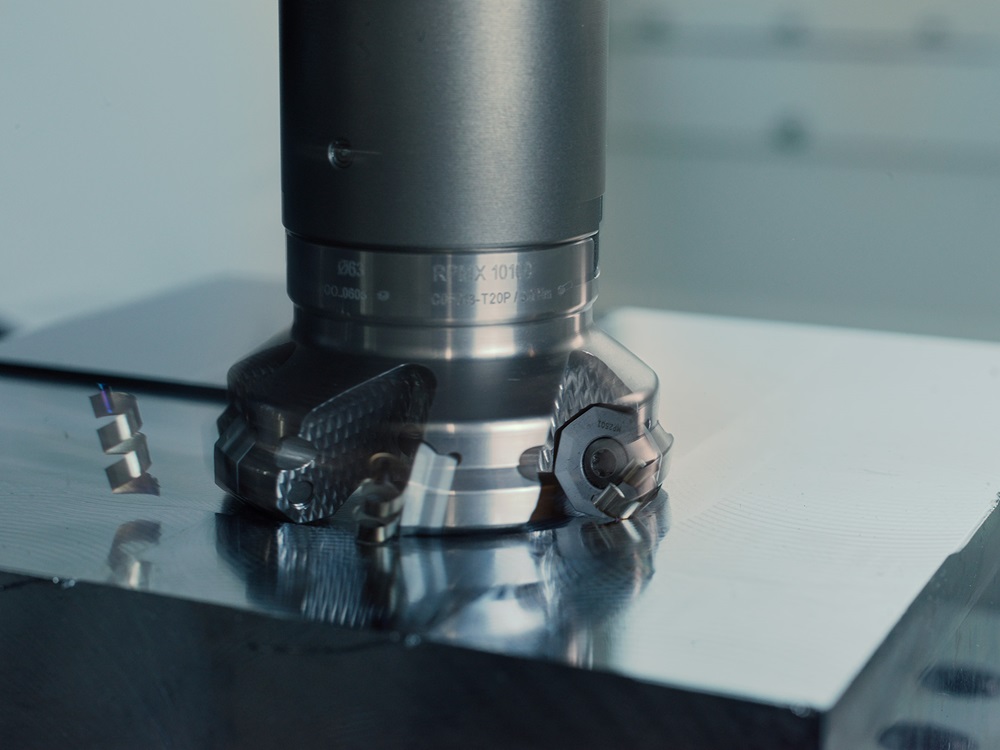
Seco is taking steps toward a sustainable future with its new Life Cycle Assessments (LCA),
helping to meet ambitious internal sustainability goals and supporting customers in making
environmentally conscious decisions. LCA systematically evaluates the environmental
impact of products across their lifecycle, from raw material extraction to disposal.
By providing detailed insights into metrics like climate impact (CO2eq) and other key
environmental measures, Seco is enabling both internal improvements and customer
transparency. Throughout 2024, Seco focused on two key pilot areas: turning inserts and
round solid-carbide milling tools. This year, the company will expand LCA coverage to
include more of its portfolio and enhance MyPages with additional sustainability data.
More information www.secotools.com

DMG Mori redefines its three-axis machines

With the new DMV series, DMG Mori says it is combining the strengths of earlier three-axis machining centres with innovations that meet increasingly demanding requirements in manufacturing. The development of the DMV 60 and DMV 110 aligns closely with the company’s Machining Transformation (MX), one of DMG Mori’s four pillars to support future manufacturing – the other three being Process Integration, Automation and Green Transformation (GX).

As three-axis machines, the two DMV models occupy an important position in numerous industries, including mould and die, medical, automotive and aerospace. In these industrial fields, productive machining of the most common materials, from aluminium and stainless steel to titanium alloys, is crucial. The travel paths of the DMV 110 are 1100 x 600 x 510 mm (DMV 60: 600 x 600 x 510 mm), while the table can support workpieces loads up to 1700 kg (DMV 60: 1000 kg).

A range of spindles is available, starting from 12,000 rpm, through a 15,000 rpm high-torque spindle, ending at a SpeedMaster offering 20,000 rpm – all with Big Plus interface. A combination of spindle with high dynamic and rapid traverse speeds of 42 m/min results in high-performance cutting, states DMG Mori.

Direct drive transmission in the X and Y axes – and direct measuring systems in the linear axes – ensure high positioning accuracy and machining precision. The same applies to the temperature compensation system and the resulting thermal stability.

Both machines are available as standard with 30-pocket tool magazine, which can be extended to 60 or even 120 stations. The large number of tools enables the use of sister tools or loading for a high variety of parts, contributing to the flexibility of DMV machines and significantly reducing non-productive times.

More information www.dmgmori.com

Heller expands five-axis machine range

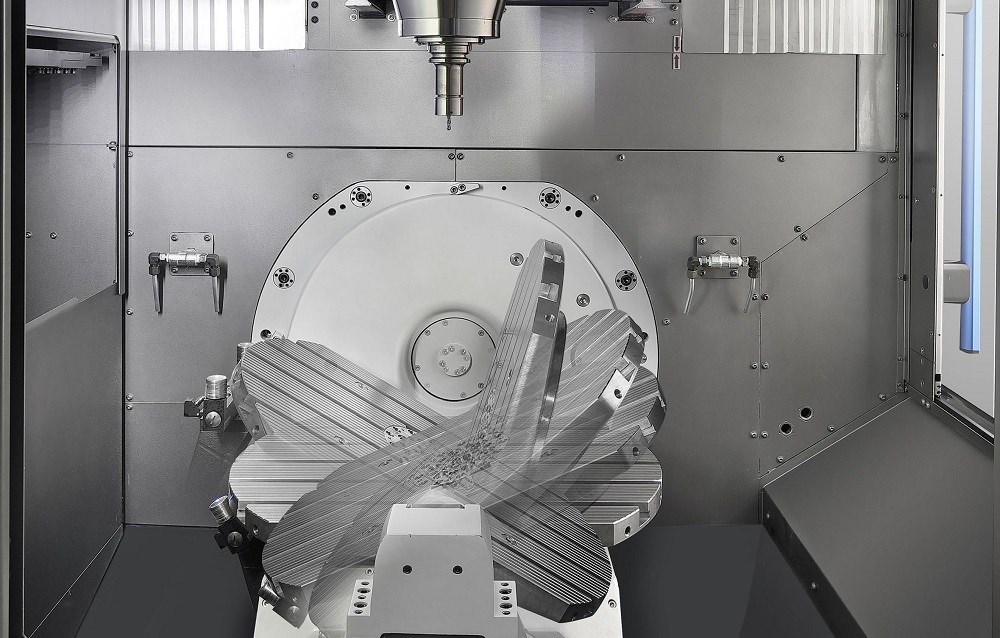
Following the introduction of its F 5000 and F 6000 five-axis machining centres, Heller has extended the company’s latest-generation series with the addition of a larger capacity model, the F 8000. According to Heller, the F 8000 is suitable for everything from single part manufacture to flexible series production, 24/7.

The machine is capable of producing parts within a 1400 x 1200 x 1400 mm working envelope, the X-axis stroke being 150 mm longer than that of its predecessor. Nevertheless, the new machine occupies a 25% smaller, narrower footprint, thanks in part to a new design of rack-type tool storage. Users can now place four machines side by side, rather than the previous maximum of three.

If a manufacturer purchases an optional, enhanced-specification PRO version, it will benefit from a machine with 50% higher linear axis acceleration at 6 m/s², reducing chip-to-chip time by approximately 30%. The PRO package also offers greater precision, with positioning tolerance in X/Y/Z of 6 µm, representing a 25% improvement over the former model.

Equipped with an automatic pallet changer as standard, the new machine utilises 800 x 800 mm pallets, although it also is possible to use larger 1000 x 1000 mm pallets. The maximum load is 2000 kg, but from the start of 2025 an optional pallet load of 3000 kg will be available. In addition, Heller can offer extended automation with linear/rotary storage systems or robots.

The F 8000 uses the same modular system as the entire F series for key components such as heads, spindles, pallets and tool magazines. Machine structure is also consistent across the series, ensuring compatibility – not only with previous five-axis generations – but also with Heller’s new H series of four-axis horizontal machining centres.

More information www.heller.biz

Setting the course for high precision

Some 15 years ago, Ammann AG changed its strategic business orientation from a contract manufacturer for machined switch and track parts to Ammann Components, a system supplier specialising in complex, high-precision workpieces. Success and growth followed – thanks in part to the company’s high-quality machinery, which is dominated by several Heckert machining centres from Starrag. Now, the of Tägerwilen, Switzerland-based is expecting a further boost from its recently delivered Heckert H75.

The successor model to the successful Heckert HEC 500, the H75 comes with various improvements and promising options. The machine produces large aluminium gearbox housings for which the customer specifies centre distances with a tight tolerance.

Managing director Paul Ammann is especially enthusiastic about the machine’s spindle with its maximum torque of 950 Nm and speed up to 12,500 rpm. This capability makes the BAZ spindle equally suitable for aluminium and heavy machining. To maximise flexibility and keep set-up times to a minimum, the Heckert H75 features extensive tool storage: with its four coupled towers, the magazine has a capacity for almost 400 tools.

As the company plans long term for all its investments, the imminent move to a new location will have an impact on the Heckert H75, as Ammann explains: “At the moment, automation is neither necessary nor possible. At our new location, however, we’ll expand the Heckert H75 and our existing Heckert HEC 500 with a pallet system to create a low-manpower production system. It was therefore important to us that the H75 is fully compatible with the Heckert HEC 500 so that a second set-up station is not needed. As expected, our partner Starrag was extremely flexible and made the necessary adjustments to the Y-axis travel and pallet changer.”

More information www.starrag.com

Double power for machining large light parts

Schwäbische Werkzeugmaschinen (SW) is strengthening its portfolio of multi-spindle CNC
machining centres with the introduction of the BA space3-22 two-spindle machining centre.
This further development of the ‘space’ series is for machining particularly large, light metal
workpieces in sectors such as automotive and aerospace.
SW launched the single-spindle version of its BA space3 in 2020. Since then, the machine
has found use primarily in e-mobility applications. To achieve even greater efficiency, SW’s
R&D team subsequently began developing the two-spindle version for demanding
manufacturing processes such as giga-casting or machining other complex components in
the automotive and aerospace industries.
The BA space3-22 is currently the largest machine in the SW portfolio. Its independent
horizontal spindle arrangement enables two machining scenarios: simultaneous machining
of two parts by two spindles, or the use of both spindles on one large workpiece. This
flexibility is particularly valuable in series production, where maximum machine utilisation is
crucial. The benefits are clear: parallel machining significantly reduces production times and
increases output.
Markus Löhe, aerospace key account at SW, explains: “In a nutshell, two-spindle machines
double output. The BA space3-22 can be used as a conventional two-person machine or, for
very large components, can easily be configured as a one-person machine with an even
larger machining area.”
At the heart of the BA space3-22 are powerful linear and torque motors. In this
combination, the advantages of both motor types are exploited to the full: linear motors
guarantee fast and precise linear movements, while torque motors provide dynamic rotary
movements. This capability allows the machine to achieve maximum acceleration, not only

minimising machining time but also downtime during tool change and positioning. The rapid
feed rate of the BA space3-22 is 120 m/min.
More information www.sw-machines.com