

BRG dives into benefits of workholding

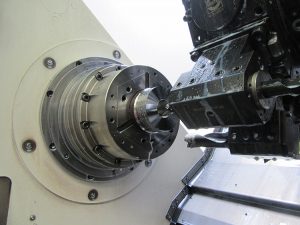
Just over three years ago, deep sea welder and fabricator Ben Goodwin gave up his dangerous day job to start BRG CNC Machining, a subcontract machine shop. The Market Weighton-based company was launched with a three-axis machining centre, but has now taken its next step, installing a DMG Mori NLX2500-700 turning centre with workholding equipment from Hainbuch.
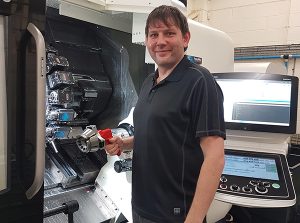
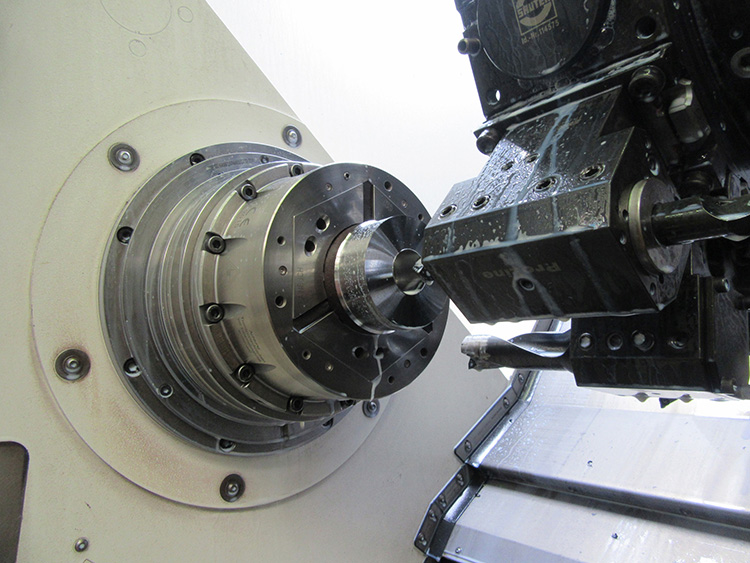
“With regard to a new high-end turning centre, one key area of investment was the workholding solution for the main spindle: a Hainbuch Spanntop Nova Combi collet chuck,” states Goodwin.
Typical workflow on the DMG Mori NLX2500-700 involves the machining of a huge variety of components.
“This week, we are machining 48-off parts for the utilities sector; 68-off 35 mm diameter components for a rape seed
drill in the agriculture industry; and motorsport components that are an urgent requirement,” explains Goodwin. “To effectively machine the huge diversity of parts that any subcontract company faces, we had to
have a machine fitted with chucks that facilitate fast changeovers, with rigid and
high clamping forces.
“By way of example, we regularly machine 76 mm diameter parts from 304 stainless steel in batches of 100-off,” he adds. “Using the milling turret, we are rough milling the components with a Seco HF end mill at over 6000 mm/min, at a depth of 0.8 mm. Clamping the parts on less than 30 mm of material, the Spanntop is achieving clamping forces of over 3.5 MPa. In comparison, the hydraulic three-jaw chuck on the sub-spindle only attains a clamping force of 1.6 MPa. The result of the high clamping force is enhanced surface finish and extended tool life, which we are achieving while running the jobs at speeds and feeds faster than we ever could have imagined.”
For further information www.hainbuch.com
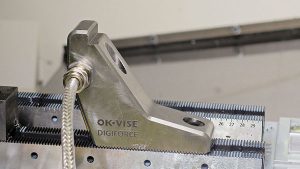
Clamping force verification made easy

Workholding equipment manufacturer OK-Vise has announced two new systems for checking how tightly a component has been clamped, mindful that during automated machining in particular, the verification of holding force has always been a challenge. The products are available in the UK through 1st MTA.

The accuracy of workpieces, especially those that are delicate or of thin-wall construction, can be adversely affected if the clamping pressure is too high. Conversely, if the grip is too weak, there is a possibility of the part becoming dislodged during machining, risking operator injury, machine damage, tool breakage and scrap.
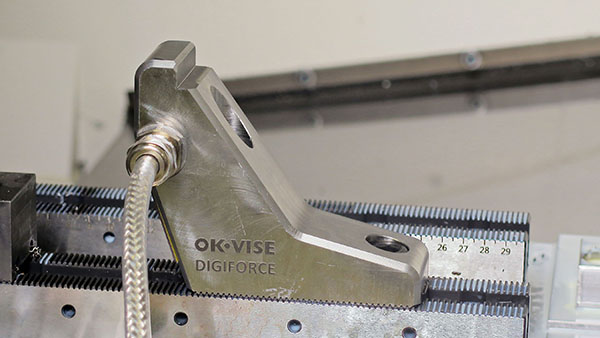
During automated hydraulic clamping, oil pressure is easy to measure, but other variables can also influence clamping force. In manual clamping systems, straightforward torque measurement is often used, although the relationship between torque and actual clamping force can be inaccurate. As a result, the approach that OK-Vise has taken is to integrate clamping force measurements directly into the company’s modular Multi-Rail RM fixturing system.
An on-screen digital readout of clamping pressure enables the operator to verify that a hydraulically secured component is held correctly. If required, an optional SCADA system can collect information from several displays over a standard Modbus connection so that historical data can be viewed and adjustments made as necessary.
The system also allows the holding force of manually secured workpieces to be checked. Here, a visual red dot in a clamp module gradually fades to grey as a spanner is turned, showing when the holding force is correct. Various modules are available for different clamping pressures.
For further information www.1mta.com

Coupling firm finds productivity mate

When the KTR Group ordered new machine tools to reduce processing times, the power transmission specialist also opted for new workholding technology from Hainbuch. The Rheine, Germany facility of KTR was aiming to generate significant improvements in set-up times and the subsequent manufacturing process.
“Several machines were due to be replaced after reaching the limit of their service life,” explains production manager Günter Schleyer.

“Therefore, we re-examined the clamping requirements. The important questions for us were how to position ourselves in the future and how do we increase flexibility? Among other things, we use machine tools for both series runs and single-item production. Here we were at a crossroads. On one hand, we required a specialised series production solution and, on the other hand, we needed a fast, flexible cell for the single parts.”
The company took a Torok manual chuck with a base plate, a clamping head and a mandrel as part of a trial phase. For KTR, the overall time saving was extremely important.
Says Schleyer: “We needed to know how the system would perform under everyday conditions. We had questions like whether the Torok was rigid, and would it meet our practical requirements? Could we organise our set-up more efficiently? And of course, holding forces and repeatability were highly significant.
“Practical experience had shown us that conventional jaws were out of the question,” he continues. “For our coupling manufacturing, parts are machined at high cutting speeds. Cams and bores are milled and drilled, so we have a wide variety of chip shapes that must not impair the function of the clamping devices. Also, the solution should be practically self-cleaning. Needless to say, the implementation of the Torok manual chuck on one of the milling machines passed the test with flying colours. With these findings, the green light was given for working together with Hainbuch.”
For further information www.hainbuch.com
Fourth axis trunnion system from Midaco

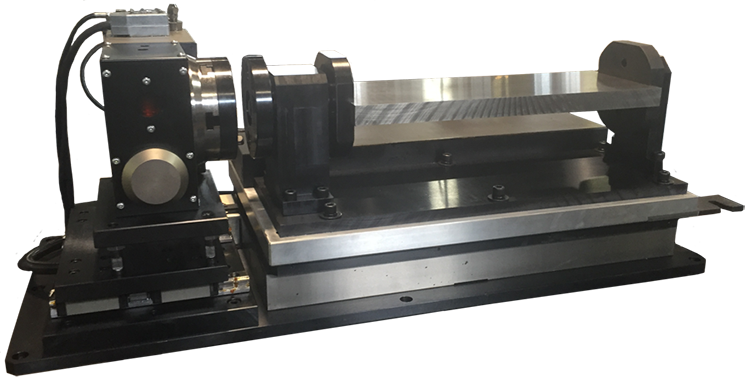
Midaco Corporation, one of the key partners of Hyfore Workholding, made its EMO debut in Hanover during September, using the opportunity to introduce a new fourth-axis trunnion system for vertical and horizontal machining centres.

The trunnion system is aimed at subcontract or low-volume manufacturing environments, where easy and rapid access to a fourth axis for three-sided machining of workpieces is necessary but not permanent. To facilitate ‘all-around’ machining, the trunnion rotates through 360°. A ‘parked’ fourth axis can impair access to the total machining envelope, whereas with the Midaco unit it is completely removed, along with its docking unit.
Midaco’s trunnion system is supplied with a permanently wired, universal receiver that automatically engages with the chosen fourth-axis unit (not supplied).
“Innovative components such as this can really help productivity as the operator can effectively be working on two jobs at a time,” says Rob Beckett, workholding product manager for Hyfore. “Different workpieces are being machined while the set up for the next – possibly different – batch can be undertaken safely out of the machine. Therefore, the transition between machining two different jobs is virtually seamless.”
In addition to the trunnion system, Midaco featured one of its M3016FL manual pallet changers on the stand. Midaco products are available exclusively in the UK from Hyfore Workholding, which can undertake all of the engineering and installation either as a retrofit or as part of a new turnkey installation.
For further information www.hyfore.com

Robo-Trex makes light work of lights-out milling

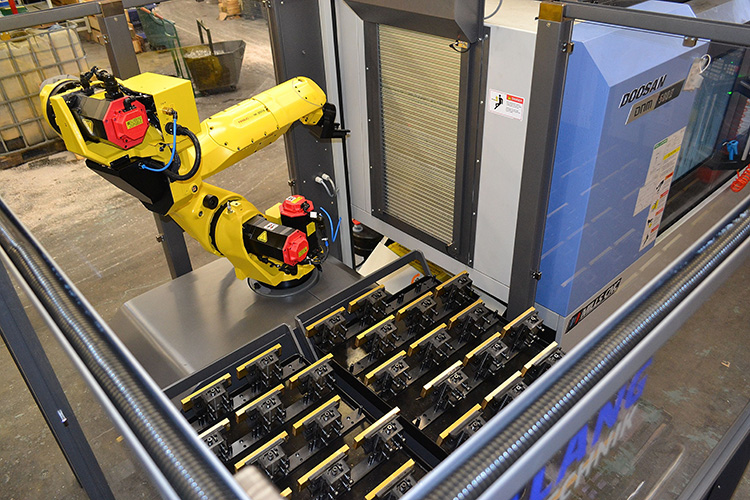
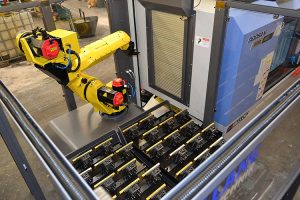
The availability of automation aids, such as the Lang Robo-Trex system from Thame Workholding, are allowing forward-thinking businesses to operate milling machines unmanned for extended periods. One such company is Hertford-based subcontractor Qualiturn Products, which operates 24 hours a day, seven days a week, 365 days a year, with only daytime staffing.

The recently installed Lang Robo-Trex robot system at Qualiturn (the first in the UK) feeds a Doosan DNM500 machining centre from two trollies. Each trolley serves as a mobile storage medium for multiple vices that hold workpieces ready to be loaded into the machine. Depending on the part sizes involved, the trollies are able to store up to 42 loaded vices. The Lang Robo-Trex system uses an articulated robot with a handling gripper that is capable of loading and unloading workpieces of up to 12 kg.
“Having previously enjoyed the benefits of other Lang workholding systems supplied by Thame Workholding, we already had great confidence in the quality the products,” says managing director Nick Groom. “After viewing a video of the Lang Robo-Trex automation system in action and recognising the lights-out advantages it would deliver, we calculated our anticipated ROI and decided that the system would be more cost effective than purchasing another CNC machine tool. In fact, the success of the Robo-Trex, which has released the latent productive potential of the machine tool it serves, means that we already have plans to install a second system.”
For further information www.thame-eng.com