
Drills designed for aluminium automotive parts

Two drills optimised for drilling aluminium automotive parts have been developed by Sandvik Coromant.

Action photo of a CoroDrill 430 drilling tool

Suitable for machining components in medium-to-large volumes, CoroDrill 400 and CoroDrill 430 deliver high throughput and low costs, as well extended tool life and enhanced process security, says the company. The drills are supported by CoroTap 100, 200, 300 and 400, which are also optimised for tapping operations in ISO N materials and help provide a complete hole-making offer from a single source for those tasked with producing aluminium automotive components.
While both CoroDrill 400 and CoroDrill 430 are available in the Sandvik Coromant N1BU solid-carbide grade, the former can also be specified in the newly developed N1DU veined PCD grade. N1DU provides PCD across the entire cutting edge, thus offering much longer tool life. Due to PCD’s low coefficient of friction and high conductivity of heat, the tool’s cutting edges are less susceptible to built-up edge. As a general guide, Sandvik Coromant recommends the use of the solid-carbide grade when the hole count is low and handling risk is high, while the PCD grade is preferable where hole count is high and higher productivity is required.
CoroDrill 400 is recommended for drilling into solid material, as it features more flute volume for better chip evacuation. When drilling into cored material or pre-cast holes, CoroDrill 430 will perform better as it features three flutes for increased stability and holding true positon, regardless of misaligned cored holes.
Optimised features of CoroDrill 400 and CoroDrill 430 include polished flutes and precision coolant holes, with support provided for MQL. The drills are available as standard in 5, 6.8, 7, 8.5, 10.2 and 12.5 mm diameters, which correspond to M6, M8, M10, M12 and M14 thread sizes.
For further information www.sandvik.coromant.com

Ultra-hard cutting material introduced

NCB100 from Sumitomo Electric Hardmetal is a newly developed cutting tool material specifically for hard-to-machine, high-specification workpiece materials. The use of NCB100 enables tool life to be increased by a factor up to 50 times when compared with more traditional carbide cutting inserts, says the company.

Sumitomo has introduced its first cutting insert produced from NCB100, an ultra-hard binder-less polycrystalline cubic boron nitride (BL-PCBN) cutting material, using a newly devised method of direct conversion sintering. Binders and the volumes used in producing cutting inserts can have a significant influence on mechanical and thermal properties, and hence performance, an area that Sumitomo’s binder-less development is said to overcome.
NCB100 has high levels of hardness, strength and thermal conductivity that will surpass conventionally sintered PCBN compacts containing binder materials, says Sumitomo. As a result, NCB100 creates high orders of wear resistance and stability from the cutting edge of the insert. This capability is critical when machining difficult, non-ferrous materials such as titanium alloys, cemented carbides, hard ceramics, and Ni-based heat-resisting and cobalt-chrome (Cr-Co) alloys used in medical applications.
Sumitomo reports that NCB100 has been proven in finish-turning trials against established carbide grades, where significant levels of tool life improvements have been achieved despite inserts being run at cutting speeds up to 200 m/min. The material has also been found to be highly stable when finish-turning Co-Cr alloys used, for instance, in medical hip joints. In addition, the insert material can be applied to
high-speed milling applications such as the finishing of titanium alloys and nickel-based heat-resisting alloys, at speeds up
to 700 m/min.
For further information www.sumitomotool.com

Tooling helps maximise five-axis investment

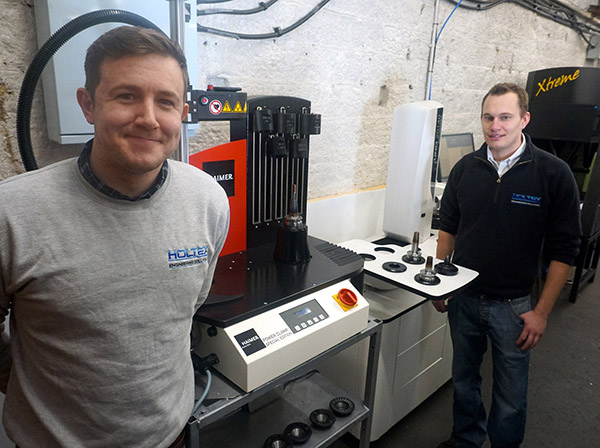
An East Sussex manufacturer of precision components that help universities and government laboratories complete ground-breaking experiments, has enjoyed a major production boost. UHV Design, which employs 50 people at its facility in Laughton, has tapped into the expertise of Hyfore to equip its new five-axis Quaser MF500UH with a dedicated tooling system.

Working closely together, the two companies identified a £30,000 Acrow tool-holding package. The Hyfore solution focuses on interchangeable NR collets that can be used exclusively on the Quaser machine. NR collets tend to be smaller in diameter, offering greater contact with components, improved tool life and the ability to move freely around tight clearance spaces.
David Heward, machine shop manager at UHV Design, which is part of AIM-listed Judges Scientific, says: “The Quaser MF500UH was equipped with a 15,000 rpm ‘face and taper’ spindle and a 48-station carousel that allows us to store 80% of all our tools in one machine – ideal for reducing changeover times and reducing secondary operations. However, to make the most of it we needed to find the right tooling system, and that is where Hyfore came into its own. Their engineers spent a lot of time at our facility looking at the components we were planning to machine, before identifying the best package.”
Oli Riley, product specialist at Hyfore, adds: “This is the largest single order placed for an Acrow package to date. Importantly, it also shows how we can work with specialist manufacturers like UHV to understand its production challenges and come up with flexible solutions.”
For further information www.hyfore.com

Touch sensors deliver pinpoint precision

Now available from Industrial Tooling Corporation (ITC) is the newly developed Big Kaiser Base Master Red and Base Master Mini touch sensors. The latest touch sensor family can determine workpiece offsets and tool lengths to improve precision, repeatability and reduce set-up times.

Base Master Red can be used with all types of machines and materials, including non-conductive cutting tools, workpieces and machine tools. The sensor allows the operator to quickly touch a tool with zero risk of damage or breakage, saving time and money. Additionally, the body set and measuring sensor are independent of each other, and this makes maintenance particularly easy as customers can simply replace the measuring sensor in the event of any issue ever occurring.
The Base Master Red offers repeatability of ±0.001 mm.
For maximum flexibility, the system has a solid magnetic base that mounts vertically, horizontally or at any angle the operator desires.
Base Master Red is complemented by Base Master Mini, which has a compact design that makes it fast, flexible and easy to use, says ITC. The main feature of Base Master Mini is its slim height of only 10 mm, making it suitable for small turning centres, sliding-head lathes and other machine tools where working space is limited.
For rapid reference point detection, both the Base Master Red and Base Master Mini are fitted with a bright green LED light. Battery life is 10 hours if used continuously.
For further information www.itc-ltd.co.uk

Drills for inclined and curved surfaces

Sumitomo Electric Hardmetal has extended its range of Flat MultiDrill series (MDF) high-rigidity, coated carbide drills for spot-facing and counter-boring features on horizontal, curved or inclined surfaces.

MDF now includes overall length tools up to 10:1 length-to-diameter ratio, a long shank, external coolant supply (L2D Type) and through-coolant feed (H3D/H5D type) variants.
The MDF series of tools benefit prime applications such as when cross drilling, expanding hole sizes and deep spot facing. With its 180° point angle, true flat bottoming can be achieved; in order to create a seating, for example. Pre-tapped holes can also be produced in thinner plate or sheet material. Now with the up to 10:1 overall length ratio, tools can be used to access component features that are deeper within housings, for instance.
Significant in the series is Sumitomo’s ‘RS’ thinning development, which creates a greater wall thickness at the tip of the drill. Swarf evacuation is effective due to wider pockets that accommodate chips with high orders of flute finishing and a specific shape applied to the rake face. A special high-strength cutting edge helps resist impact damage when features involve interrupted cuts, while also maximising the overall stability of the tool. Due to the design of the tool, minimal burr formation is said to be a further benefit.
The extended line up of MDF drills can be used on general, stainless, alloy and hardened steels up to 50 HRc.
For further information www.sumitomotool.com