

New chucks use ER-driven tools for versatile turning

“The best of both worlds” is how German tooling manufacturer GEWEFA describes its M96 and M96+ hydraulic chucks, which fit into any ER-driven tool quickly and effectively for conversion into a high-precision hydraulic holder. Availability in the UK and Ireland is through subsidiary company GEWEFA UK, which offers the products from stock in Germany.

Avoiding the limited clamping force, runout issues and lengthy tool change times associated with mechanical ER holders, the versatile M96/M96+ products give the machinist all the benefits of hydraulic clamping. These include higher and more consistent all-round gripping force, effective vibration damping, extended tool life, higher accuracy and improved surface finish on machined components. GEWEFA says all this is available at a much reduced cost compared with standard hydraulic chucks.

In addition, because the chucks simply mount in the output shaft of the ER driven tool and twist to seal, users can enjoy quicker and easier tool changes, saving time and increasing productivity.

The M96 is suitable for driven tools with an internal thread, while the M96+ is for driven tools with an external thread and is secured to the live tool with a locknut. GEWEFA’s new hydraulic chucks are available for sizes ER16, 20, 25, 32 or 40 (currently only the M96), accommodating tool diameters from 5 to 25 mm.

More information www.gewefa.co.uk

Clearcut winner in ACM delamination challenges

Industrial Tooling Corporation (ITC) has launched its Clearcut range of single-flute balanced routing tools, specifically engineered to eliminate delamination issues when machining aluminium composite material (ACM) panels.

ACM panels have become increasingly popular in signage, architectural cladding and display applications. To meet growing demand for faster turnaround times, more manufacturers are now printing directly on to ACM panels before cutting. This workflow significantly reduces lead times but introduces new machining challenges. ITC says it listened to the industry and developed a solution with its Clearcut range of cutting tools.

“The trend towards printing directly on to ACM substrate before cutting has created a perfect storm for delamination issues,” says Sally Hunt, technical sales manager at ITC. “Manufacturers gain significant time savings in production, but they’ve discovered that conventional cutting tools simply cannot handle the increased complexity of machining pre-printed panels without causing costly damage.”

Traditional cutting tools often leave jagged edges with visible print layer damage, forcing manufacturers to choose between speed and quality. However, with the slow helix Clearcut series of routing tools from ITC, manufacturers can maintain both of the key metrics.

ITC’s solid-carbide Clearcut range is VITREO coated, with the company reporting that the slow helix geometry ensures maximum productivity with unparalleled edge finishes. The single-flute routing tools are available in both coated and uncoated variants, with unbalanced or high-performance balanced tools offered.

The balanced tools are designed for modern digital cutting tables that incorporate high-frequency spindles operating at speeds exceeding 30,000 rpm. Notably, the single-flute balanced design on a 6 mm shank provides construction that eliminates vibration at high speeds, preventing print damage and substrate delamination.

More information www.itc-ltd.co.uk

Fine-pitch milling cutter suits aluminium parts

Kyocera Corporation has launched its MD90 super-fine pitch cutter, a new milling tool specifically designed for machining aluminium parts in industries such as automotive.

In recent years, there has been a growing demand for lightweight, high-strength aluminium components, driven by advancements in vehicle fuel efficiency and the rise of electric vehicles (EVs). Additionally, the increasing use of smaller machines in manufacturing sites has created a need for cutters that can efficiently and effectively process machines aluminium parts. According to Kyocera, the MD90 not only meets these needs but also offers potential cost savings through its high efficiency and quality, making it an attractive option for manufacturers.

The MD90 features a 24-insert design with a diameter of 125 mm, enabling efficient and high-quality machining of aluminium components.

Among the main benefits of the MD90 include the ability to maximise machining efficiency. The proprietary shape of the holder ensures high rigidity, even with super-fine pitch specifications. This design reduces chattering and enables efficient machining with a table feed of Vf ≥24,000 mm/min.

Lightweight aluminium holders are a further advantage, ensuring suitability for small machines tools (BT30).

With the MD90, Kyocera says customers will gain from high-quality production. PCD inserts are specifically engineered to reduce burr, achieving surface roughness of 0.8 μm Ra or less. Moreover, the company says that the double coolant holes and streamlined chip pocket structure offer excellent chip control performance, ensuring smooth and precise machining and long tool life.

Of course, every application presents unique requirements. For this reason, the MD90 is available with customised configuration options. Cutting diameters range from 20 to 350 mm diameter, and the cutting-edge geometry can be precisely tailored to suit specific operational demands. This level of flexibility ensures optimal utilisation of the tool’s full potential.

More information www.kyocera-unimerco.com

Schabmuller taps into Mapal’s expertise in aluminium

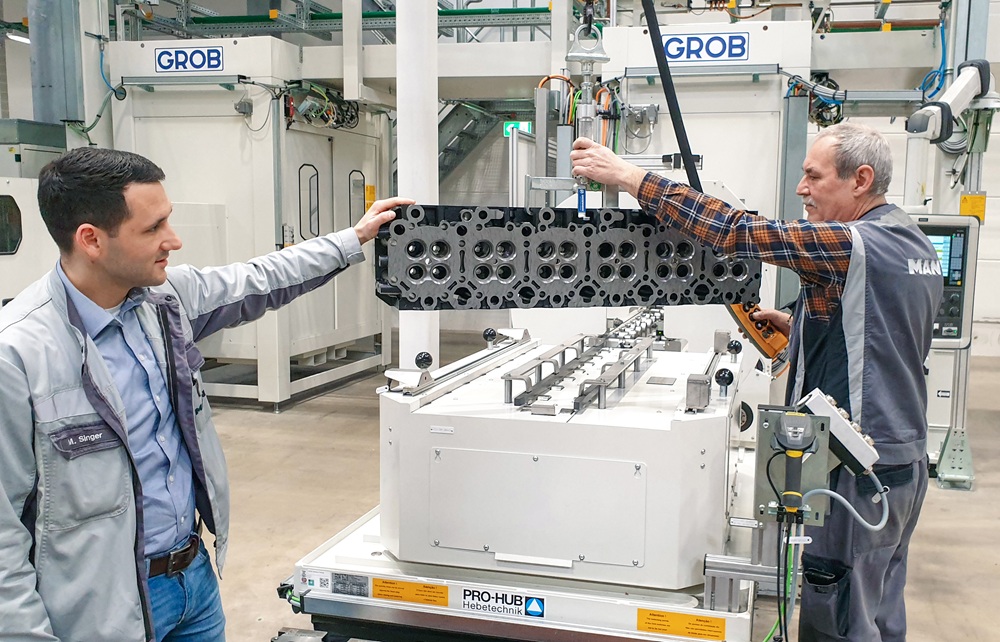
Although cutting tool manufacturer Mapal has handled tool management at automotive supplier Schabmüller Automobiltechnik for some time, the company has now also taken over CADCAM programming for components, including simulations. With growing requirements for aluminium machining, Schabmüller says it values this full-service solution.

Schabmüller near Ingolstadt has been an automotive supplier since 1988, specialising increasingly in the efficient manufacture of large series. The parts are installed in vehicles made by Mercedes, Porsche, Audi, BMW and Jaguar, among others. SMI operates predominantly as a tier-two supplier. Major clients include Aludyne and Strojmetal, which directly supply the automotive industry as an aluminium foundry and forge.

When recently becoming involved in the production of suspension parts, Schabmüller had a whole new experience. A good example was a hub carrier, where issues with stiffness arose during test drives. Almost at the last minute, another surface required machining and a stiffening rib was added.

To get a better grip on these short-term changes and continue optimising overall production, Schabmüller decided to bring Mapal on board at the CADCAM programming phase.

“We have a very co-operative partnership with Mapal and appreciate their rapid response times,” explains Schabmüller’s managing director Helmut Häckl. “So we felt good about expanding our co-operation to CNC programming and simulation.”

NC programming, simulation and tool management are today perfectly intertwined. For instance, simulation data is included in tool planning, which helps detect potential collisions at an early stage. Simulation also plays a key role, showing approach angles that can be used to improve material removal, for example.

More information www.mapal.com

Horn demonstrates efficient lead-free alloy turning

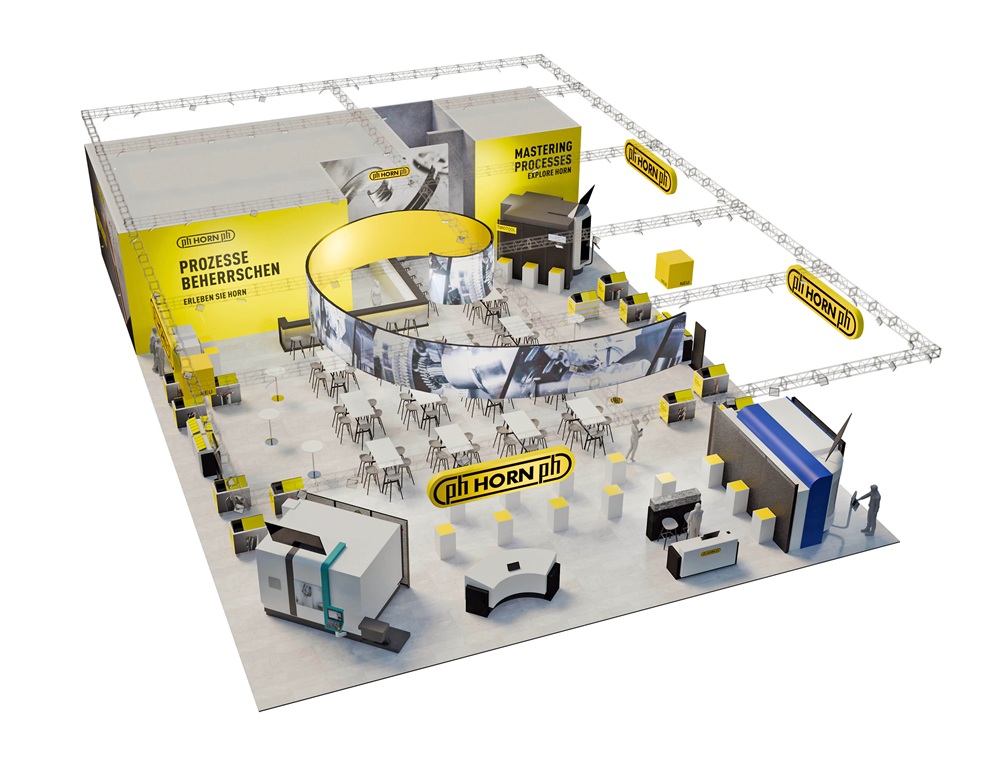
At its recent Technology Days open house in Tübingen, Germany, cutting tool and insert manufacturer Paul Horn GmbH explained the measures it is taking when producing its latest products to mitigate the difficulties that its customers face due to the phasing out of lead as an alloying element.

The main problem when machining lead-free alloys, whether steel or brass, is a lack of reliable chip breaking. Horn engineers remedied this for grooving and longitudinal turning by taking laser-cut chip-breaker geometries normally reserved for cutting steels, adapting them and applying them not only to those materials but also to lead-free brass and other non-ferrous alloys that no longer have their free-machining properties. Extensive investigations showed this works very well.

For boring, geometries were again adapted to ensure reliable chip breaking. One of the biggest challenges in internal machining is the generation of long swarf that wraps around the tool, clogs the hole or, in the worst case, leads to tool breakage. Previously, laser-cut or ground chip breaker geometries were employed but such carbide inserts tend to be expensive.

With Horn’s new Type 105 Supermini and now the Type Mini with I geometry, Horn has succeeded in developing boring tools with a chip breaker form that is pressed into the insert’s rake face as the green tungsten-carbide blank is being manufactured. After the blank has gone through the high-temperature sintering process, the chip-breaker shape is permanently fused into the final, hard insert. Such geometries are cost-effective, can be used universally for different material groups, and are suitable for internal, face, copy and back turning. Horn reports that chip control is good, even when the infeed rate is low.

More information www.horn-group.com