

Mapal improves machining of axial piston parts

Mapal has carefully examined critical components of the fluid power industry and their potential for complete machining. An example is axial piston pumps and motors, a central component of which is the cylinder block, made either of steel (C45 or 42CrMoS4) or spheroidal cast iron (EN-GJS-500-7 or EN-GJL-400-15. Mapal experts have developed a solution that reduces the machining time for a customer’s cylinder blockby 19%.

“One customer was struggling with high costs for manufacturing cylinder blocks,” says Tobias Stolz, component manager for general machining at Mapal. “A great deal of effort was required to ensure the defined surfaces, which had to be between Rz = 27 and 37 µm, as well as the high quality of liners with tolerances for roundness, straightness and parallel alignment of 3 µm.”

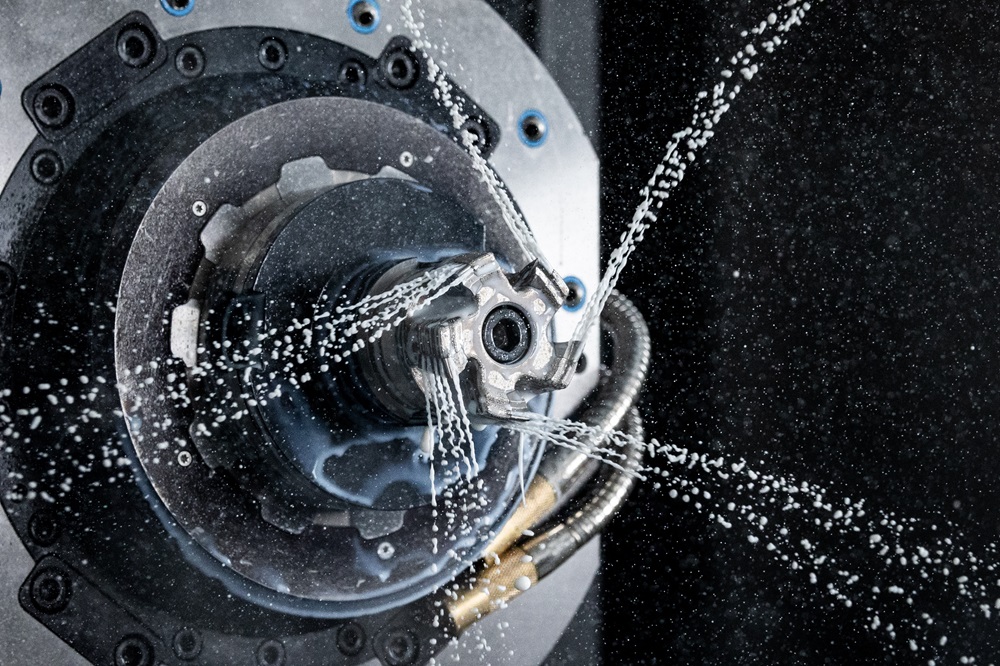
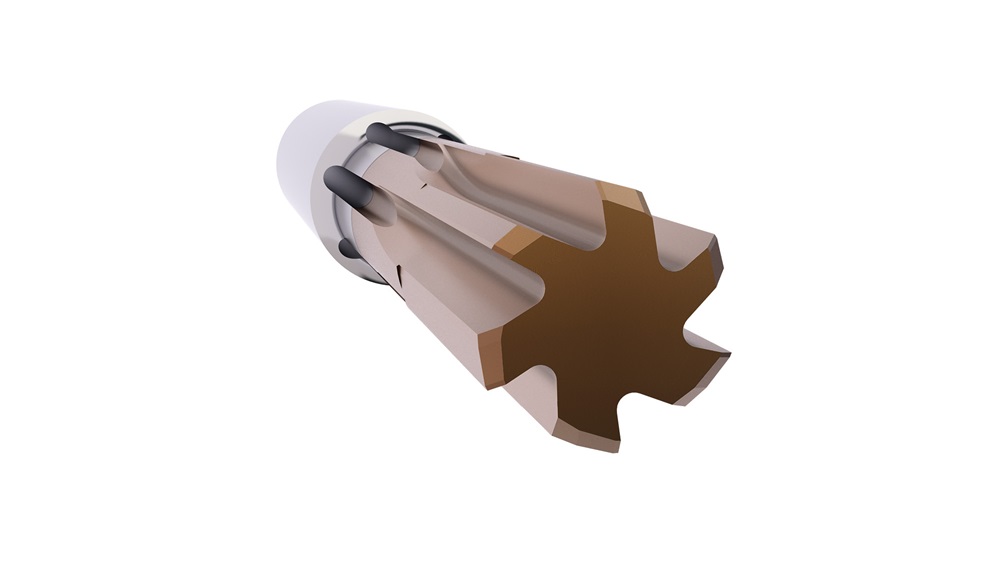
The customer today machines the pressure and suction kidney with the Mapal OptiMill-Uni-Pocket solid-carbide milling cutter as part of a new process. This tool supports the boring operation by way of inclined plunging. The machining of these inlets and outlets therefore does not require any other tools.

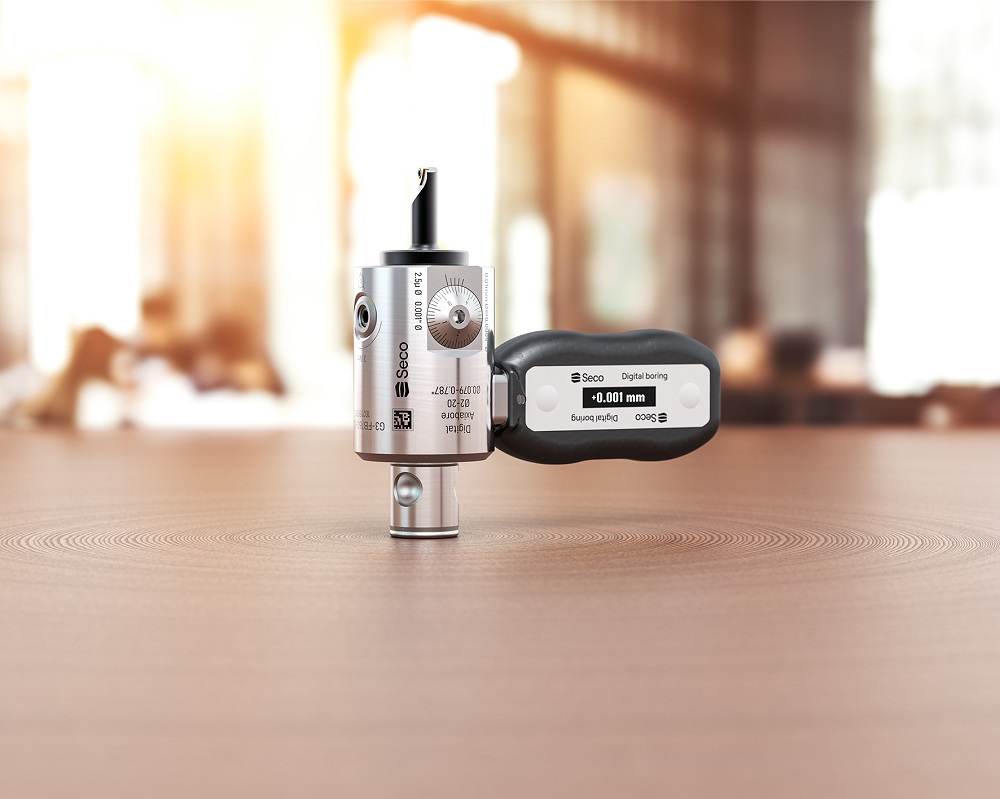
A step drill with Tritan-Drill geometry offers similar benefits when pre-machining the piston bores, dispensing with the requirement for a spot face. Furthermore, thanks to sharp cutting edges, the bottom of the bore no longer requires deburring. The multi-stage Mapal fine-boring tool ensures optimal quality before pressing in the brass bush. It is not only very precise during machining but also particularly economical thanks to the HX insert’s six cutting edges. These three tools alone reduce machining time by 19% compared with the previous method.

“We offer our customers economical processing solutions to their machining challenges for all functionally relevant parts in the fluid power industry,” summarisesStolz.

For further information www.mapal.com

Walter PVD grade suits high-load grooving

Walter is launching its patent-pending Tiger·tec Gold WSM33G grade: the company’s first PVD grade to accommodate the high loads that occur during grooving operations. The cutting tool material combines third-generation TiAlN with TiSiN to form a multi-layer coating with exceptional hardness and increased toughness, reports Walter.

A special post-treatment reduces friction and ensures a smooth surface, thereby optimising chip removal and process reliability. Furthermore, the gold top layer makes it easier for users to detect wear. Walter uses the new PVD coating on single-edged SX cutting inserts with positive engagement and a self-clamping system. It is also applicable to indexable inserts from the double-edged DX18 system, where a second prism ensures stability in the insert seat.

For manufacturers, the fact that this grade is usable with both systems delivers maximum versatility as it caters for all insert widths from 1.0 to 10mm. Another advantage of the Tiger·tec Gold WSM33G grade is its adaptability, even under challenging conditions. Walter says the universal grade is suitable for 75% of all applications, including grooving and parting-off, groove and copy turning,and slot milling.

The system can undertake these operations on a range of materials, including steel (ISO P30), stainless steel (ISO M30) and materials with difficult cutting properties (ISO S30). Offering universal application, long tool life and high resistance of the multi-layer coating against plastic deformation and flank face wear, Walter says that its WSM33G grooving inserts are a productive and reliable choice.

For further information www.walter-tools.com

Walter introduces WL17 indexable inserts


Cutting tool specialist Walter has expanded its WL copy-turning system with the introduction of WL17 indexable inserts for Swiss-type automatic lathes and small diameter machining. Used on the W1011-S-P external turning toolholder, which is also a new arrival (along with W1210/W1211 boring bars), they bring the benefits of the existing WL25 inserts to smaller dimensions.

The W1011-S-P toolholder has a square shank that is available in the most common shank sizes of 12 x 12 mm and 16 x 16mm. They are for use on automatic lathes and multi-spindle turning centres. Walter says it is the only manufacturer to offer a turning system for automatic lathes with positive engagement and three-edge turning inserts.

As with the WL25 turning inserts and toolholders, the smaller indexable inserts facilitate equally high cost efficiencies, thanks to the three cutting edges, high stability and 50% improved indexing accuracy in comparison with ISO inserts. The targeted Walter precision cooling on the rake and flank faces also increases tool edge life.

When it comes to internal turning, the inner diameter (Dmin) of the workpiece is often a limiting factor. ISO turning inserts, such as the VBMT11, only have two cutting edges and are applicable at a 93° approach angle from a Dmin of 22mm. By contrast, the new Walter boring bars W1210 and W1211 with WL17 inserts are suitable for internal turning from Dmin 18 mm, while also sportingone more cutting edge.

Furthermore, the operator can use the indexable inserts for both forward and reverse turning. Just like all WL inserts, WL17 inserts can be used in a neutral, right-hand and left-hand configuration, and feature the latest cutting tool coatings, such as Tiger•tec Gold.
For further information www.walter-tools.com

Addmore boosts tool life and cuts cycle time


Addmore Engineering, based in Bedford, is a CNC machining company that supplies high-precision parts to the automotive, medical, and oil and gas industries. What started from a barn in Watford is now a large operation which spans several buildings, employs 48 skilled machinists and runs 24 hours a day.

Specialising in highly precise and intricately machined parts, Addmore turned to Ceratizit over 20 years ago to help with its complex component and tooling needs. Regularly visited by an applications sales engineer and a technical sales engineer from Ceratizit, the two companies enjoy a strong working relationship that positively impacts business growth.

While manyCeratizit inserts are in use at Addmore, a recent switch made was to Ceratizit’s Pentron drill with the ambition of increasing tool life and saving money on tool replacement costs. The tool Addmore was using previously was the 2xD 46 mm diameter C900 from Ceratizit. Although successfully completing the job, the inserts were getting pick-up and sticking to chips.

Addmore saw immediate benefits from using Ceratizit’s 2xD 46mm KUB Pentron drill. Whereas the previous drill had an insert life of between 55-75 parts per edge, the Pentron drill increased this to 120+ parts per edge, delivering an improvement of well over 50%.

Shaun Thornton, technical manager for Ceratizit UK, says that this improvement is “down to Ceratizit’s SOGX 03 geometry and BK8430 coating in combination with the Pentron drill. This specialist coating minimises chip-sticking and increases swarf evacuation due to its optimised flutes.”

As well as the cost-saving benefits which come from the extended insert life of the Pentron drill, switching to this insert also meant that machine cycle time was reduced by 10%.
For further information www.ceratizit.com

Guhring mould and die range hits the spot


Guhring is releasing a range of tools especially for companies working in the mould and die industry. Among the stand-out performers is the G-Mold milling line, which allows manufacturers to benefit from longtool life and optimal component surfaces.

According to Guhring, the G-Mold milling series maximises tool life when machining materials up to 65HRc. With the new Guhring Signum and Perrox coating technologies, alongside an ultra-hard carbide substrate, G-Mold demonstrates extended tool life and high levels of machining performance. Indeed,further gains are available thanks to the Guhrojet peripheral cooling system that delivers through-tool coolant or compressed air to remove swarf.

G-Mold milling cutters are available in ball-nose, torus, finishing, radius finishing, universal and high-feed variants, all of which incorporate micron-precision radius accuracy. Three prominent arrivals among the range include the new 55 and 65 G-Mold Series ball-nose tools, and the high-feed range.

The new G-Mold 65B series of high-precision two- and four-flute ball-nose cutters for machining materials up to 65HRc incorporate a radius contour tolerance of ±0.005mm to ensure component contour accuracy and repeatability. The cuttersfeature centre-cutting geometry, and 25° flute and neck clearance for extended reach applications.

Alongside the G-Mold 65B, is the new G-Mold 55B series. More of an all-rounder, the G-Mold 55B is suitable for machining steel, stainless steel, cast iron, super alloys and hard materials up to 55HRc.

For mould tool companies that demand the epitome of high-performance cutting, the G-Mold 65 HF series is for high-feed roughing with low depths of cut and maximum feed rates to optimise metal removal rate. The G-Mold 65 HF high-feed series incorporates Guhring’s Guhrojet peripheral cooling from 1 to 3mm diameter with central through-coolant for 4mm diameter and above.
For further information www.guhring.co.uk