

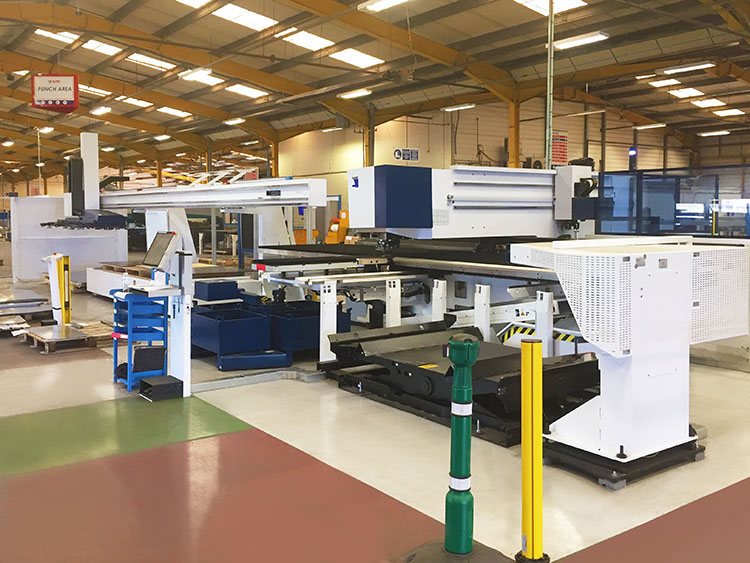
Trumpf machine keeps Alpha on target

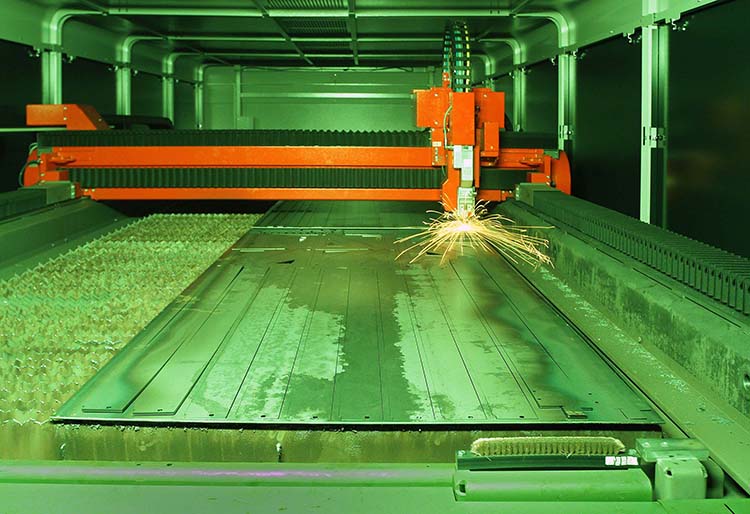
Alpha Manufacturing, one of the UK’s largest precision sheet metal fabricators, has ordered a TruPunch 5000 CNC punching centre from Trumpf, which complements the acquisition last year of a Trumpf TruLaser 3030 CNC fibre laser profiling centre, and helps keep the company on track to achieve its ‘2020 Vision’ – a five-year plan to double turnover by 2020.
Last year, Alpha installed a STOPA automated materials handling and storage system, to which the company linked its new Trumpf TruLaser 3030. In the coming 18-months, the company intends to extend the STOPA by 5-10 bays, when it will be possible to fully integrate the TruPunch 5000.
“The TruPunch 5000 replaces an automated machine from another supplier and gives us far greater capacity – I estimate that it is 100% quicker,” says operations director Paul Clews.
Trumpf‘s TruPunch 5000 features backlash-free drives for high axis acceleration, while the high rotational speed of the C axis enables fast tapping, as well as the productive processing of complex contours. Thanks to the hydraulic drive it is possible to punch at up to 1600 strokes per minute and mark parts at 2800 strokes per minute.
“This investment is a clear indication of the direction in which the company will be heading in the coming years,” concludes Clews. “In fact, we have taken on three really big customers in the past few months, bringing orders that represent around £3 million per annum. Together with the greater efficiency and capacity afforded by our new Trumpf machines, we remain on track to double turnover by 2020.”
For further information www.uk.trumpf.com
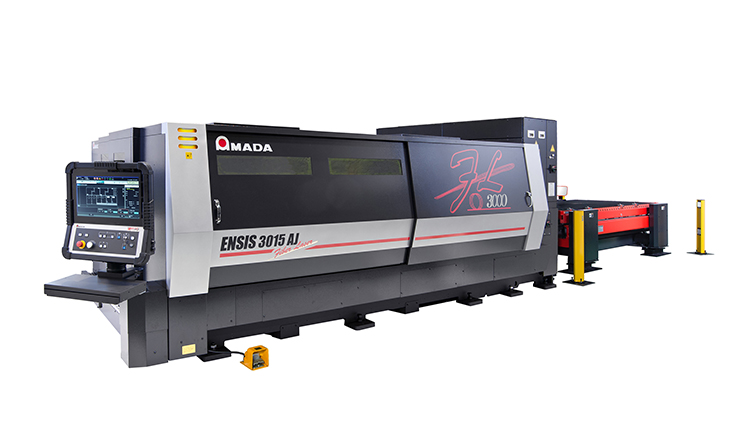
Amada UK sells first 3 kW ENSIS

Amada has launched the ENSIS-3015 AJ fibre CNC laser cutting machine featuring a 3 kW source, already selling two into the UK market. The first has been bought by Bristol-based LW Jenkins Ltd, a specialist in fine-detail sheet metal solutions for the electronics industry.

At 3 kW, the machine offers the industry’s largest single-diode module size. Unlike other machines, there is no diode module beam combiner, thus improving reliability and increasing machine uptime.
Aside from the large, single-diode module, there are many more advancements in the 3 kW ENSIS. Firstly, Amada’s patented ENSIS technology is capable of changing the laser beam mode, not just the focal spot size and focus position. This results in the optimum beam control for both thin and thick sheet processing. The machine also offers single-lens processing for all materials and thicknesses, and features a large-capacity nozzle changer to cover the full range automatically.
Importantly, the machine is capable of cutting up to 25 mm thick mild steel, which is equivalent to the performance levels of a standard 6 kW fibre laser, but uses just half the power to do the same job. With energy prices proving a major overhead for profiling and fabrication shops, this presents the opportunity to make significant savings.
Among further new features is a development of ENSIS technology that provides a high-speed pierce in 20 mm mild steel, and faster cutting than a 4 kW fibre laser. This performance is achieved by instantaneously changing the beam mode between pierce and cut. For piercing materials at the thicker end of the material spectrum, oil-shot functionality is available for added reliability.
For further information www.amada.co.uk

Prima Power unveils latest innovations

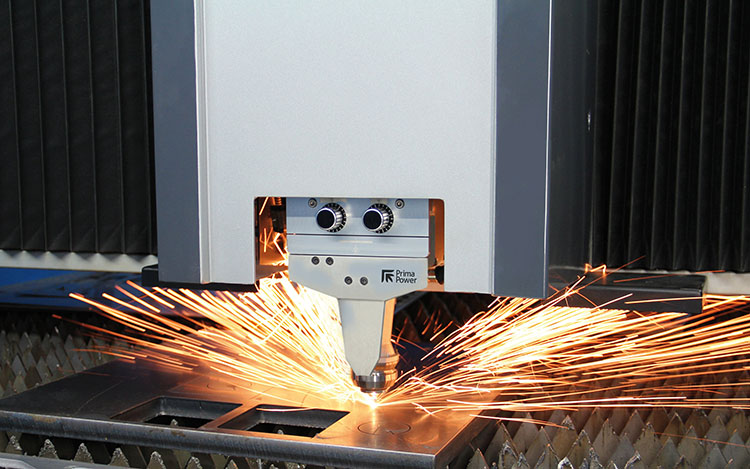
Many new technologies and solutions by Prima Power had their world premiere at Blechexpo in Stuttgart last week. For instance, the top-of-the-range Laser Genius 1530 laser cutter with a Combo Tower Laser automation system was showcased for the first time with a 10 kW fibre laser source by IPG Photonics, which further boosts its performance, especially on thicker materials.

This product configuration is particularly suited to market sectors where heavier gauges are commonly used, such as agriculture and construction. Thanks to its laser head with adaptive optics for the automatic management of the focal position, Laser Genius is said to provide high quality and maximum speed without compromise on the whole thickness range for a wide variety of materials, including mild steel, stainless steel, aluminium, copper and brass.
Novel machine architecture based on a synthetic granite frame and carbon-fibre cantilever structure, along with linear drives, are some of its other key technical features. Laser Genius is managed by the user-friendly Prima Power Open CNC, while the HMI framework is the new Prima Power Tulus Laser 2D, a logical, modern interface that applies the existing Tulus platform and its ecosystem to 2D laser cutting machines.
At Blechexpo, the machine was equipped with a Combo Tower Laser flexible storage system featuring integrated loading and unloading features. The Combo Tower Laser has been developed and manufactured by Prima Power specifically for 2D laser machines.
For further information www.primapower.com

Integrated laser cutting from Citizen

Citizen Machinery’s fully integrated laser processing into the turn-milling cycle of its Cincom CNC sliding head lathes enables near endless possibilities for the creation of geometric shapes or precision holes into solid bar material which has been pre-drilled within the same production cycle or directly into tubular bar material.

The development opens the metal cutting process to producing burr-free holes as small as 0.2 mm diameter, produce features such as spiral cuts with 0.025 mm kerf width and maintain consistent and accurate radii less than 0.1 mm in corners of slots without any risk of tool wear or breakage. These can also be produced at a far faster rate than can be achieved by a separate EDM process, for instance.
Citizen’s breakthrough opens new design concepts in sectors such as medical, electronic and micro-machining. In a recent trial, a 150 W continuous laser head with an air purge to seal and clear the lens was mounted in the gang tool slide of the latest Citizen Cincom L20-Vlll machine in order to be incorporated into the cutting cycle to produce a complete workpiece from tubular material in a single cycle.
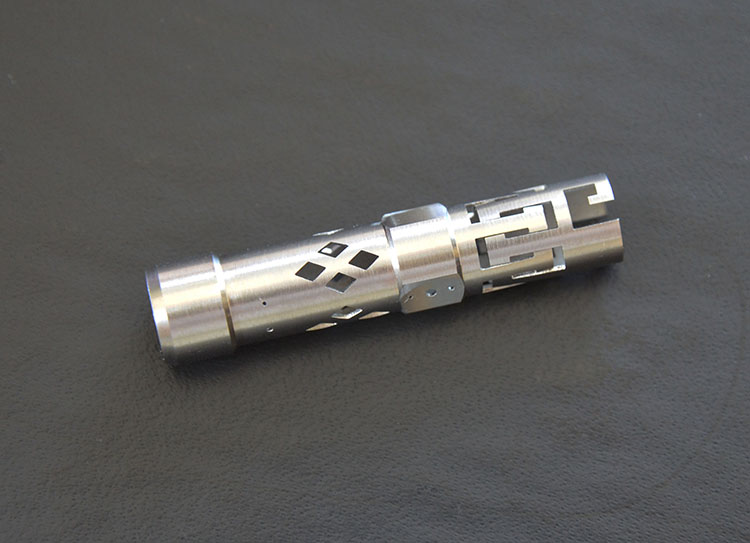
The workpiece, produced from 18 mm diameter tube with a 16 mm bore was turned, faced and had a single flat milled on the outside diameter. The laser beam then proceeded along and around the periphery using C-axis rotation to create a series of rectangular shaped features that were interlocked allowing the component to extend and retract.
A series of cuts were made to form a mesh and the Citizen logo profiled around the circumference.
For further information www.citizenmachinery.co.uk

Trailer manufacturer picks up productivity

At the Bolton factory of trailer manufacturer Indespension, sheet metal cutting productivity has doubled following the replacement of a CO2 laser-powered machine with a fibre laser profiling centre costing nearly £800,000.

The Bystronic ByStar Fiber 6520 has a 4 kW fibre laser and a 6.5 x 2 m capacity bed, making it the largest fibre machine to date delivered by this supplier into the UK market. Only around a dozen machines of this size have been sold worldwide.
Steve Sadler, Indespension’s purchasing director, says: “We cut mainly 43A and pre-galv mild steel, plus some aluminium, from 1 to 12 mm thick. Up to 3 mm, the fibre laser cuts three times faster than CO2. It flies through 1 mm steel, producing 10 holes per second.
The advantage tails off as the thickness increases, but overall the ByStar is twice as fast across all the gauges we process. At a stroke, it has eliminated the bottleneck in our factory that was being caused by the CO2 machine not being able to keep up with our increasing laser cutting workload.”
The fibre laser was purchased in part-exchange for a 6 x 2.5 m capacity CO2 model supplied by Bystronic to Indespension in 2009. Sadler confirmed that a good price was realised for the old machine, despite it having worked up to 20 hours a day, highlighting value retention as an advantage of buying equipment from this Swiss manufacturer.
“Now we can produce the parts in-house in a matter of days, reducing the lead-time for a new trailer from typically six or seven months to less than five, or for a modified trailer from three or four months to less than two,” he says.
For further information www.bystronic.co.uk