

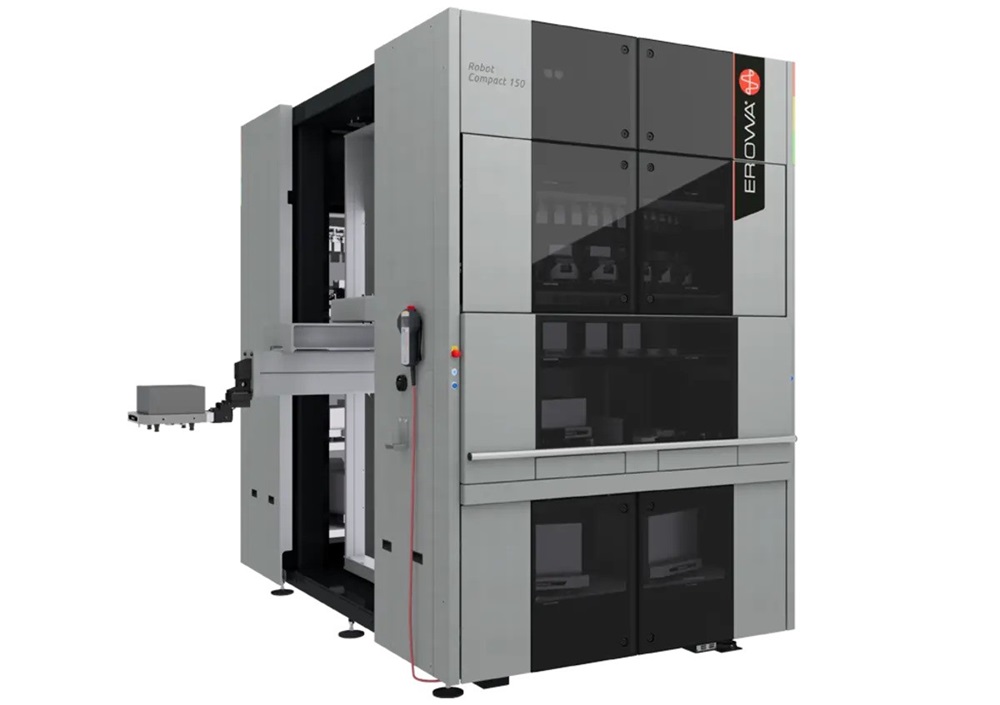
Erowa introduces Robot Compact 150

The new Erowa Robot Compact 150 features a wide range of functions and a transfer weight of up to 150 kg. This new automation solution is suitable for the flexible loading of up to two production machines for all processing technologies – from eroding to milling. Thanks to its design, the loader offers high magazine density within a small footprint. 

An autonomous and flexible production cell, the Erowa Robot Compact 150 loads a die-sinking EDM machine with little space requirement. The two independent drives of the X axis enable long reach and minimal interfering contour to the machine.

It is even possible to load large Erowa MTS 400 pallets with a transfer weight of up to 150 kg and a workpiece height up to 400 mm on to the EDM machine. Over 500 Erowa pallets with different system sizes can be stored in the magazines, with magazine levels set up exactly as required.

An optional loading station can be integrated to save space. It enables large and heavy workpieces (UPC and MTS pallets) to be set up at an ergonomic height while the robot is working. An indexing system (4 x 90°) prevents the pallet from engaging in the wrong position and locks it automatically upon engagement.

Notably, the Erowa EWIS chip identification system (option) is based on RFID technology. It enables the unique identification of pallets and electrode holders fitted with EWIS chips in the robot magazine.

Regarding process control, the Erowa JMS 4.0 connects all data and oversees the entire production process. Due to the automated data flow and real-time monitoring of production processes, JMS 4.0 provides the basis for a seamless workflow, reports the company.

More information www.erowa.com

University’s challenge accepted by ETG

Over its 150-year history, the School of Engineering at Newcastle University can lay claim to being the birthplace of great ideas that changed the world. It is this propensity to push the boundaries of innovation that has recently seen the university invest in a Mitsubishi wire EDM machine from the Engineering Technology Group (ETG). 

Newcastle University recently invested more than £110m to re-develop its Stephenson building, aptly named after engineering pioneer George Stephenson, the renowned ‘father of the railways’. Part of the investment includes new plant and equipment to support students, academic researchers and industrial partner projects.

The university’s technical team leader for manufacturing, Stuart Baker, says: “By investing in a new EDM machine we could keep as much of our work as possible on-site to increase the student experience. Having the technology on-site also enables us to demonstrate the EDM process in considerable depth.”

He continues: “The Mitsubishi MV1200S scored the highest above other applicants on our tendering process, particularly as our new workshop in the new Stephenson Building is very sustainability-focused. Mitsubishi’s MV1200S has a wealth of energy efficiency measures that tie in with our ambition to be a carbon-neutral facility by 2030. One such innovation that caught our eye and scored highly above other vendors was the Mitsubishi E.KO Ioniser system, which is environmentally efficient compared to standard ion resin systems.”

Mitsubishi says its E.KO ioniser system offers the world’s most innovative and ecologically optimal technology for the production of deionised process water used in wire EDM. The E.KO Ioniser completely replaces the mixed bed resin and is therefore one of the most environmentally friendly solutions in the field of process water treatment. 

More information www.engtechgroup.com

Micro-Precision Tool Capability at Brandauer

A new micron-precision tooling capability is now in place at Brandauer. CEO of the 61-
employee business, Rowan Crozier MBE, says: “Our micron precision tooling offer has been
a real labour of love. However, we now have processes available that de-risk the modular
tooling route for customers, giving them the capability to produce their tools to the finest of
margins and at a cost price that works.”
He adds: “Days have also been taken out of production lead times and I’m delighted to say
that numerous customers – from several different sectors – have already signed up and are
using tools made in this way.”
Last year was a whirlwind period for Brandauer, with more than £4m invested in new high-
speed Bruderer UK and Yamada presses, an additional 1-micron capable wire EDM machine,
a state-of the-art laser micro-cutter and a new rapid prototyping area.
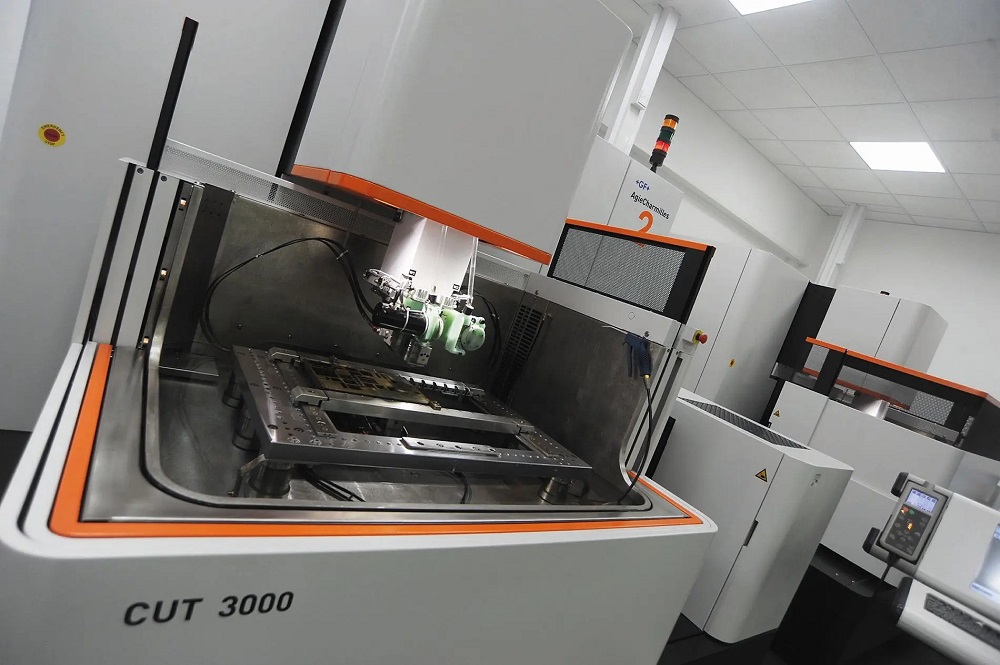
The technology utilised in the company’s wire EDM cell includes two AgieCharmilles GF CUT
3000 machines, an investment that is typical of the firm’s constant drive for precision. These
machines are 1 micron capable across their long-bed CNC table geometry, making high-
speed, high-precision, 1250 mm modular tools a reality.

Through its wire EDM technology, Brandauer meet the challenges of miniaturisation and
high precision, while maximising productivity. The company can machine with wires as small
as 0.05 mm in diameter and, thanks to the crossed table situated directly under the
workpiece that requires machining, high-precision guides and glass scales are situated as
close as possible to the machining zone. This configuration helps maximise precision and
positioning repeatability as the play in inversion is almost eliminated.
More information www.brandauer.co.uk

Anotronic Installs Sodick ALC600G Premium

Anotronic is a subcontract machining business and manufacturer of EDM fast-hole drilling
and EDM die-sinking machine tools. Founded in 1982, the business started in ECM, ECD and
EDM tooling and machining, evolving to the production and growth of its own ECM and ECD
technology brand. Along this journey, the company has worked with Sodi-Tech UK and the
Sodick brand of machines. The Bedfordshire-based manufacturer currently operates three
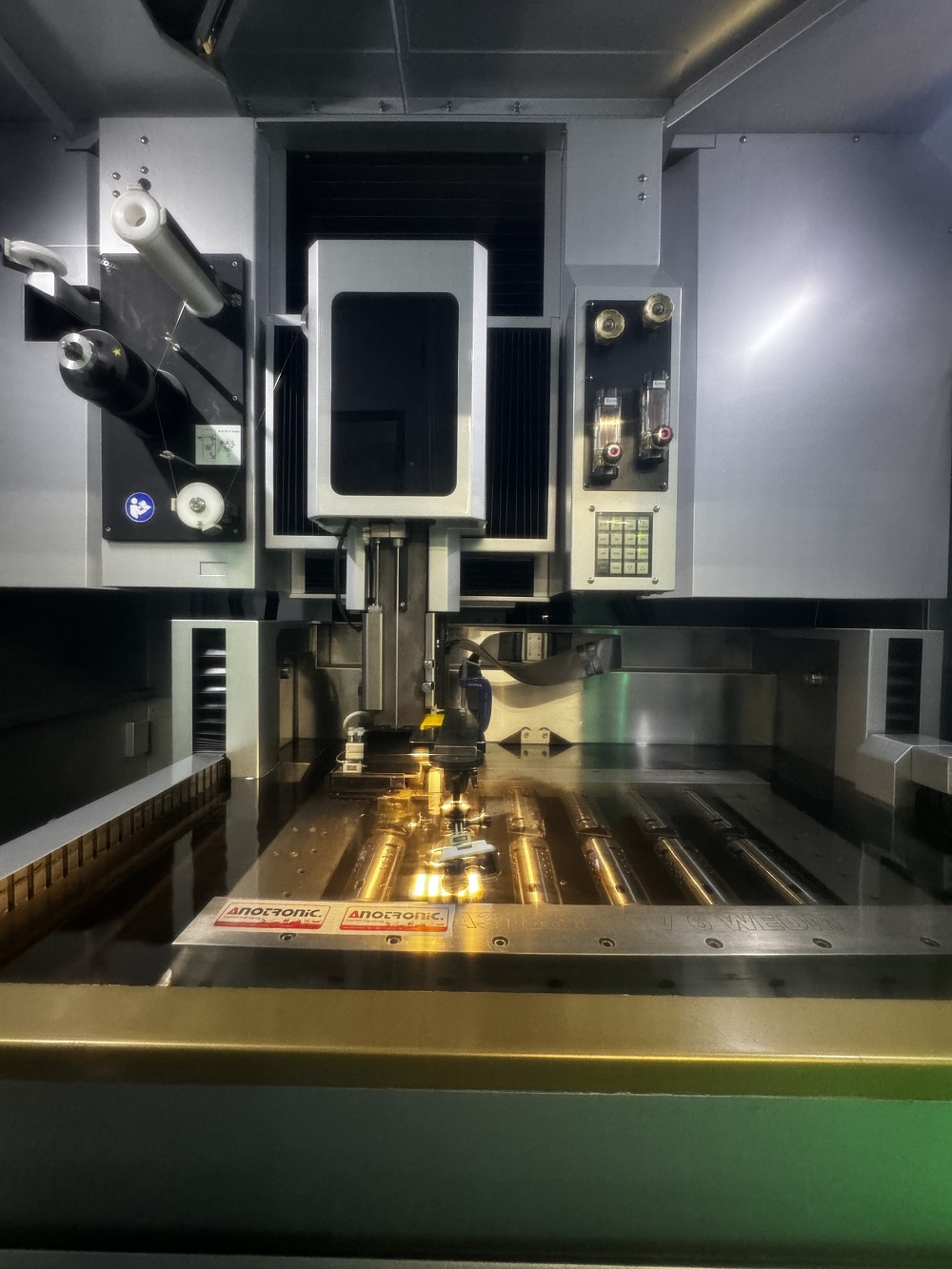
Sodick machines, with the latest ALC600G Premium wire EDM with linear motor drive
technology arriving recently.
 
Martin White, managing director of Anotronic, says: “We always buy premium machines
and, as the company has become more experienced, we constantly look to invest in better
technology. This always comes down to machine reliability and the ability to run
unmanned.”
He continues: “We bought this latest machine because we had a project that typically
consists of 40 parts which would maybe take us three months to complete. We suddenly
had an order placed on us last year for 300 components. We couldn’t have done this
without another machine, as we knew we would have to operate 24 hours a day to get the
parts done.”
 
Sodi-Tech UK sales manager Richard Bailey says: “Manufacturers can use the on-board
technology and IQ software system that brings the CAD model into the machine and
draws the profile on-board utilising the U- and V-axis cutting technology. The program is
generated, parts are machined and the job is complete.”

 
White adds: “We’re using a very complex four-axis program to cut a rotary part with 45°
slots in it. We used the on-board software within the CNC of the Sodick machine to create a
3D model and a tool path to cut the part.”
More information www.sodi-tech.co.uk

Sarix unveils SX30-pm micro-EDM hole drill

Sarix says that the release of its new SX30-pm micro-EDM hole drill allows customers to boost productivity at an affordable price. Designed to push the boundaries of what is possible, the SX30-pm combines high micro-drilling speed with extreme accuracy.

Imagine producing zero-deviation, precision, wire-cut free holes in a fraction of existing cycle times, whether working with tough aerospace-grade materials, medical devices or complex watch components. Sarix says that the SX30-pm’s advanced technology ensures superior results, helping users to increase throughput, reduce downtime and stay ahead of the competition.

Offering high-speed micro drilling, the SX30-pm is suitable for jobs ranging from 3.0 mm down to 100 µm. The machine delivers a high depth aspect ratio for extreme deep-hole drilling. It has travel of 300 x 300 x 400 x 400 in the X, Y, Z and W axis respectively, supported by a positioning precision of 0.01 mm (resolution 0.1 µm). An option is available offering positioning position of ±0.003 mm. The machine features automatic axis co-ordinate positioning and depth control.

The new SX-HMI interface streamlines programming and editing tasks with intuitive operating apps. Furthermore, the SX-Pulsar generator employs the latest Sarix ‘Micro-Pulse Shape’ EDM technologies for faster, deeper and more precise holes than conventional machines, reports the company.

Additional features include an automatic electrode re-feeding spindle and continuous production with the high-pressure flushing of dielectric oil or deionised water. An optional SX-MDH micro deep-hole drilling device is available for producing 0.10 mm deep holes in 15 mm carbide (Sarix patented).

More information www.sarix.com