When Steve Knowles founded Newport CNC over 10 years ago, like many start-ups he bought his first machine and worked evenings and weekends in his new venture while retaining a day job. Knowles’ first port of call was to buy a Haas VF4SS machining centre and use cutting tools from Industrial Tooling Corporation (ITC).

Building its early success in the high-end automotive and aftermarket industries, Newport CNC is now entering its 11th year of business, which has been celebrated with several investments. Before the COVID-19 pandemic, the company had planned to move into a new factory and purchase its fifth Haas machine, a ST20Y turning centre. The lockdown created several obstacles, but the five-employee business has now moved into its new 4700 sq ft facility and installed its Haas turning centre.
Commenting upon the challenge, Knowles says: “Our new facility is three times the size of the previous site, and the Haas machine is the first turning centre we’ve installed. Despite the challenges of the pandemic, we’re confident that our new machine and new facility are a bedrock for us to build an even stronger business in the future.”
One of the bedrocks of the company from day one has been cutting tools from ITC and, alluding to this, Knowles says: “I’ve used ITC cutting tools for over 20 years and they’ve never let me down. More than 80% of our work is aluminium machining and ITC’s solid-carbide cutters for this material are beyond compare. I’ve had sales reps from virtually every tooling company trialling tools down the years and none of them can match the tool life, productivity, surface finishes or overall performance of the ITC range for aluminium. Over 80% of our cutting tools are now supplied by ITC and we have little interest in wasting time trialling alternate tools; time has proven that we’re already using the best tools available for our business.”
The Milton Keynes company typifies subcontract manufacturing by serving the aerospace, electronics, medical, motorsport and automotive sectors, manufacturing everything from commercial airline seats and high-end bespoke automotive work, through to participating in the recent Ventilator Challenge. Offering three, four and five-axis machining, as well as Y-axis turning capability, Newport CNC is well equipped to meet industry’s demands. With 75% of the company’s work revolving around aluminium machining and the remaining 25% being a mixture of titanium alloys, plastics and stainless steel, ITC has been instrumental in the tooling strategies adopted by Newport CNC.

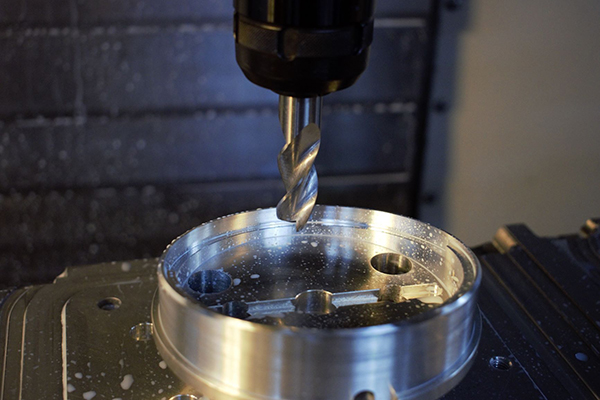
For a number of years, the ITC 3081 solid-carbide end mill for aluminium has been the go-to cutter.
“We started with several ITC solid-carbide end mills, but found our sweet spot with the 3081 series for high-feed machining – it has been a revelation,” says Knowles. “The metal removal rates are beyond compare and the surface finishes are outstanding. We’re using these end mills for everything from high removal roughing through to pocketing, profiling and finishing.”
With such a glowing reference for the 3081 series, Newport CNC now uses the range with diameters that include 3, 5, 6, 10, 12, 16 and 20 mm, with a selection of square-end and corner radii from 0.5 to 3 mm.
As the company has evolved, so has its reliance on the range of products from ITC. The company has subsequently adopted the Britcut series of two and four-flute end mills in diameters of 4, 6, and 10 mm. With centre cutting, facet relief and a 30° helix, Newport CNC has selected the TiAlN-coated option for machining various materials. The success of both the 3081 and Britcut range has since paved the way for the introduction of the 3152 three-flute, short-length AlTiN-coated end mills, the 2112 and 2012 series ball-nose end mills for profiling, and the 4071 series of chamfer tools.
ITC has been a longstanding distributor of Widia solid-carbide end mills, so when it widened its scope by adding Widia indexable tools, Newport CNC trialled the Widia VSM11 high-feed 40 mm diameter face mill. Comparing the Widia VSM11 against an industry-leading manufacturer, the VSM11 outperformed the competitor with a tool life improvement of 30% and a productivity increase of 40%, all while reducing the cost-per-insert against the previous tool. The business has since added the VSM11 80 mm diameter face mill to its inventory list.
As a relatively small subcontract machine shop that serves a multitude of sectors, Newport CNC can never second guess what type of work will be coming through the door next.

“We have a standardised tooling strategy on each of our machining centres,” explains Knowles. “Each machine has a 24-tool capacity and the first 10 positions are standardised across all of them. The first two tools are the 80 and 40 mm Widia VSM11 face mills. We can change the inserts from the XDCT aluminium grade, and geometry to the XDPT steel insert designation, in a matter of minutes. This prepares us for rough machining and facing every job that comes through the door, regardless of whether its aluminium, steel, stainless or heat-resistant alloys. It also keeps our inventory and costs to a manageable level.
“Positions three through to 10 are ITC solid-carbide end mills,” he adds. “Once again, the 3081 series plays a prominent role with a 16 mm diameter end mill featuring a 1 mm radius slotting into position three. Tool positions four, five and six also house 3081 series end mills, in diameters reducing from 10 to 3 mm. These first six positions give us complete flexibility for everything from high-feed roughing and facing, down to slotting and finish-machining operations.
“In our other prominent tooling positions, we have 3 and 6 mm ball-nose tools that support all our needs when it comes to intricate machining, profiling and finishing of precision features. Beyond these positions, we have a spot drill, chamfer tool and a couple of standard tap sizes, which leaves many carousel positions free. We can rapidly fill these positions if new jobs with challenging features or material types arrive. This strategy allows us to standardise our tool positions and overhang lengths, while giving staff familiarity with the system.”
For further information www.itc-ltd.co.uk