When refining castings and improving performance characteristics, shot blasting remains
one of the most important surface treatment technologies. Rösler’s broad equipment and
blast turbine portfolio, supported by a comprehensive service package, is designed to help
foundries meet growing demands for product quality, productivity, cost-efficiency and
sustainability. Today, advanced shot blasting methods are just as important as innovative
casting processes.
Castings play a vital role across almost every industrial sector, from equipment
manufacturing to household appliances. Regardless of size, weight or complexity, cast
components produced by different casting methods share one common requirement:
effective shot blasting. The process is essential for deburring, surface cleaning,
homogenisation and shot peening, helping to optimise both surface quality and mechanical
properties.
As cost pressures continue to rise, foundries need shot-blasting systems that make
processes faster, more flexible, more productive and more economical. At the same time,
shortages of skilled labour and increasing quality demands are driving greater levels of
automation, not only in workpiece handling but also in the blasting process itself.
Rösler addresses these challenges with a wide portfolio of machines for efficient batch and
single-piece processing, supported by automation concepts tailored to individual customer
requirements. Digital tools developed by Rösler also enable continuous monitoring of the
entire shot blasting process, helping users improve consistency and reduce downtime.
Complex components with difficult-to-reach internal contours and surfaces require
specialist equipment. For these applications, systems such as the Roboblaster, crankshaft
blasting machines and manipulator-based systems for engine blocks provide effective
solutions.
Each machine is designed specifically for the customer’s application. During project
development, advanced simulation software is used to optimise performance, ensuring
maximum productivity, minimal wear and efficient use of resources, reports Rösler. One
example is a fully automated deburring and surface homogenisation system developed for a
major German iron foundry producing engine blocks for utility vehicles using an innovative
casting process.
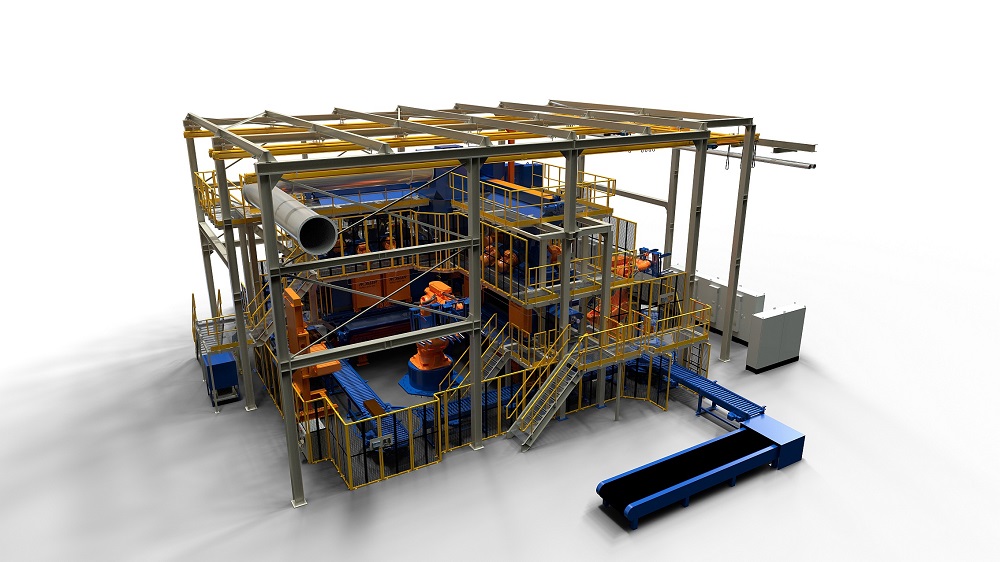
The key requirement for the RMBS engine block blasting system was the ability to process
workpieces weighing up to 700 kg while maintaining a total cycle time of just 50 seconds,
including only 20 seconds of actual blasting time. This task demanded extremely high blast
intensity combined with rapid robotic handling. High wear resistance was also essential to
maximise uptime and minimise maintenance.
To meet these demands, Rösler developed a blast chamber constructed from 8 mm thick
manganese steel and lined with replaceable wear plates. In a novel approach, the chamber
floor is filled with wear-resistant steel balls. These prevent steel flashes from entering the
media recycling system while also improving wear resistance by deflecting blast media more
effectively than a flat surface.
The system uses six direct-drive blast turbines, each with an installed power of 45 kW. While
turbines above 37 kW are typically indirect-drive units, these require more space and offer
slightly lower efficiency. Direct-drive turbines were therefore selected for better
performance and lower energy consumption.
As the process uses coarse blast media with grain sizes up to 1.6 mm, Rösler chose its
Evolution turbines, equipped with reinforced bearings and more powerful motors. Mounted
on the roof of the blast chamber using a specially designed support structure, each turbine
contains eight straight throwing blades capable of delivering up to 500 kg of blast media
every 60 seconds.
Handling the heavy engine blocks also required a specialist robotic solution. A manipulator
capable of carrying up to 700 kg had to rotate the workpieces in front of the machine and
tilt them through 360 degrees to remove trapped blast media after processing. For this, the
robot uses a lightweight gripping system that safely handles different engine block designs.
At the centre of the system is a specially developed manipulator-gripper with two jaws,
allowing either one large engine block or several smaller parts to be processed
simultaneously. A dedicated transport system moves raw castings directly from the foundry
to an alignment station, where they are positioned for robotic pick-up.
The robot transfers the workpieces to the manipulator inside the blast chamber, where they
are rotated during the 20-second blast cycle for full exposure to the blast stream. Once
blasting is complete, the robot removes, tilts and places them on to a transport system for
transfer to the next manufacturing stage.
For delicate parts prone to scratching or impact damage, Rösler offers spinner hanger and
wire mesh belt blast machines. These systems can be configured to suit specific throughput
requirements, turbine arrangements and wear protection needs.
Spinner-hanger machines are particularly versatile and compact, making them suitable for
delicate components that must not tumble against each other, as well as large or heavy
parts with complex shapes. Workpieces are either processed in batches or mounted
individually on carriers. Inside the blast chamber, the carrier rotates and oscillates at a
speed matched to the component geometry, ensuring consistent and repeatable blasting
across all surfaces.
Wire mesh belt blast machines are suitable for long, flat or larger components requiring
reliable all-round treatment. A durable wire mesh belt transports parts through the machine
while strategically positioned turbines ensure complete surface coverage. As the lower
turbines blast through only one belt layer, shadowing – known as the ‘cover effect’ – is
minimised, ensuring more uniform results.
A manufacturer of cast manhole covers and clutch pressure plates weighing up to 270 kg
needed to significantly increase shot blasting capacity. Rösler supplied an RDGE 1250-8-30-F
continuous wire mesh belt blast machine designed specifically for the application.
The main challenges were safe and rapid transport of heavy workpieces, consistent blast
quality, prevention of wire mesh belt damage and minimal machine wear. To ensure reliable
belt alignment, Rösler developed a special drive roller that prevents slippage under high
loads. Higher-capacity drive rollers, a more powerful belt drive and reinforced support
rollers allow the workpieces to move safely through the machine at speeds of up to 2
m/min.
An automatic belt tensioning system, replacing the usual manual adjustment, ensures
consistent belt tension and allows operators to make adjustments directly from the machine
control panel.
As the parts pass through the machine quickly, achieving sufficient blast intensity was
critical. Traditionally, turbines are positioned opposite each other, but this increases wear as
they blast directly against one another. Using digital blast process simulation, Rösler
redesigned the machine housing and roof angles, enabling a new turbine arrangement that
maintained blast quality while reducing wear.
The machine uses eight Evolution turbines, each rated at 37 kW. Four are mounted on the
roof and four below the first belt layer. The layout also had to accommodate tight
installation space at the customer’s site.
Turbines are critical to shot-blasting performance. They consume significant amounts of
energy and consumables while also requiring regular maintenance. Selecting the right
turbine has a major impact on productivity, operating costs and sustainability.
Rösler offers several turbine ranges designed to balance performance, efficiency and
uptime.
The Gamma range uses Y-shaped throwing blades with precisely calculated curvature to
achieve high throwing speeds and focused media acceleration. Compared with conventional
turbines, Gamma units can reduce energy consumption by up to 15% while maintaining
similar blasting performance.
The blades are reversible, allowing the use of both sides, and can be replaced quickly by
opening the turbine lid. Depending on the blast media used, blade life can be up to three
times longer. For foundry environments, Gamma turbines can be equipped with eight
blades and tool steel housing linings for improved durability.
Rutten turbines also use curved throwing blades for precise, energy-efficient media
acceleration. Manufactured from hard metal alloys, they offer significantly higher wear
resistance, delivering 10 to 16 times longer service life than traditional turbine designs.
For coarse blast media and high throughput applications, the Evolution turbine range offers
high performance. Its straight throwing blades and twin-disk turbine wheel create a focused
hot spot, ensuring efficient blasting even under demanding conditions.
With a combination of advanced equipment, specialist turbine technology and custom-
engineered automation solutions, Rösler says it enables foundries to increase throughput,
improve cost and resource efficiency, reduce maintenance costs and maximise equipment
availability. As casting technologies continue to evolve, modern shot-blasting systems
remain essential for ensuring both product quality and competitive manufacturing
performance.
More information www.rosler.com