Mills CNC, the exclusive distributor of Doosan machine tools in the UK and Ireland, has recently supplied two new high-performance machines to the recently launched Advancing Manufacturing Centre (AMC) – a research, design and manufacturing ‘hub’ based within West Highland College UHI’s Ocean Frontier facility in Fort William.
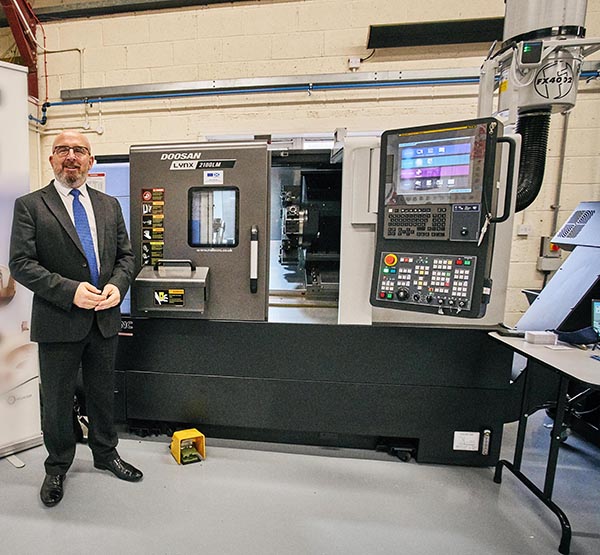
The machines, a Lynx 2100LMB multi-tasking lathe and a DEM 4000 vertical machining centre, were installed at the AMC in September and October 2021 respectively, in good time for the facility’s official opening on 15 November. The machines form part of an impressive array of advanced manufacturing technologies and equipment that the AMC now has at its disposal.
The AMC is part of the national ‘Advancing Manufacturing Challenge Fund’ (AMCF), an economic growth and regeneration partnership between the Scottish Government, Scottish Enterprise, and Highlands and Islands Enterprise, and is also part funded by the 2014-2020 European Structural & Investment Fund.
A principal aim of AMCF-funded projects is that they have a direct and measurable impact on increasing the manufacturing capacities, capabilities and competitiveness of SMEs within Scotland, and of becoming recognised agents of change and best-practice: transforming, exponentially where possible, national and regional skill and productivity levels.
To achieve these aims, the AMC, through its £1.6m funding, will help stimulate and improve the performance of SMEs by providing them with direct access to advanced manufacturing technologies and expertise – at zero cost to their businesses.
Says Margaret Weir, AMC’s project manager: “Providing existing and new companies with a risk-free ‘sandpit environment’ where they are able to fully explore and understand specific manufacturing issues and challenges, and be able to then design and develop innovative solutions using freely available advanced manufacturing technologies at the AMC, is a real business benefit.”

It is also anticipated that the centre, through its successes, will be instrumental in helping to promote STEM subjects and careers within schools and colleges resulting, over time, in the establishment of a skilled STEM workforce aligned with local and regional business needs.
The two new Doosan machines supplied to the AMC share pride of place with a range of advanced manufacturing technologies and equipment that include: CNC machine tools; additive manufacturing, 3D printing and laser-scanning equipment; automation and robotic systems; and advanced CADCAM software. Also in situ are Festo Didactic ‘smart factory and Industry 4.0’ integrated hardware and software training systems and solutions focused on wind and solar power generation, building automation systems, mechatronics, hydraulics and pneumatics, machine maintenance, electric car charging stations, and electric drives and industrial controls.
Explains David Campbell, STEM project director: “The emphasis and focus of our project are on meeting the needs of SMEs in the West Highlands of Scotland; helping them become more competitive through embracing, utilising and exploiting the latest manufacturing, automation and smart digital technologies.”
The technologies and equipment acquired have a broad scope and are intended to attract as many SMEs to the AMC as possible. As a point of note, the equipment and technology at the facility were acquired via a rigorous tender process, with Mills CNC being one of a number of machine tool manufacturers/suppliers invited to submit tenders for supplying a CNC lathe and machining centre.
Mills CNC says it is regarded and respected, not just for the machine tools it sells, but for the range of aftersales services it provides to customers. Every year, hundreds of large and small UK and Irish component manufacturers (OEMs and tier-one suppliers through to precision subcontractors), as well as universities, colleges and research centres, invest in Doosan machine tools from Mills CNC.

Among the best-selling models in Mills’ machine-tool portfolio are Lynx 2100 series lathes and compact Doosan vertical machining centres like the DNM range of machines.
The Lynx 2100LMB is an 8-inch chuck multi-tasking lathe equipped with a 15 kW/4500 rpm spindle, driven tooling capabilities (3.7 kW/6000 rpm), a tailstock (to machine longer parts), and the Doosan Fanuc 0iTF control with 15” iHMI touchscreen. Notably, the lathe has a maximum turning diameter of 310 mm and turning length of 510 mm, and was also supplied to the AMC with a CNC bar puller, enabling it to machine components in larger batches from bar stock.
Says John Morning, Mills CNC business manager for Scotland: “The Lynx 2100LMB is a compact turning centre equipped with many advanced features that enable it to machine complex, high-precision parts in one hit.”
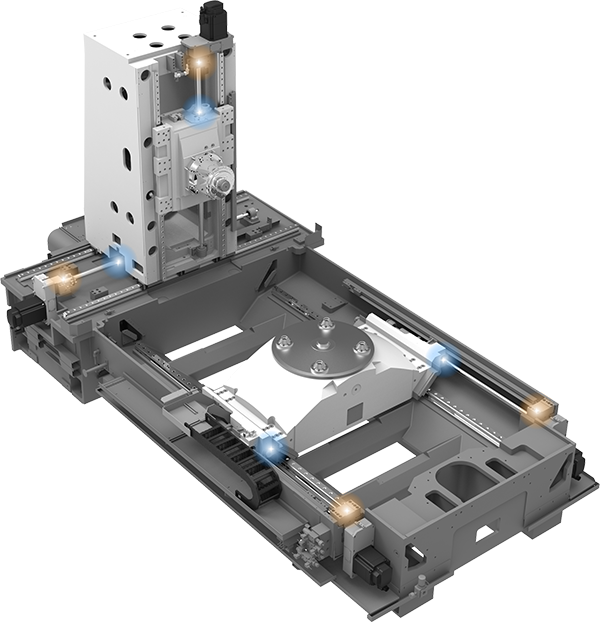
The DEM 4000 is a compact, fast and versatile three-axis machining centre equipped with a 5.5 kW/8000 rpm spindle, a 20-station ATC and the latest Fanuc 0iMF control. Furthermore, the machine features a 650 x 400 mm worktable with 400 kg maximum table load and boasts 24 m/min rapids on its three axes.
“The DEM 4000 is ideal if you are looking for a small, compact machining centre but don’t want to compromise on speed or power,” says Morning.
The AMC is an essential and integral component in helping Scotland grow and diversify its manufacturing base, and create a highly-skilled workforce to fill well-paid and sustainable jobs in the future.
By providing SMEs with a range of services (including training) and access to advanced manufacturing technologies and equipment at zero cost to their businesses, the AMC is tackling issues and perceived weaknesses in Scotland’s manufacturing base and sector supply chains exposed recently by the Covid-19 crisis.
Concludes Morning: “We are delighted to have been involved with the AMC at the outset and to have installed two of our best-selling machine tool models at the facility.”
For further information
www.millscnc.co.uk