Efficient and effective tool and insert processing

The United Grinding stand at the EMO exhibition in Hanover last month featured a host of Walter machines and technologies for effective and efficient tool and insert grinding/erosion. In particular, parent group United Grinding’s CORE (Customer Oriented REvolution) hardware/software architecture and Walter’s Laser Contour Check non-contact tool measurement development, shared centre stage.

CORE architecture embraces the digital age by offering intuitive operation that facilitates machine set-up, operation, networking and maintenance. Underpinning this ethos is ‘work simplification in production’ topave the way for a new generation of machine tools which fully embrace the digital age.

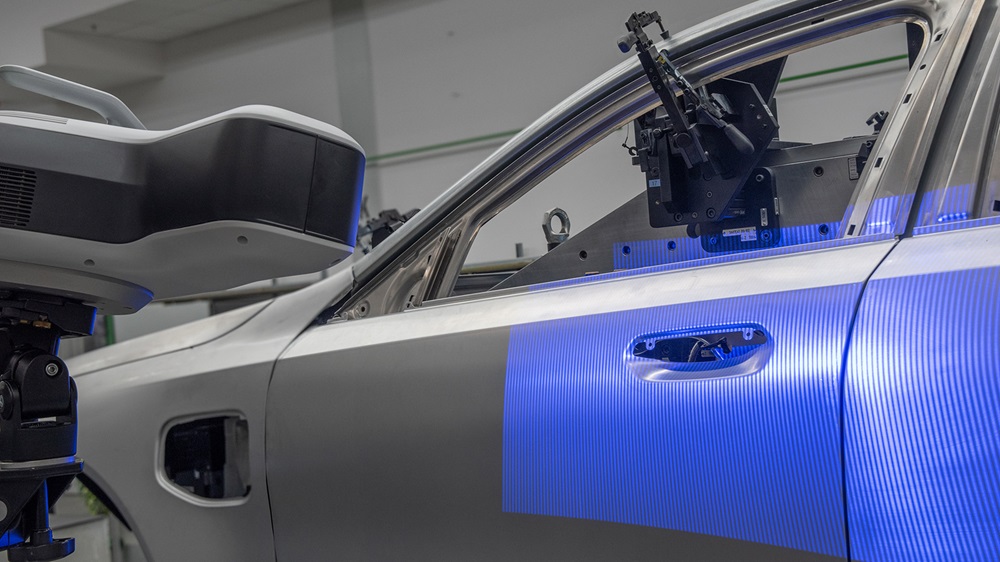
Laser Contour Check is now optional on all Walter Helitronic tool grinding and erosion machines. This featureensures high precision and fast in-process measurement of tool parameters using blue laser technology in conjunction with process intelligence to measure various features on cylindrical tools from 1 to 52 mm diameter. Compensation for any deviations takes place during the machining process.

Laser Contour Check’s analogue laser beam measures a tool’s entire contour rather than just specific points, as with tactile or digital methods. Laser technology also avoids possible damage to the tool’s cutting edges, as well as measuring errors that could occur due to probe tip wear during tactile measuring routines. It is possible to integrate the measuring system directly into the machine’s working area, so it moves into position when required.

At EMO, visitors saw both CORE and Laser Contour Check on Walter’s Helitronic Mini Plus and Helitronic Micro tool grinders.While the former produces tools of 1 to 16 mm diameter and up to 255 mm long, and re-grinds tools of 3 to 100 mm diameter, the latter processes tools from 0.1 to 12.7 mm diameter and 220 mm long.
For further information www.walter-machines.com/en

Premium solution for grinding large gears

The serial production of large gears requires a high level of quality, excellence and continuity in production. Particular emphasis is on maximising the synergy between the grinding machine, grinding process and grinding wheel. After several successful trials on various Klingelnberg Höfler Rapid series grinding machines carried out at various customer production facilities, Krebs & Riedel has received several significant orders for grinding large gears and introduced its new premium grinding wheels with high process reliability.

Krebs & Riedel is a major manufacturer of grinding wheels for gear grinding in the automotive and EV sector. Now, with its new Blue Moon TZ premium product range, the company is expanding into other sectors that require large gears, such as wind turbines.

“In some tests, the material removal rate (Q’w) was more than 30 mm³/mm,” says Sigurd De Ridder, senior application engineer at Krebs & Riedel, who conducts trials and process optimisation for customers worldwide. “Precision-shaped abrasive grains are state of the art today. Blue Moon TZ is self-sharpening, very sharp-edged, microcrystalline and has an elongated trapezoidal shape.”

According to Krebs & Riedel, the homogeneous pore structure of Blue Moon TZ contributes to an extreme improvement in the entire cooling system during grinding. Due to the open structure, coolant immediately floods the whole grinding wheel. Even with extreme material removal rate, the coolant transports chip away from the contact surface, avoiding heat input that could lead to thermal damage of the gear.

On average, tests on Klingelnberg Höfler Rapid 2500 machines showed the following grinding results: a cooler grind and a longer tool life, combined with up to 20% faster grinding time compared with standard grinding wheels. In dressing tests, the average result showed 20% longer dressing intervals and 30% less infeed.
For further information www.krebs-riedel.com

Renishaw expands team

Renishaw has appointed a new non-executive director. Last month, Professor Karen Holford CBE joined the board of directors of the FTSE 250 company, where she will contribute over 43 years of expertise in the engineering sector. Holford, who is chief executive and vice-chancellor at Cranfield University, will also join Renishaw’s audit, nomination and remuneration committees. As well as her extensive engineering, technical management and governance experience, she has previously helped to address a lack of diversity in organisations by challenging perceptions and working with underrepresented groups.
For further information www.renishaw.com

Studer introduces insertLoad universal loader

The new insertLoad automation solution from grinding machine manufacturer Studer supports the loading and unloading of Studer S33 and S31 universal cylindrical grinding machines, and can load workpieces between centres and into the chuck.

Where customised solutions were previously necessary, the new universal loading system from Studerenables standardised automation for loading and unloading its S33 and S31. Notably, insertLoad is suitable for centre distances of up to 1000 mm, thus closing a gap in standardised automation systems.

Workpieces can be up to 100 mm long and weigh 1.5 kgin alternating mode, or 5 kg in a single mode. The sophisticated design and ease-of-use (with the digital set-up wizard) allow users to configure individual jobs themselves (for centres and chucks).No programming knowledge is required. Furthermore, insertLoad can handle workpieces that are stored either vertically or horizontally.

The new Studer loader combines the advantages of a standardised system with high levels of flexibility. It handles a wide variety of parts in terms of geometry, weight and size; even the capacity of the drawers and degree of autonomy is adaptable based on requirements. A FANUC robot handles loading and unloading, moving independently on a linear axis between the loader and the machine’s work area. Typically, the time without human operator intervention is between 30 and 60 minutes.

Studer placed particular emphasis on safety during development. For example, a loading hatch separates the loading area of the insertLoad from the working area of the machine to prevent flame flashback during machining processes using grinding oil. In addition, the software and a safety switch ensure there is no danger to grinding techniciansin the event of a deflagration.
For further information www.studer.com/en

NEW VMC AND LATHE FROM MILLS CNC DRIVE 30% GROWTH IN TURNOVER AT PRECISION SUBCONTRACTOR

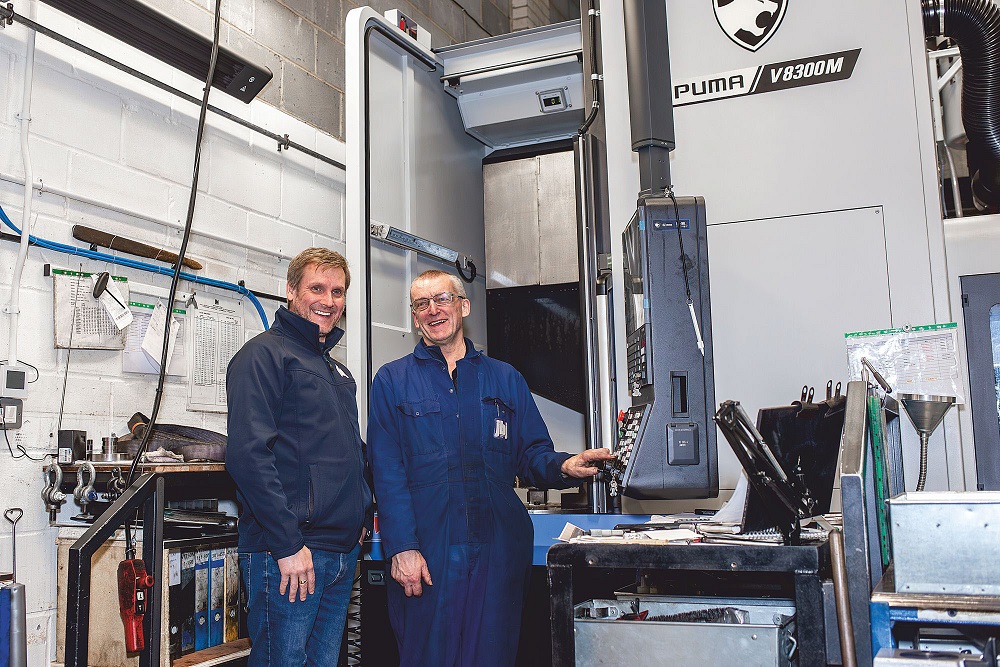
Mills CNC, the exclusive distributor of DN Solutions and Zayer machine tools in the UK and Ireland, has supplied Wordsley General Engineering with two new large-capacity machines.
The machines – a DNM 750 II vertical machining centre and a Puma 4100LB horizontal lathe – arrived at the company’s 2400sq ft Stourbridge machine shop facility in May and July 2023 respectively. They are the first DN Solutions’ machines the company has acquired in its 14-year history.

Wordsley General Engineering is a small precision subcontract company with a dynamic workforce and a reputation for achieving and delivering engineering excellence. Established in 2009 and today employing eight members of staff, the company provides high-quality machined components to a diverse range of customers operating in numerous UK industries. A specific strength the company is its fast and precise processing of precision subcontract components.

Machined from solid bar and billet, as well as castings and forgings, components machined by Wordsley General Engineering are typically complex in nature and feature tight tolerances and high surface finish requirements. The company machines these parts -usuallyfrom steel, stainless steelor aluminium – in small to medium volumes with batch sizes varying from one-offs (including prototypes and pre-production components) through to 500-off.

Wordsley General Engineering is a company committed to continuous improvement. It is passionate about delivering best-in-class machined components to its customers, on time and on budget. And, to ensure future growth and profitability, the business always looking at ways in which it can differentiate itself in the market and exploit new commercial opportunities.

Back in late 2022, with the disruption caused by pandemic firmly in its rear view mirror, Wordsley General Engineering made the strategic decision to strengthen its in-house milling capacity and capabilities by investing in a new machining centre.

Says Adam Tarbet, Wordsley General Engineering’s owner and managing director:“The objective was to invest in a new, large-capacity machine that would enable us to secure contracts, from new and existing customers. In particular, we’d be able to target the machining of larger-sized components that, in the past, would have been out of our reach. We did our homework on the size and specification of the new machine tool and, naturally, first approached our existing machining centre supplier.”

Believing that the response it received from this supplier was not particularly competitive, Wordsley General Engineering cast its net wider and, after discussions with employees, contacted Mills CNC.

“We had recently appointed a highly-experienced machinist who, in his previous employment, had worked on Doosan machines from Mills CNC and extolled the virtues of both,” says Tarbet. “Up to that point we always believed that machine manufactured by Doosan/DN Solutions were going to be expensive. However, after discussions with representatives from Mills CNC, we were pleasantly surprised with the new machine tool package they put together.”

The machine Mills CNC recommended to Wordsley General Engineering was a DN Solutions’ DNM 750 II, a large-capacity, three-axis vertical machining centre. This model features a 15.6kW/12,000rpm Big Plus spindle (165.5Nm), a 40-tool position ATC, a large worktable and aFANUC 0iTP control with 15” touchscreen iHMI.

Importantly, the DNM 750 II is fast and flexible and features 24-30m/min rapid traverse rates, linear guides, through-spindle-coolant capability and a spindle chiller. The model supplied to Wordsley Engineering also has a Nikken 260 fourth-axis unit for fast part indexing.

“The DNM 750 II is a heavy-duty machining centre”, explains Tarbet.“Its 1630 x 750mm worktable enables us to machine large components and/or smaller parts in a single set-up. Furthermore, its rigid design and build means we can ramp up speeds and feeds and take more aggressive depths of cut, when required, to help reduce cycle times and increase work throughput.”

According to Tarbet, the DNM 750 II, despite its recent arrival, has already had a dramatic impact on the company’s turnover, providing a 30% boost in less than six months.With such a positive experience of the machine tool technology available from DN Solutions, it was no surprise that Wordsley General Engineering approached Mills CNC when looking to improve its turning capabilities in June 2023.

“We contacted Mills CNC as we needed to increase our in-house turning capacity,” states Tarbet. “We were looking at investing in a proven, heavy-duty lathe with a large turning diameter and turning length.Following in-depth discussions with Mills CNC, we decided to invest in a new 15” chuck/116.5 mm bar capacity, box guideway Puma 4100LB.”

The FANUC-controlled Puma 4100LB provides Wordsley General Engineering with a significant increase in its turning capacity and capabilities. The lathe has a maximum turning diameter of 550mm and maximum turning length of 2092mm, and features a powerful, gearbox driven 26 kW/2000rpm spindle, a servo-driven 10-station turret and a hydraulic manual tailstock.The machine was also has a Filtermist mist extraction unit, vital when machining castings. It arrived at Wordsley General Engineering’s machine shop in July 2023, just four weeks after order placement.

To increase the machine’s productivity potential still further, Wordsley also ordered a SLU4X steady rest.In the near future, Mills CNC will retrofit an 18” chuck for even larger chucking work.

“The Puma 4100LB is a beast of a machine with impressive overall performance in terms of speed and precision,” says Tarbet. “Moreover, embedded functionality within its FANUC control, like the variable speed option, enable us to undertake boring operations without vibration, resulting in faster and more precise part processing.”

Wordsley General Engineering’s decision to invest in DN Solutions’ machine tools from Mills CNC is clearly paying dividends, resulting in the company having a full order book.Since their installation, both machines have been put through their paces.According to Tarbet, the new investments have helped the company “acquire over 10 new customers in just a few months”.

“We are delighted with our two new DN Solutions’ machines, and with the service and support we received from Mills CNC,” he concludes.
For further information www.millscnc.co.uk