

NAKAMURA BOOSTS THROUGHPUT FOR SUBCONTRACTOR

As a company that has been in business for more than half a century, BD Precision Engineers has certainly established its track record of providing high-quality precision-manufactured components. Machining anything from prototypes to production runs in the thousands, the Bedfordshire-based company has recently invested in a Nakamura-Tome AS200MYF turn-mill centre from the Engineering Technology Group (ETG).

The arrival of the Nakamura-Tome AS200MYF with a 1m Samsysbarfeed demonstrates the Leighton Buzzard company’s philosophy of continued investment in new plant and machinery. As the manufacturer’s largest single investment in machinery to date, the AS200MYF marks a step forward in the type of machining processes the ISO9001-accredited business can now offer, while also increasing its capacity.

As a business passed down the family, managing director Andrew Fogden and his wife Debbie now own BD Precision. Since Andrew joined the family business in the late 1980s, it has shifted from being a small subcontract machine shop with a handful of manual mills, drills and a surface grinder, to a full CNC facility with the Nakamura-Tome turn-mill centre taking centre stage.

BD Precision has long- been a milling facility with just two CNC turning centres. However, the nine-employee company recognised that one two-axis turning centre was doing much of the turning work, producing small batches and production runs up to a few hundred with the second machine operating as a ‘jobbing’ lathe. With the primary turning centre at full capacity and the company transferring a lot of turning work to the prismatic department for secondary operations, the company needed both capacity and capability.

Recalling the decision to purchase a new turning centre, Andrew says: “As a company that operates a 10-hour day shift, our two-axis turning centre was running non-stop and any downtime would create serious capacity issues for our business. We produce a lot of mast-climbing rollers for the construction industry and these almost fill our turning capacity. As a result,weneeded a solution to alleviate capacity and support growth. We looked at four different machine tool vendors for a compact CNC turning centre that would fit into a limited floor area.”

BD Precision did not want to sell any of its existing machines and space was particularly tight. Despite the limited available floor area, the company wanted a machine that was going to give its business an extra dimension. The Nakamura-Tome AS200MYF was the solution.

The business manufactures a complete variety of work for the aerospace, defence, rail, scientific and laboratory sectors, as well as the construction and automotive industries. To facilitate the variety of materials, tight dimensional tolerances and the complexity of parts going through the turning department, a large envelope machine with Y-axis milling and a small footprint was a must.

“Out of the machines we looked at, the Nakamura was by far the best machine,” says Andrew.“It has a 65mm bar capacity with a maximum workpiece length of up to 300mm and a distance between centres of 427mm, giving us all the capacity we needed. Additionally, the specification versus cost made the Nakamura a ‘hands-down’ winner.When you add in the impeccable reputation of the Nakamura brand, it was a no-brainer.”

As soon as the AS200MYF landed in April 2023, there was an initial bedding-in period before the machine made an impact.

“We needed to get a CAM system to run the Nakamura, so we invested in ONE CNC,” he explains.“Furthermore, the machine has a FANUC CNC and most of our machines are Heidenhain. Despite the transition to a new CAM system and CNC on a completely new machine configuration, the impact of the AS200MYF after the initial learning curve has been tremendous.”

Discussing the productivity benefits of the Nakamura-Tome machine, Andrew continues: “Its’ at least 40% more productive than our existing turning centres, and that’s during our learning curve. We’ll increase our productivity rates, the more we become familiar with the machine. Another major benefit has come from Y-axis milling. We can get parts off the machine in one hit, whereas previously we had to transfer a lot of parts to our milling department for secondary finishing. The capacity the Nakamura has created in our milling department is incredible.”

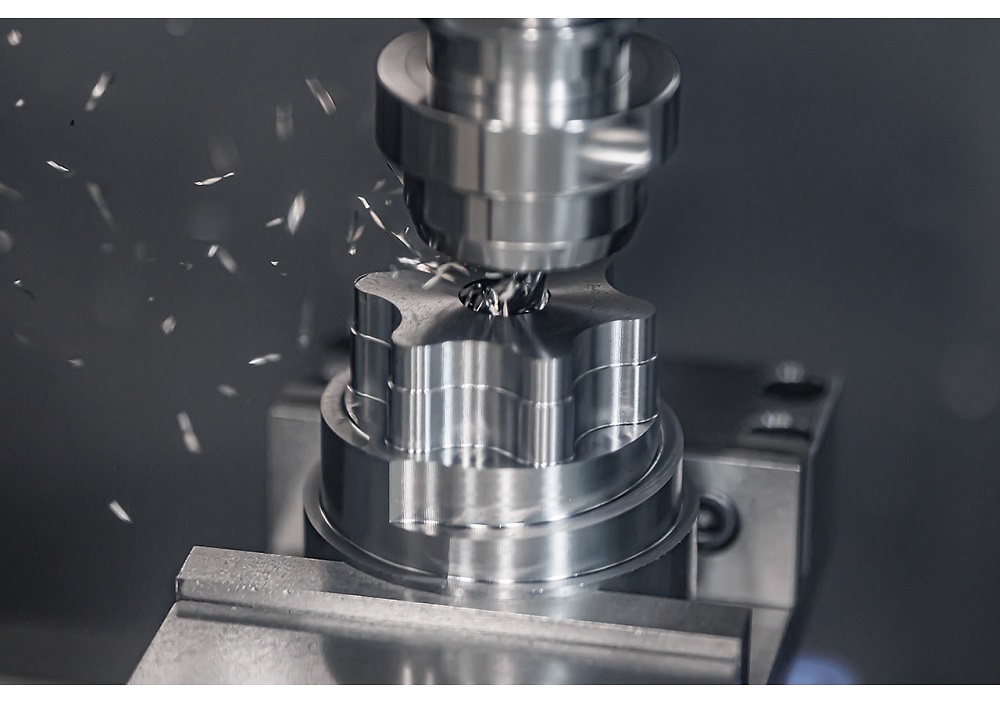
The Y-axis milling facility on the Nakamura-Tome has virtually eliminated all secondary finishing operations in the milling department and opened new opportunities for BD Precision.

“We manufacture a lot of turned parts that require cross-drilling and milling,” says Andrew.“Here, the Nakamura has completely eliminated the need for secondary operations. This ability to complete jobs in one hit has enabled us to compete for and win new business that we knew we couldn’t previously complete. We’ve also won new business based on our ability to compete on both short lead times and price. There’s one project we’ve won that requires the machining of complex-shaped flanges with holes on a PCD. Previously, we could have done it in 2-ops, on a lathe then a mill, but we wouldn’t be cost-competitive. With the Nakamura, we have won the order and our impressive cycle times and competitive pricing will lead to additional work with this new customer.”

With more work completed in one hit on the Nakamura, the opportunity for error has reduced.

“One-hit machining has eliminated any opportunity for deviation and error in our batch production, considerably improving our overall quality,” he says.“Furthermore, the stability and rigidity of the Nakamura have improved our surface finishes. The tooling turret on our existing turning centre is a VDI configuration and the Nakamura has a BMT tooling turret which is far more rigid and stable.The surface finishes on the AS200 are far superior toanything we’ve seen before. This is also making a marked improvement on our tool life.

“The Nakamura-Tome AS200 has improved our quality no-end, while our productivity, capability and throughput have also improved considerably,” concludes Andrew.“We’re absolutely delighted we bought the Nakamura from ETG. The machine is a ‘door opener’ for our business and, as we open more doors, we’ll certainly be looking for further high-end machine tool investments like the Nakamura.”
For further information www.engtechgroup.com

Rolls-Royce Submarines welcomes ministers

Rolls-Royce Submarines recently hosted Richard Marles, Australia’s Deputy Prime Ministerand Minister for Defence, and Grant Shapps, UK Secretary of State for Defence, at its site in Raynesway, Derby.The visit included a tour of the nuclear-licenced site and a chance to meet some of the team dedicated to providing the reactors that will power both UK and Australian future attack submarines under the AUKUS agreement.The Ministers watched the fabrication of the first nuclear propulsion plant components for the UK’s SSN-AUKUS programme, one of the first stages in building the submarines.
For further information www.bit.ly/3CCG2UG

Produmax joins forces with ASG Group

Produmax, an aerospace manufacturer headquartered in Bradford, is integrating with the rapidly expanding ASG Group, based in Manchester. Produmax employs around 90 people and has worked at the forefront of aerospace manufacturing for the past 25 years, led by Jeremy and Mandy Ridyard.

Jeremy Ridyard says: “We have been on a remarkable journey for over two decades and this partnership will allow us to expand our reach and impact in the aerospace industry even further. ASG Group’s value of engineering excellence aligns perfectly with ours, and together we’re well-equipped to take on new opportunities. Our joint goal is to drive this business to in excess of £20m over the next five years.”
For further information www.asg-group.co

TLM grows portfolio with ultra-short pulsed lasers

The latest addition to TLM Laser’s range, from partner FOBA Laser, is a new ultra-short pulse range of laser systems, the pulse width of which is in the femtosecond to picosecond range. These laser types are able to offer a number of distinct advantages in many marking applications.

Ultra-short pulse lasers produce an intensive beam of light that allows high-precision processing, while minimising the amount of heat absorbed by the surrounding area. Due to the adjustable pulse duration, from the femtosecond to picosecond range, the heat input remains low, despite the high pulse energy. As a result, it is possible to create precise marks even on temperature-sensitive materials, reliably and economically.

The fine structures created by the laser process prevent the reflection of light, so the laser marks appear deep black and offer good readability from different viewing angles. Almost any material can be marked with the F.0100-ir laser system. From metals to heat-sensitive components and even transparent materials, the new laser marker opens up many possibilities.

TLM Laser says the system is suitable for medical sector applications, where its performance characteristics allow it to produce high contrast marks on medical instruments made of stainless steel, titanium or even plastics. These same attributes also make it suited to various applications in the production of automotive and electronic components.

Depending on the workpiece material, marking speeds of up to five times faster than nanosecond laser systems are possible, reports TLM Laser. Furthermore, TLM says FOBA’s F.0100-ir offers one of the most compact designs in the field of ultra-short pulse lasers, suiting easy integration into production lines and laser marking machines such as the FOBA M series.
For further information www.tlm-laser.com

Mazak unveils OPTIPLEX 3015 NEO 20 kW at EMO

At the recent EMO exhibition in Hanover, Yamazaki Mazak showcased its newest high-power 2D laser machine for sheet metal cutting operations: the OPTIPLEX 3015 NEO 20 kW. The machine’s working area allows the processing of workpieces up to 1525 x 3050 mm through a new 20 kW fibre laser resonator. Thanks to this high power, the machine is able to cut 30% faster and reduce gas consumption by 30% when cutting with nitrogen.

Mazak says that the OPTIPLEX 3015 NEO 20 kW is equipped with proprietary beam-shaping technology to adjust the power density of the laser beam in a controllable and automatic manner, ensuring the best possible result on various materials and thicknesses.

The new MCT3 cutting head and MAZATROL SmoothLx CNC system are just two stand-out technical features of the machine. Mazak’s MCT3 boasts multiple intelligent functions to streamline the operator’s role. For instance, beam diameter control automatically adjusts the laser beam diameter while automaticfocus enables distance adjustment for different materials to deliver faster cutting speeds. Furthermore,automaticprofilercalibration is a function that maintains the nozzle to workpiece distance to boost edgequality and productivity.

Automating the overall set-up time can lead to 95% quicker preparation compared with standard laser machines, reports Mazak. Moreover, intelligent cutting functions such as flash cutting and fine power ramping are able to enhance the overall process even more. Instead of stopping at each axis, the laser turns on and off through ‘flash cutting’;synchronising the axis and laser movements leads to reduce cutting times. Another function, fine power ramping, adjusts the laser power and feed rate, minimising dross at cutting corners without compromising straight-line cutting speed.
For further information www.mazakeu.co.uk