MACH 2026 gets underway next month at the NEC Birmingham, bringing together the UK’s
largest collection of machine tool and manufacturing technology suppliers. On 20-24 April,
visitors will have the opportunity to explore innovations across automation, precision
measurement, surface finishing, laser processing and more. With live demonstrations,
technical presentations, and hands-on experiences, the show promises a comprehensive
insight into the technologies shaping modern manufacturing.
Among a myriad of exhibitors, advanced Grinding Solutions (AGS) will present an extensive
portfolio of high-end grinding and finishing solutions on stand 20-418. Featuring
international partners including Krebs & Riedel (precision grinding wheels), Tschudin
(centreless grinding machines), Danobat (OD/ID grinding), Comat (filtration systems), Wick
(bespoke handling and automation), and DLyte (dry electropolishing), the AGS stand offers
live demonstrations and technical presentations highlighting the latest in precision grinding,
polishing, and automation.
REM Surface Engineering (stand 20-576) will showcase its Extreme ISF process alongside
proprietary surface engineering solutions designed to enhance component performance
and longevity. Applications span aerospace, automotive, motorsport, off-highway vehicles,
firearms and additive manufacturing. Visitors can explore how REM’s chemical and
chemical-mechanical technologies are delivering improvements in efficiency, durability and
reliability across industries.
From a measurement and quality control perspective, Accretech (stand 18-519) will
highlight innovations in surface and contour measurement. The SURFCOM NEX system, for
example, combines surface texture and contour measurement in a single platform, enabling
precise evaluation of complex geometries in one run, while the RONDCOM NEX series
focuses on high-precision roundness and cylindrical form measurement. Both systems
reduce setup time, enhance measurement stability, and support reliable quality control in
high-precision manufacturing.
Elsewhere at the show, Mastercam 2026 CAM software will also be demonstrated on stand
20-240. The latest version includes GPU simulation for complex parts verification up to 10
times faster than CPU methods and features an AI-enabled programming assistant, making
programming accessible to operators of all skill levels.
TXM Lean Solutions (stand 17-361) will focus on the challenges and benefits of factory
automation. Using a 3D-printed virtual factory, TXM is set to demonstrate how optimising
production steps, facility layout and workflow can significantly enhance return on
investment while reducing congestion and inefficiency.
TLM Laser (stand 6-38) highlights precision laser systems for marking, repair, fabrication,
and welding applications. Also on the stand, the Alpha Laser ALO system delivers controlled
heat input for fine-detail welding and low-heat joining, making it suitable for tool repair,
high-value component modification, and precision fabrication.
For tube and metal fabrication specialists, the AMOB UK (stand 6-170) will feature live
demonstrations of its fully integrated tube bending and inspection workflow. The eMOB-100
and eMOB-52-2bend all-electric CNC tube benders highlight high-precision, multi-radius
bending capabilities. At MACH, the machines will see integration with Hexagon inspection
and measurement systems for end-to-end workflow efficiency.
Ficep UK (stand 6-330) will shine the spotlight on its Gemini Laser, an integrated steel
processing system combining high-power fibre laser cutting with mechanical machining for
drilling, tapping, milling, and marking. Capable of handling plates up to 60 mm thick and
equipped with an optional 45° bevel head, the system reduces material handling,
accelerates production and increases accuracy, all key benefits for structural steel
fabrication projects.
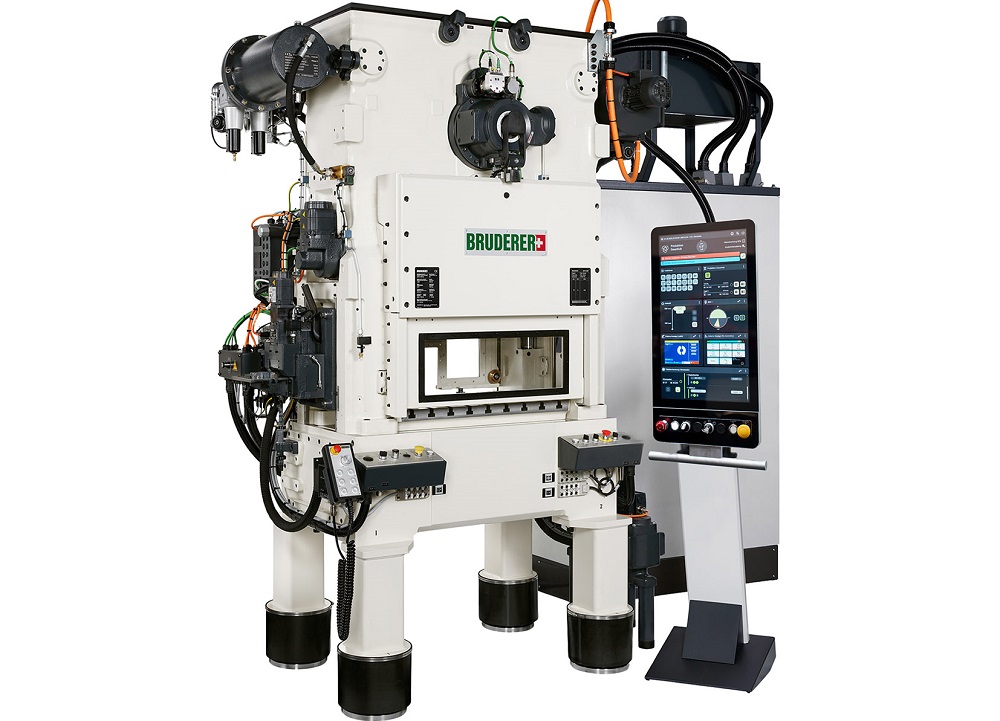
Another essential stand to visit will be that of Bruderer UK (stand 6-479), which celebrates
nearly 50 years at MACH with the UK debut of the BSTA 280-88-B3 high-speed precision
press. Equipped with the new BSV 170 servo feeder and B3 control system, the press
enables micron-precise shut height adjustment, advanced tool and press protection and
multi-axis control for lamination processes.
In the same hall, Rainford Precision (stand 6-112) will present the Kern Fortis HD five-axis
machining centre, featuring a high-speed shaft-cooled spindle, four-stage cooling, advanced
linear drives, and a substantial X, Y, Z-axis travel. The machine combines the precision and
repeatability of the Kern HD with the flexibility of five-axis machining for complex, high-
accuracy components.
From a cutting tool standpoint, Guhring (stand 20-362) will officially launch its RF 100 AL
solid carbide end mills for high-speed CNC machining of aluminium and other non-ferrous
materials. The range supports faster cycle times, higher material removal rates, improved
surface finishes and better burr control. The micro-range, RF 100 AL Micro, includes ultra-
thin Carbo+ coating and GühroJet internal coolant for reliable unattended operation.
There will also be plenty of parts washing and surface preparation innovations on show. A
case in point is Ecoclean (stand 20-579), which will highlight modular cleaning systems for
solvents, modified alcohols and water-based media, alongside special systems tailored for
high-throughput or dimension-specific requirements. The Lab-on-a-Chip system monitors
cleaning quality automatically, while Smart Drying uses AI-supported control to optimise
drying with hot air and vacuum.
MecWash Systems (stand 20-380) will showcase the MWX300 and MWX400 industrial
component cleaning systems. Joined by Sugino, exhibiting the JCC high-pressure deburring
washer, the stand demonstrates solutions for complex parts cleaning and consistent
deburring performance.
Turbex (stand 6-310) is set to feature the MAFAC SABA, a precision cleaning system with
integrated basket rotation for consistent exposure of intricate components to cleaning
media. The system combines spray/flood cleaning, adaptive programming, and a compact
footprint, ensuring reliable, repeatable results.
With a vast spectrum of exhibitors covering automation, precision machining, surface
finishing, cleaning and inspection, MACH 2026 offers UK manufacturers an unmatched
opportunity to explore the latest in manufacturing technology. From live machine
demonstrations and workflow simulations to advanced metrology and software tools, the
show brings innovation to life, helping manufacturers improve efficiency, quality and
competitiveness. Whether visitors are seeking high-precision machining solutions, advanced
surface engineering or factory optimisation strategies, MACH 2026 provides a
comprehensive view of what’s possible in modern manufacturing.
More information www.machexhibition.com