

HOW TO EMPOWER ALUMINIUM MACHINING

For many years now, aluminium materials have been becoming more and more prevalent in many industries, a trend that continues to this day. While lightweight construction and corresponding materials and structures area historically important aspect of the aerospace sector, the use of aluminium to reduce weight in automobile manufacturing is increasing steadily, really taking off recently due to electromobility.

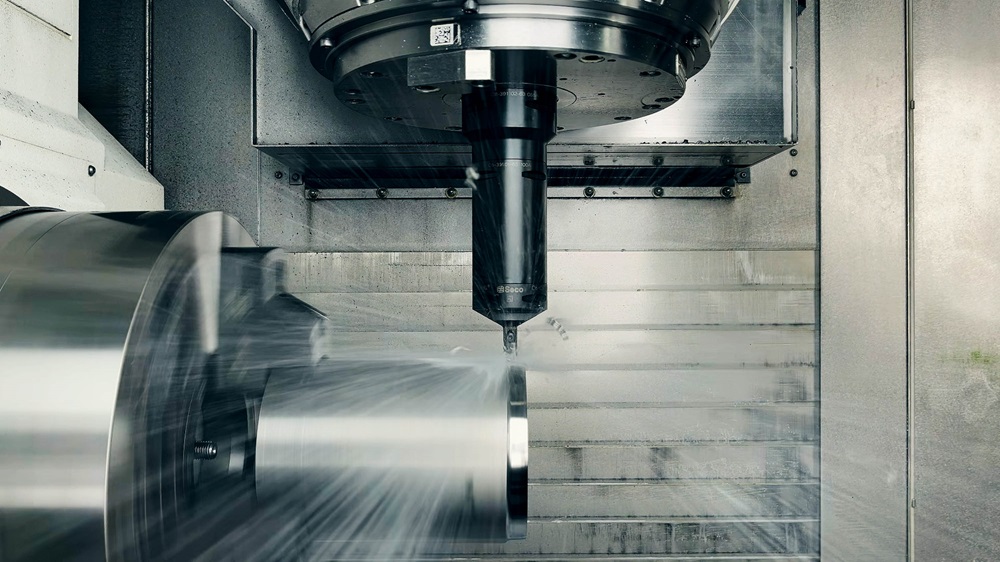
Aluminium and aluminium alloys are in principle easy to machine. As the cutting forces are low, high cutting data and long tool life are achievable with appropriate process planning. However, aluminium alloys have some special features that require mastering. The geometry of the component and ever-increasing demands on tolerances and process capability pose additional challenges when machining this popular and versatile material.

Aluminium alloys sub-divide into the principal categories of cast alloys, wrought alloys and powder-metallurgical alloys, whereby mainly the first two play a role in machining. For cast alloys, various alloy elements and corresponding casting methods create the component properties. When casting, it is important to come as close as possible to the part’s final form to simplify machining.

‘Near net shape’ technology is today prevalent in mass production in particular.When machining cast parts, the silicon content is decisive with regard to the alloy element as it has a powerful effect on wear and tool life. For wrought alloys as well, it is the alloy elementsthat bring about component properties. The silicon content is lower here though, enabling chip-less ductility. It is possible to use other alloy elements to achieve good strength and stability, as well as fatigue strength. Cold- or warm-worked alloys are the result, which are processable into wrought material prior to machining.

Mapal says that the aerospace industry deploys its tools both for part machining – manufacturing components to form assemblies such as fuselage or wing sections- as well as for the final assembly where individual sections of the entire aeroplane come together.

Most aluminium part machining is from solid material. Machining rates of over 90% call for as much raw material machining in as little time as possible. Powerful tools are key here. The tools must meet a wide variety of requirements in final assembly.

Not only is aluminium prevalent here, other lightweight materials like titanium and fibre-reinforced plastics also require machining in one machining step. These so-called ‘stacks’ are material combinations that pose a particular challenge as the machiningcharacteristics of the different materials are very different and the tools have to meet varying requirements.

Weight reductions are also a primary concern in the development of electric vehicles. After all, every kilogram saved means more range and less CO2. In machining for electric vehicles, established processes and tools are very good for producing some of the parts. However, there are inevitably new systems and components in e-vehicles that require redevelopment due to their function in terms of geometry and precision and/or material properties. Precision toolmaking companiesmust deliver answers when it comes to scaling production volumes in the automotive industry and the habitual demands on process stability, consistent parts quality and attractive price levels.

One example of special requirements are electric motor housings. The large stator bore with a diameter tolerance in the IT6 to IT7 range and circularity and cylindricity of 20-30 µm or less, combined with other functional surfaces for accommodating rotors and transmission elements,requires the highest degree of precision with regards to shape and precision tolerances.

Large battery trays are another example. Their main structure consists of extruded profiles made of aluminium with low silicon content. The challenges here are to keep chip and burr formation under control and to machine these very large parts using economical cutting data without vibration. This strategy also applies to the trend of mega and giga castings, where large-scale structural parts are no longer made of individual parts but cast as a single piece. The components’ large size and tendency to vibrate call for special tool geometries that facilitate low-vibration machining with a high degree of precision. New long-chipping aluminium alloys, whose machining characteristics first require mastering, represent a furtherrelated challenge.

Mapal has an extensive product and application portfolio thanks to many years of experience in thefield of aluminium machining. The range includes established bore machining applications like fine boring, reaming and boring. Notably, the company’s guide pad technology for fine boring achieves high precision for diameters, circularity and cylindricity.

For tools with fixed blades for reaming and boring, Mapalsays it offers a one-of-a-kind range for PCD tools. The series includes everything from tools for a single diameter with a chamfer to very complex tools for multi-stage bore geometries. For drilling into solid, there is also a large selection of solid-carbide drills and drills with indexable inserts. Deep drilling and dry drilling are a particular challenge as special geometries and expertise are necessary for both.

For the milling of aluminium, Mapal offers a broad range that includes face milling cutters, high-volume milling cutters, end milling cutters and special designs. Series with cassettes, inserts or a fixed design are available for face milling cutters, for example. PCD and different varieties of carbide serve as the cutting material and are available for various cutting depths in combination with the required surface finishes and profiles. In this way,users can create special cross-cut structures for sealing faces, for example. In addition to the universally applicable range of end milling cutters made of solid carbide or with PCD blades, Mapal has products that cater to special requirements such as high precision, parts vulnerable to vibration or high-volume machining.

This product range and manufacturing expertise form the basis for optimal machining processes for aluminium parts. But the tool itself is not the only factor. Only through the art of engineering can the wide-ranging product and application portfolio provide the optimal solution.

According to the Mapal philosophy, the optimal solution can only be the one tailored precisely to the needs of the customer. The expectation is not over-engineering but rather machining processes designed around specific requirements. Mapal sees itself as a solution provider and technology partner and, as opposed to a conventional tool supplier, does not only consider technical aspects but also tries to put itself in the customers shoes.

More information www.mapal.com

Robot order in double-digit million range

Kuka is supporting its customers in the transition to more sustainable mobility with state-of-the-art technology: the company is supplying 23 FSW (friction stir welding cells) with integrated robots for the production of electric vehicles at an automotive customer. Kuka says it is the largest single order in this area to date.

The FSW cells with various technologies and Kuka KR Fortec robots integrate fully into production lines for electric vehicles, where they perform several production steps. Kuka robots in the cells weld battery trays and join cooling plates to the battery trays in a second operation. This is an important task, as battery trays play a crucial role in electric vehicles. They must be leak-proof and resilient, support the correct temperature of the batteries and help to prevent the battery from endangering vehicle occupants in the event of an accident.

A particular challenge in production is 3D welding, for which robot-based FSW technology is suitable. The application also requires complex clamping technology, where Kuka was also able to contribute its engineering expertise. A tool changer and a cleaning station for the FSW tools are also in place to facilitate fully automatic operation.

In addition to the technical solution, Kuka’s expertise and years of experience in process technology, engineering and co-operation with the sales experts impressed the customer. 

Kuka is now working with research partners to develop the technology further, namely to monitor weld seam quality in-process and subsequently reduce the time and cost of inspection. The company is collaborating with partners at the University of Augsburg on an AI-based process monitoring system.

More information www.kuka.com

Robot-driven production meets military demand

Heckler & Koch USA (HKUSA), a designer and manufacturer of small arms and light weapons for military forces and law enforcement worldwide, has chosen Flexxbotics for robot-driven manufacturing with autonomous process control. Advanced robotic machine tending with Flexxbotics enables Heckler & Koch to increase capacity with precision quality, subsequently keeping up with strong demand and addressing labour challenges.

With Flexxbotics, HKUSA achieves a robot-enabled, multi-machine cellular-based set-up for machining complex-geometry parts. The robot will operate an Okuma five-axis vertical machining centre and an Okuma horizontal machining centre along with an integrated water dunk and blow-off station, a Hexagon CMM, Renishaw inspection probe, and SICK safety scanner – all within an individual work cell. Automating the complete process of machining and inspection results in an 87% capacity increase and 24:1 machine-to-man ratio.

“Our main goals with robotic automation are increasing throughput, maximising machine utilisation and creating flexibility to react quickly in line with production volume demands,” says John Mitchell, VP of operations at HKUSA. “Flexxbotics offers a unique ability to use the robot to co-ordinate multiple machines and have inline inspection results automatically correct the machining operations.”

The Flexxbotics solution connects the robot to each piece of equipment and co-ordinates the work so the robot has full command and control of the work cell. Using closed-loop feedback CMM inspection results, Flexxbotics writes offset-macro-variable changes to the CNC programs, thus ensuring all parts are built to specification for continuous operations using autonomous process control.

In addition, Flexxbotics communicates with the in-machine probes to ensure proper part seating before and after each CNC cycle. Based on the probe’s feedback, the robot either automatically removes and replaces the part or escalates the problem via text and email if there is a work-holding issue.

More information www.flexxbotics.com

Robot safety enables mobile machine tending

Be ambitious, dream big,’ proclaims a giant, brightly-coloured graphic that towers encouragingly above the bustling machine shop crammed with CNC machines at ALM Engineering near Newton Aycliffe in County Durham.

It was this spirit of enterprise and vision that turned necessity into a pioneering robotics innovation. ALM has uprooted machine tending robots, set them on wheels and turned them into freely accessible and adaptable mobile units that it can quickly and easily reposition wherever necessary.

The idea originated from the need for a device that would meet the growing needs of the family-run business. ALM’s development of collaborative robot (cobot) applications, based on technology from Universal Robots, was so successful that the company decided to perfect and market it to external customers, calling it the CoboTend. Now, a partnership with SICK UK enabled effortless safety without sacrificing productivity for the CoboTend, representing a vital step in the product’s continued development.

Two SICK nanoScan3 Pro safety laser scanners sit at opposite corners of the CoboTend’s trolley cabinet. Together, the laser scanners provide 360° coverage around the robot, slowing it to a safe speed when a person enters the outer of two fields and only stopping upon breaching the inner field. This concept means that the cobot can continue to operate safety and dynamically based on the proximity of the person rather than simply stopping if anyone gets too close, ensuring maximum uptime and productivity.

The SICK nanoScan3 Pro safety laser scanner is easy to integrate thanks to the SBot Speed URCap, a safety system that combines safety technology from SICK and Universal Robots.

SBot Speed URCap is simple and fast to set up using smart field definition and field teach-in. 

More information www.sick.co.uk

Automated tool production system launches

With its new Automated Tool Production (ATP) system, Walter is offering a new automation system for tool handling in the manufacture and inspection of cylindrical cutting tools. The system networks tool production and measuring machines not only from Walter but also upstream and downstream machines from other system partners.

Available from Walter Ewag UK, a manufacturer of CNC grinding, erosion and measuring machines, the new ATP provides a higher degree of automation and thus delivers elevated levels of efficiency. ATP does not require additional floor space and is suitable for integration into existing tool manufacturing systems independent of current automation providers without any need to change system layouts.

System control is based on the Flames OPC-UA data model and comprises at least one robot cell accessible from the front (ATP Robocell) for automatic machine loading/unloading plus at least one autonomous, mobile transport robot (ATP AMR) for transporting workpiece pallets and individual parts between storage and processing stations. The data model also includes a standard communication model between the machines and ATP AMR, as well as a control system for higher-level data and process control.

ATP Robocell offers three access gates and therefore additional buffer spaces for production without waiting time or downtime. A separate removal station for the in-process exchange of individual tools between the measuring and production machine enables automatic correction and, as a result, closed-loop processing.

The ATP Robocell’s multi-range gripper contributes to the system’s flexibility by covering a large workpiece diameter range and providing the ability to exchange collets at the same time.

More information www.walter-machines.com