


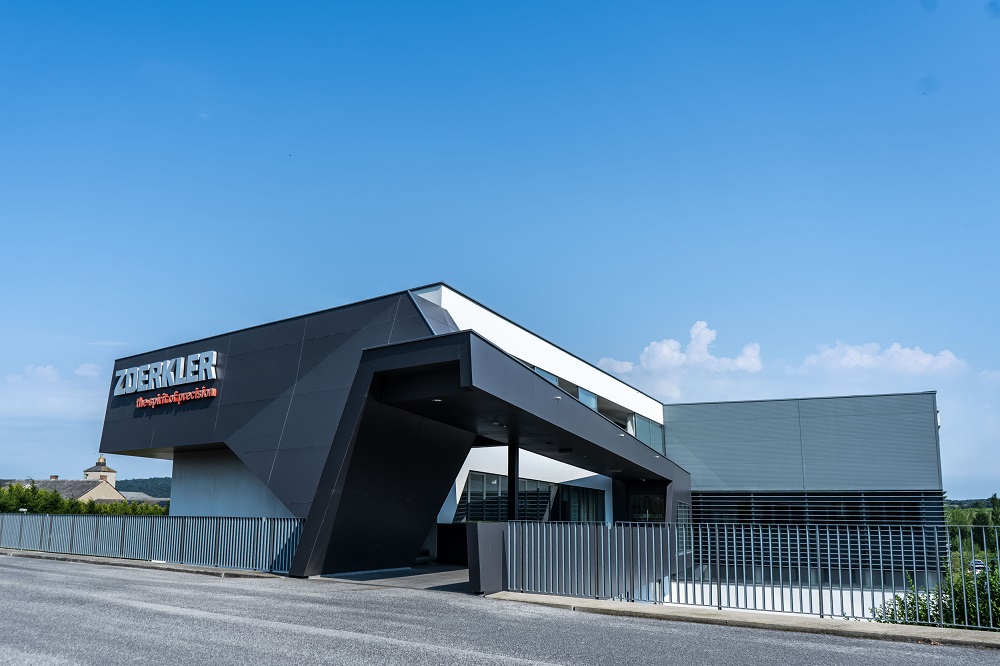
Zoerkler Gears, a manufacturer of precision drive systems for the aerospace and automotive
industries, is using a VL 6 vertical pick-up turning machine from EMAG for machining high-
precision transmission components. This strategic investment underlines Zoerkler’s
commitment to innovation and quality in the production of complex drive components.
Zoerkler can look back on almost 120 years of history. It started out as a modest family
business – a small mechanical workshop. The grandfather of current managing director
Bernhard Wagner, laid the foundations by manufacturing simple spare parts. Over time, the
business specialised more and more in gear cutting, especially for construction machinery.
“We expanded continuously over the following decades,” says Wagner. “At our old location
in Vienna, we began producing high-quality drive systems and gears on an area of around
1800 m². We made the big leap in 2008 when we moved to Burgenland. Here we have a
production area of 8000 m², which enables us to manufacture high-quality drive systems
and precision parts at the highest level.”
Today, the company employs around 100 people, including eight trainees and 15 highly
qualified design engineers who work in the development team. The majority of the
workforce, namely 77 employees, work in production, where they contribute their
knowledge and skills to the manufacture of precision components.
Zoerkler specialises in the design, manufacture and testing of drive systems for high-
performance automobiles, helicopters and airplanes.
“Our drive systems can be found in high-performance vehicles that belong to the absolute
top class of the automotive industry,” confirms Wagner. “In aviation, we equip helicopters
and airplanes with our systems. The extreme operating conditions demand the highest
quality and reliability. We also serve the railway and agricultural machinery industries,
where our drive systems are also used. However, our main focus is clearly on precision drive
systems for the most demanding applications in the automotive and aviation industries.”
Many orders are future-oriented “built-to-spec” projects. This means that Zoerkler receives
detailed requirements and specifications from the customer. On this basis, the company
takes over the entire development process.
“First, we create a comprehensive layout. Our engineers develop, design and manufacture
the drive system down to the smallest detail. Once the planning phase is completed,
production begins. All components are manufactured in-house and then assembled by our
specialists.”
The decision for the EMAG machine was based on several decisive factors. The main reason
was that Zoerkler needed a solution for the automated machining of heavier workpieces
with the highest accuracy and reliability.
Bernhard Wagner, managing director of the company, says: “The VL 6 enables us to produce
complex components with excellent dimensional accuracy, even with frequent changes of
workpieces for our small series. This is crucial for our production flexibility and meeting the
high-quality requirements of customers.”
The machine’s integrated hard turning and milling functions are particularly noteworthy.
This multifunctionality enables Zoerkler to perform demanding machining steps in a single
set up, which contributes significantly to increasing precision and shortening cycle times.
Another advantage of the VL 6 is its highly developed automation system.
“We can often run the machine autonomously in the second and third shifts, which
significantly increases our productivity,” explains Wagner. “The combination of reliable
automation and constant precision enables efficient production around the clock without
compromising on quality.”
Switching to the vertical design of the VL 6 was indeed a big change, but Wagner is proud of
how well his team has met this challenge.
“The advantages of the vertical design, especially in combination with the automation and
the pick-up system, were obvious to us. We achieve significantly higher accuracies when
clamping and turning the workpieces, which contributes directly to the quality of our
products.”
He adds: “As far as the changeover for our employees was concerned, I had full confidence
in their ability and adaptability. The 90° turn in machining logic was a challenge at first, but
our technicians and engineers mastered it with enthusiasm and professionalism and with
the support of the EMAG technicians.”
The integration of the VL 6 complements Zoerkler’s machine park with production
technologies such as turning, milling, grinding, gear cutting, tooth cutting, bevel gear
grinding and eroding, as well as testing equipment. The company has a high-performance
test stand for helicopter gearboxes with an output of up to 2 x 4 MW, along with special test
stands for e-mobility applications. This equipment underlines Zoerkler’s ability not only to
manufacture complex drive systems, but also to test and optimise them under realistic
conditions.
Zoerkler’s expertise covers a wide range of gearing technologies, including the manufacture
of internal gears, gear rims and bevel gears for helicopters. The company is particularly
proud of its expertise in producing bevel gear ratios not equal to 90° – a specialty of high
valued to the aviation industry.
The successful integration of the VL 6 into Zoerkler’s production processes underlines the
company’s commitment to continuous innovation and quality improvement. This
investment consolidates the company’s position as a specialist in the manufacture of
precision drives and prepares the business for future challenges in the rapidly evolving
mobility industry.
“Our production is very flexible and customer-oriented,” states Wagner. “Orders are
typically in batches of between 50 and 100 off. This allows us to manufacture each product
with the utmost care and precision without compromising on quality. However, we also
have some series orders in our portfolio where we produce significantly larger quantities. In
these cases, we sometimes deliver 800 to 900 units per week. This range shows that we are
able to handle both small series and larger production volumes efficiently.”
Zoerkler carries out almost all gearbox production steps in-house. The production chain
begins with the purchase of raw materials and includes all essential processing steps.
The company uses state-of-the-art turning and milling machines for basic machining. High-
precision grinding processes, both cylindrical grinding and co-ordinate grinding, then
achieve the tight tolerances required.
“A special focus is of course on gear cutting,” says Wagner. “We have a wide range of
options here. We can perform helical broaching and grinding on internal gears, which is
particularly advantageous for compact gearboxes. Our repertoire also includes the
manufacture of sprockets and ring gears, even for the smallest dimensions.”
Quality assurance is the company’s top priority. It has implemented a sophisticated QA
system that covers all areas of production. Especially for the EMAG machine, Zoerkler has
installed a high-precision measuring machine right next to the system. This enables
continuous intermediate checks during the production process. All measurement results are
automatically recorded and documented electronically to ensure complete traceability.
“However, our quality assurance system goes far beyond this,” reveals Wagner. “We take an
integrated approach in which each part is managed in a batch-related manner. For each
batch, we create a comprehensive documentation report that shows the entire production
history – from the origin of the raw material to each individual processing step.”
He concludes: “Our aim is to further strengthen our position as a technology leader and
reliable partner in our core markets – and at the same time open up new markets. Our
know-how, strength and dedicated team means we are ideally equipped to meet these
challenges. We’re delighted to have found in EMAG a reliable partner for our ambitious
future goals.”
More information www.emag.com