Traditional homeware made on modern XYZ machines

Capacity in the Suffolk workshop of Jim Lawrence Traditional Ironwork is mainly taken up by producing parts for a range of lighting products. With recent growth, particularly during the pandemic when the company virtually ran out of stock, the focus of company owner Jim Lawrence is firmly on making investments to maintain high productivity and efficiency. This is among the reasons he recently approached XYZ Machine Tools to look at more effective ways of manufacturing the housing for the company’s popular ‘Harbour’ range of outdoor lights.

Production manager Chris Moore says: “We were machining these housings in six operations with the added complication that they are coming from a brass casting. The aesthetic appearance of these lights is critical to our customers, so ensuring that the two parts fit together correctly and the wiring inlets are central to the boss is of paramount importance.”

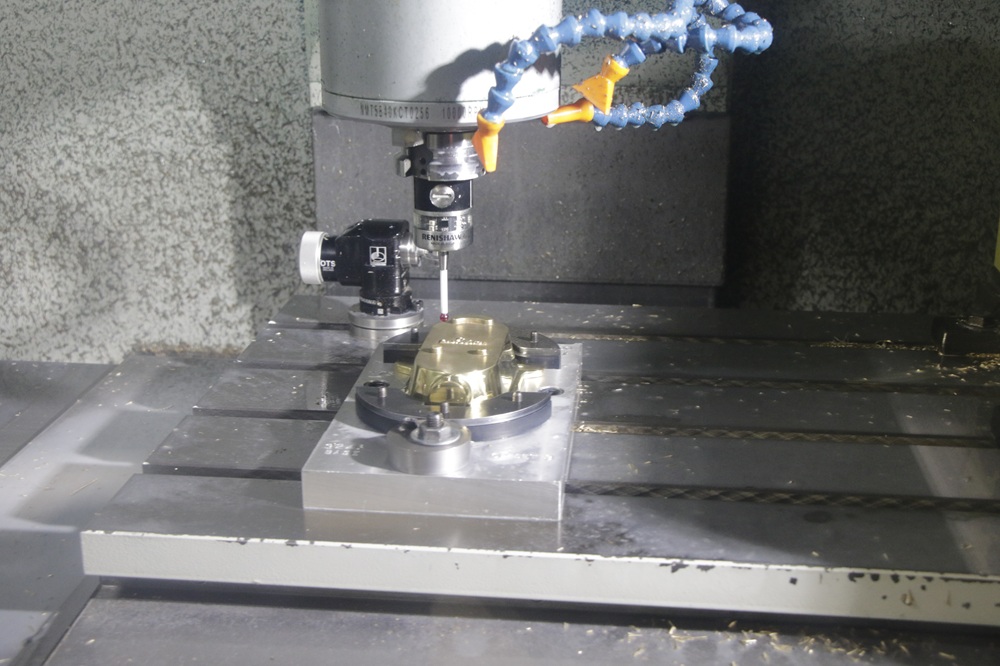
Having provided drawings and samples to XYZ, the applications team looked at how the cycle time could be reduced and that every single one of the housings machined looked pleasing on the eye. The team proposed an 800 HD vertical machining centre fitted with a Nikken 5AX-201 five-axis table and Renishaw OTS tool setting probe, along with an OMP 40 spindle probe arrangement.

“With the help of XYZ, we’ve reduced the machining of these parts to two operations,” reports Moore. “Having produced a fixture to hold the part on the bed for op 1, the parts are then located on a fixture which sits in the tilt/rotary table where [for op 2] we can machine not only the main face of the housing but also the features located around the outside in the same set up.”

More information www.xyzmachinetools.com

NORTHANTS PRECISION: A MOVER AND SHAKER IN THE MOTORSPORT SECTOR

Mills CNC has recently supplied motorsport precision subcontract specialist Northants
Precision with two new DN Solutions Lynx lathes. The machines, an 8” chuck, long-bed Lynx
2100LMB with driven tooling, and a 6” chuck, two-axis Lynx 2100A, were installed at the
company’s new 3500 sq ft manufacturing facility in Northampton earlier this year.
The machines have been positioned in close proximity to four previously acquired Lynx
lathes: a 2100B (2022), 2100MB (2021), 2100LMB (2021) and an older 220LSY. Together, the
six FANUC-controlled machines, three of which feature driven tooling capabilities, provide
Northants Precision with a flexible in-house turning and milling resource that meets the
accuracy and turnaround demands of its motorsport customers.
Since installation, the new Lynx lathes have gone “straight into action” machining a range of
small, complex, high-precision engine, chassis, sub-frame and gearbox components for the
company’s Formula 1, World Endurance Championship, World Rally Championship and
supercar customers.
Characterised by their closed, tight tolerances (typically ±5 µm on specific features and 0.01
mm or 10 µm flatness) and by their super-fine surface finish requirements, both pre- and
production parts are machined in small-to-medium batches from solid bar stock with heat-
treated stainless steels (13-8PH and MP35N), titanium 6242/6246 alloys and some
aluminium representing the predominant materials processed.
Cycle times are short, from a just a couple of minutes up to 10 minutes at the top end and,
to ensure accuracy, concentricity, flatness and fast processing speeds, parts are held
securely in position using Hainbuch collet chucks.
Says Daniel Green, Northants Precision’s owner and managing director: “Machining and
supplying hundreds or sometimes thousands of identical high-precision parts from hard and
difficult-to-machine materials to exacting quality standards is commonplace for us.
However, to do this all the time, every time, requires reliable, high-performance machines
and proven CADCAM, machining and inspection processes. We’ve invested significant
resources to ensure all the above are in place.”
Northants Precision regularly monitors and benchmarks it performance to identify actual
and potential production bottlenecks, addressing them before problems arise. The

company’s continuing success in securing small part machining contracts from new and
existing customers, including recent contracts won directly with Formula 1 racing teams,
caused Northants Precision to review its in-house machining and ultimately place orders for
two new lathes.
“Our previous positive experiences with DN Solutions (previously Doosan) Lynx 2100 lathes
and Mills CNC’s pre- and after-sales services and support meant that we made Mills our first
port of call and ultimately invested in the new Lynx 2100A and the new Lynx 2100LMB,”
says Green. “Both lathes have significantly strengthened our in-house machining, making us
more competitive and allowing us to take on more work.”
Made from 10 mm diameter pre-cut titanium bar stock supplied in 42” lengths, an engine
housing washer component undergoes machining to completion in medium batches of
around 600-off using two of Northants Precision’s Lynx 2100 lathes. The machines form part
of a flexible manufacturing cell operated and controlled by one member of staff.
Front-end ID and OD turning operations are undertaken on a Lynx 2100 two-axis lathe
where the use of an independently-sourced bar puller, located in the machine’s turret, helps
deliver a reliable and repeatable process in support of continuous production.
Following first operations, which take approximately 2 minutes per part, the semi-finished
components are individually and manually loaded into the Lynx 2100LM for back-end
processing. This effectively requires the machining of an angled groove/chamfer on each
part, taking approximately 30 seconds. Despite the small size of each component and
relatively large batch numbers, all parts undergo rigorous inspection to ensure accuracy and
specification compliance.
Lynx lathes feature high-torque spindles, servo-driven turrets, roller-type LM guideways,
hydraulic tailstocks and the FANUC iPlus control with a 15” touchscreen. The Lynx 2100A has
a maximum turning diameter of 350 mm and a maximum turning length of 330 mm, and
features a 15 kW/6000 rpm spindle and a 12-station turret. The machine was supplied to
Northants Precision with an automatic tool setter and FilterMist extraction unit.
The Lynx 2100LMB has a maximum turning diameter of 300 mm and, as a long-bed model,
offers a maximum turning length of 510 mm. It features a 15 kW/4500 rpm spindle, a 12/24-
station turret and 6000 rpm driven tooling capabilities. As part of the deal, the machine was
supplied with an automatic tool setter and an extraction unit.
In addition to investing in two new Lynx 2100 lathes, Northants Precision has further
strengthened its in-house machining capabilities by acquiring a pre-owned sliding-head
lathe with integrated bar feeder, a used three-axis machining centre and a 3D printer for
producing fixtures and tooling.

“The sliding-head lathe is for high-volume part production, specifically an automotive
customer,” explains Green. “Integrated with a bar feeder that enables it to run unattended,
overnight and over the weekends, we can machine and supply the customer with up to
30,000 parts per month.”
The investment in the second-hand milling machine was made to help out the company’s
small turned part processing operations.
“Although our focus is on machining small turned parts, we occasionally need access to a
separate milling machine. Producing specific features on mill-turned parts using a dedicated
machining centre is often more efficient and effective than machining them on one of our
multi-tasking Lynx 2100 lathes with driven tooling.”
To be successful in the motorsport sector, process efficiency is critical. Northants Precision’s
investment in a PSL Datatrack modular production control system and, more recently, the
introduction of a tool vending machine, have helped the company achieve productivity
gains.
Northants Precision currently employs five members of staff – two of which are recent
additions. All machine shop personnel are experienced, multi-skilled and wear a number of
hats. They operate and tend more than one machine with one staff member also
responsible for the company’s inspection operations.
“We’re a close knit team,” states Green. “We rely on each other and have the same
continuous improvement and commitment to quality mindset which has proved to be a
winning formula.”
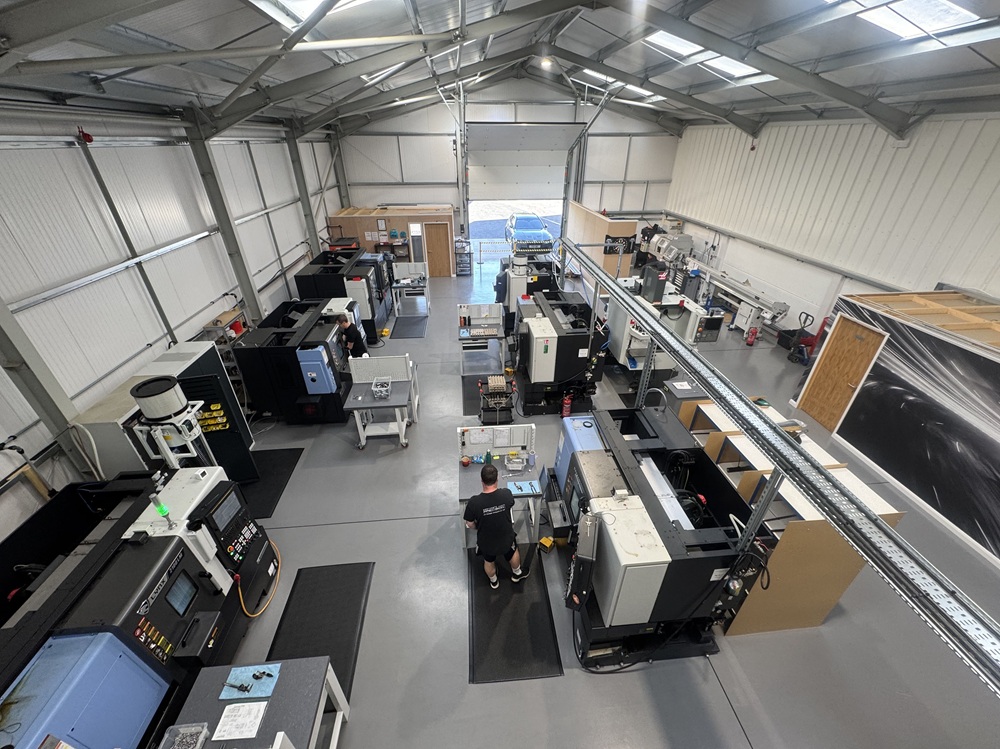
Northants Precision completed its relocation to new, larger premises in January 2025. With
its newly painted floor, mezzanine and efficient machine shop layout replete with eight
machine tools, the facility certainly looks the part. The relocation occurred during one of the
busiest motorsport periods and, for a time, while the new facility was being prepared and
finished, the company was effectively operating from two sites.
“It wasn’t ideal, but we just had to bite the bullet and get on with things,” recalls Green.
“Now we’re through the other side and everything we’ve done is paying dividends.”
More information www.millscnc.co.uk

Robotic Production with Autonomous Process Control 

Flexxbotics says that Precision Metal Industries – a manufacturer specialising in precision sheet metal products, precision machining, and complex mechanical and electromechanical assemblies – has selected Flexxbotics for robotic machine tending to enable robot-driven manufacturing with autonomous process control in multi-machine processes. The result is greater unattended operation, increased capacity and higher yields.

With Flexxbotics, Precision Metal Industries achieves a cellular-based set up based on a single robot managing multiple factory machines, including a Haas vertical machining centre with tool breakage sensors, a CMM for in-line inspection, along with deburring and cleaning blow-off stations. By increasing per shift throughput productivity and running an additional ‘lights-out’ shift each day, an overall production capacity increase of 125% is achieved with a 17:1 machine-to-man ratio.

Flexxbotics solution seamlessly connects the robot to each piece of equipment, co-ordinating the work so the robot has command and control of the machines in the work cell. Based on inspection results, closed-loop feedback corrections are provided to the CNC machine in real-time for autonomous process control to maintain continuous operation while achieving tight tolerances.

“Our customers demand precision quality and Flexxbotics takes advanced robot automation to the next level with autonomous process control,” says Greg Wilson Jr, owner of Precision Metal Industries. “We especially like Flexxbotics ability to detect tool breakage and automate tool change to keep production running without downtime.”

He adds: “We were impressed with Flexxbotics full turnkey deployment services, which ensured our business goals and requirements drove the solution’s design.”

Precision Metal Industries makes custom missile containers, cabinets, electronics enclosures, chassis, medical equipment housing and many other parts and components for the defence, medical, electronics and avionics industries.

More information www.flexxbotics.com

Teaching robots to weld could solve skills shortage

Robots could be the solution to filling the UK’s shortage of welders thanks to existing human expertise, a new study from the University of Nottingham has revealed. The UK’s critical welder shortage threatens certain industries, from construction to aerospace, potentially impacting the economy and infrastructure. Declining vocational training and Brexit, as it becomes more challenging to attract and retain skilled welders from the EU, has further exacerbated this skills gap. According to Axiom Personnel, half of the nation’s welders are due to retire by 2027. 

In the new study, the authors asked whether robots could bridge this divide and if expert welder skills could be transferred to automated systems. By developing a robotic welding system that learns from skilled welders, and building a skills library, the system could then tackle new, unseen welding tasks by intelligently combining learned skills, demonstrated successfully with both expert and novice welders. 

In the proposed approach, proficient welders execute basic tasks, such as welding simple lines or arcs, while their actions are recorded using an operation tracking system. Then, key welding parameters such as torch travelling speed, welding arc length, welding angle, welding current and wire feeding rate, are extracted and stored in a skill library.  

Experiments have also been conducted to verify the system, comparing a skilled welder with a robotic welding system. Welding results from the robot show a quality that is on par with that of a skilled welder, effectively saving time and resources in the long term. 

More information www.nottingham.ac.uk

SW Mobile Robot Cell Represents World-First

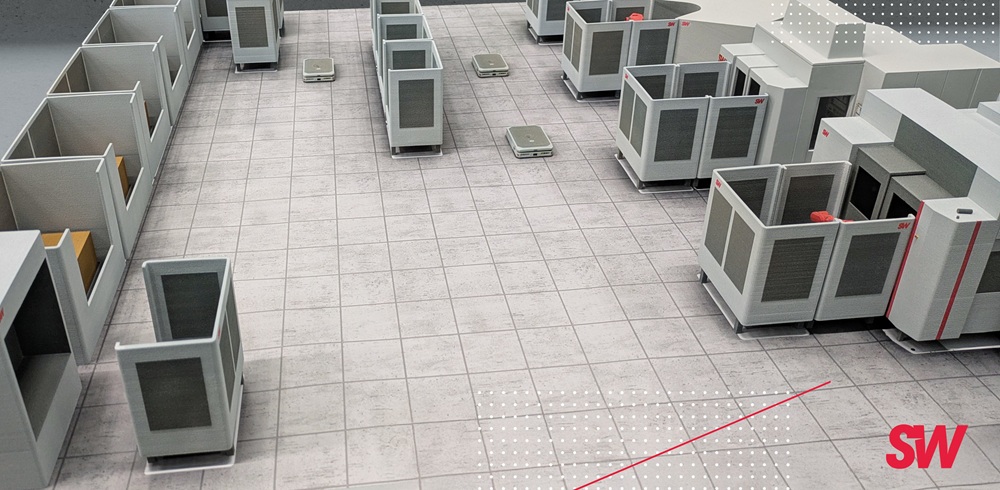
Schwäbische Werkzeugmaschinen GmbH (SW) presented a new solution for modular automation at the recent Automatica 2025 exhibition in Munich. The Mobile i-Cell robot cell is a scalable unit that flexibly connects assembly, logistics and machining stations. It supports manufacturing companies in the automated and efficient machining of a wide variety of components and order volumes without rigid interlinking or complex integration.

“As a mobile unit for automated machining, the Mobile i-Cell opens up new possibilities, from small-scale to easily expandable large-scale automation,” says Roman Wolf, team leader for control technology development at SW Automation.

With its combination of high productivity, modular design, flexible application options and end-to-end connectivity, the self-sufficient Mobile i-Cell fits seamlessly into modern manufacturing environments, especially where product diversity and dynamic production requirements are commonplace.

The i-Cell is mounted on a mobile carrier system and can be moved through the production environment using a driverless transport system (Mobile i-Wagon). The cell docks at the desired station, be it machining, washing, assembly or a DMC laser station. An integrated robot with a gripping system takes the raw material from upstream storage stations, known as Mobile i-Storages, loads the machining station, and returns the workpieces after completing the process.

The Mobile i-Storages are also automatically movable by the Mobile i-Wagon, with workpieces fed and removed independently of the cell.

“Flexible docking eliminates the need for complex and rigid coupling of the processing stations with the robot cells – and our customers gain efficiency and design freedom,” explains Wolf. This saves space, increases machine availability, and makes production processes more adaptable.

More information www.sw-machines.com