DNE Global range extended with LC4 model

TheEngineering Technology Group (ETG) says that the success of DNE Global fibre laser cutting technology has been phenomenal since its introduction to the UK last year. Now, ETG is extending the line-up with the arrival of the LC4. The latest high-quality cost-effective fibre laser cutting machine has a larger capacity and a host of features that reach beyond the smaller LC3 variant.

The new LC4 machine is suitable for a wide range of applications, from thin to thick sheets of steel, stainless steel, aluminium and non-ferrous metals. Delivering greater profit per part with its low investment level, comparatively low operating costs and low maintenance requirements, the LC4 is available in four variants: the LC4 2000, 3000, 4000 and 6000 with each of the four models signifying the respective laser power from 2 to 6 kW.

The LC4 can accommodate sheets up to 4 x 2 m with a cutting area of 4120 x 2110 x 100mm, and a maximum workpiece weight up to 1300kg. Depending upon the selected model and material in-cut, the LC4 can cut sheets from 5 to 20 mm thick at high speed and with a changeover time of just 27 seconds. The maximum positional speed in parallel axis X/Y is 100m/min with a maximum positional speed of 140m/min.

When it comes to precision, the new LC4 has a bilateral repeatability positioning of one axis (R) of 0.5mm,offering an average bilateral deviation of one axis (M) of 0.1mm with an edge detection precision level of ±0.5mm. Regarding footprint, the compact machine has a floor area of 13.1 x 6.4m with a height of 2.74m.
For further information www.engtechgroup.com

Bodor unveils scanning laser cutting technology

Bodor Laser showcasedits latest laser cutting solutions, including the company’s new scanning cutting feature, at the Global Industrie trade show in Lyon last month. On the stand was a P3 12kW sheet fibre laser cutting machine and a T230A 3kW fibre laser tube cutter. The company presented live demonstrations of its new scanning laser cutting, a new technical innovation applied to the P3 12kW model. Bodor machines are available in the UK from World Machinery.

Bodor scanning laser cutting technology tackles long-existing pain points in the metal fabrication and laser cutting industry, such as poor processing efficiency of non-ferrous metal, damage to the beam from the highly reflective material batch process, and limited output power of laser cutting equipment.

With an optical system device, optical path spatial programming technology and patented process algorithm, scanning cutting enables a significant increase in cutting material thickness with the same machine power band,while also delivering a substantial enhancement in cutting speed.

The secret behind Bodor scanning cutting lies in dynamic spot cutting, with the spot travelling 30 m for every 1 m of cut, which significantly increases the efficiency of the laser energy absorbed by the material being processed in contrast to static spot cutting.

Amelie Yu, regional sales manager (France) at Bodor Laser, says: “Compared with conventional laser cutting machines, the same power laser scanning cutting machine achieves a cutting thickness increase of 100% and cutting speed of 180%. Scanning cutting as a new technical feature makes Bodor’s laser cutting solutions a real game-changer in processing thick and highly reflective materials at fast speeds with minimised costs.”
For further information www.worldmc.co.uk

Global machine tool market set for growth

The machine tool manufacturing industry is facing a transformative decade, and as manufacturers’ needs become more digitally focused, machine tool builders must evolve their products to meet changing market requirements. According to global technology intelligence firm ABI Research, the worldwide machine tool market will grow by a CAGR of 4.3% from 2022 to 2032 and reach US$245.2bn in manufacturing value added.

“This growth is driven by new product design facilitating the need for new machine tools, old equipment reaching the end of its lifecycle and requiring replacement, and new machine tool solutions being provided and incentivising upgrades,” explains James Prestwood, industrial and manufacturing research analyst at ABI Research.
For further information www.bit.ly/3KaoVhL

Turning up productivity with lathes from Dugard

Companies with the heritage of AW Engineering are very rare. Founded in 1908 by Alfred Wood, the subcontractor switched its workload to munitions and aircraft parts during World War II and, ever since, the company has remained under the stewardship of the same family.

In 2020, AW Engineering moved to a new 15,000sqft factory in West Molesey, since when the companyhas doubled its turnover under the leadership of Mark Felstead, the great, great grandson of company founder Alfred. Contributing to this growth is the investment in three machine tools and a robot from Dugard: two SMEC SL2000BSY twin-spindle, single-turret turning centres; a Hanwha HCR5 collaborative robot (cobot); and a Hanwha XD38 IIRNHY sliding-head turning centre.

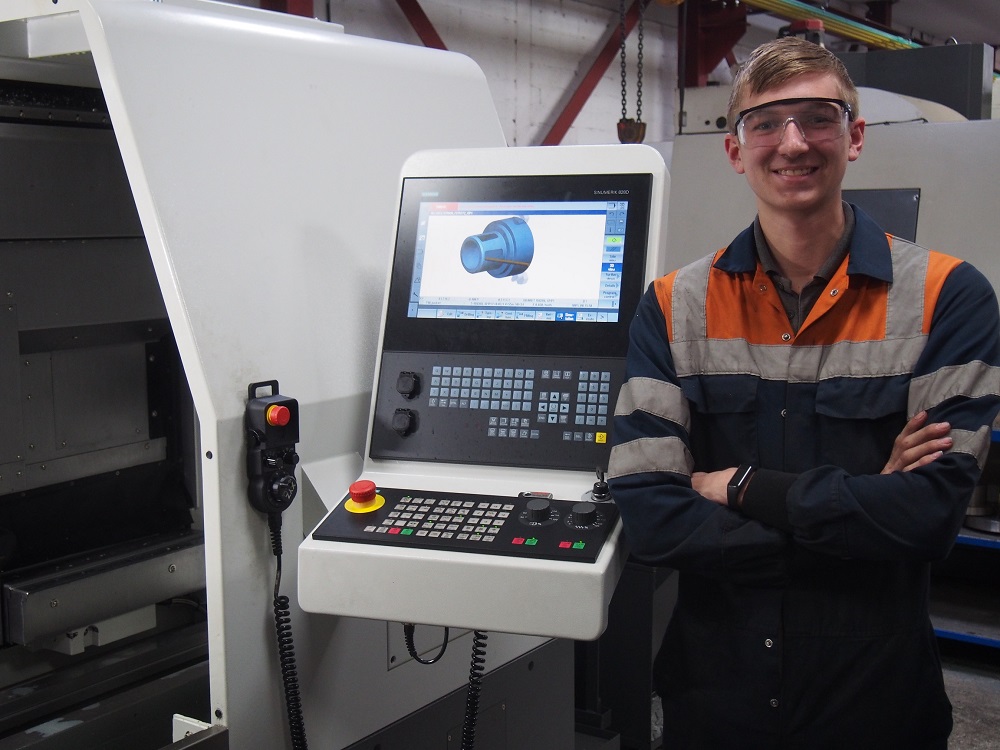
“During the pandemic, suitable machine tool supply was sparse,” says Felstead.“We spoke with Dugard and, within two weeks of placing an order for a SMEC SL2000BSY, the machine was on our shop floor and running. With furlough and other restrictions during the pandemic, Dugard was the only company that could serve our needs. Set-ups and programming are at least 20% faster with the Siemens control and we can prepare jobs and programs with confidence using the conversational programming and simulation within the system.”

Less than six months after the installation of the first machine, AW Engineering placed an order for a second SMEC SL2000BSY. A single operator mans the two SMEC machines. However, some components in the family of parts are above the 65mm diameter bar feed threshold and require manual loading. Here, AW Engineering has purchased a Hanwha HCR5 cobot from Dugard.

“Our cobot cell is now up and running, which means that both SMEC machines can run unmanned 24/7,” concludes Felstead.
For further information www.dugard.com

Latest MACH flat-bed lathes feature DynaPath control

MACH Machine Tools, part of the Vigilance Group, has introduced twoflat-bedCNC lathes into the market, both equipped with the DynaPath WinDelta control system.
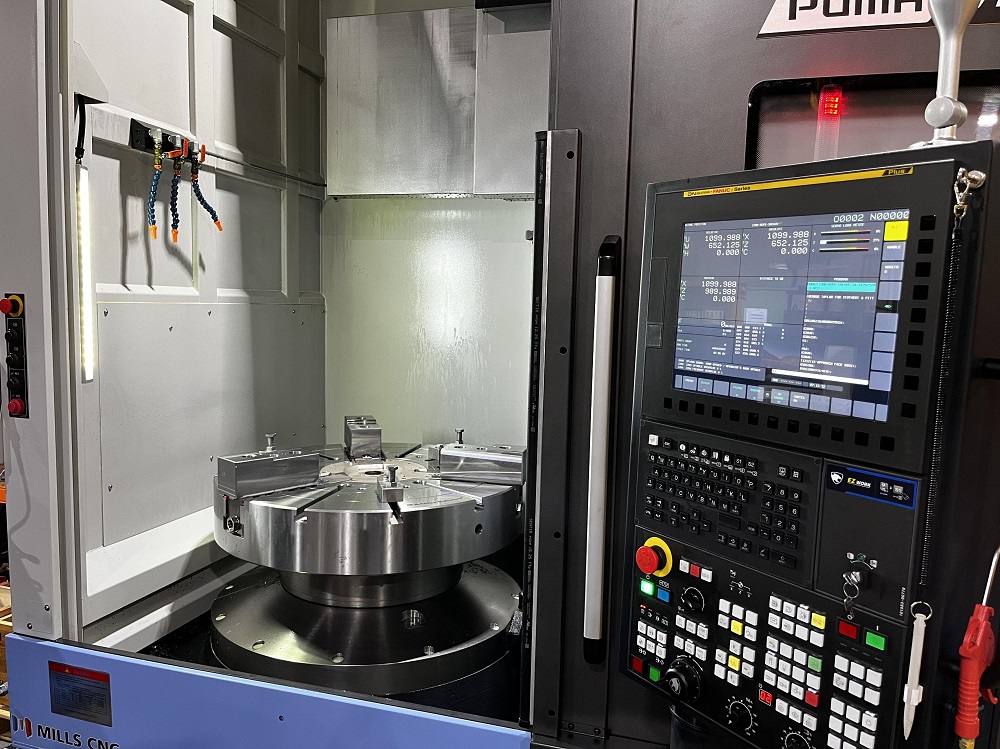
The 8” (three-jaw) chuck MDL 1600 lathe and the larger 8/10” (three-jaw) chuck MDL 1800 model are equipped with 7.5kW/3500rpm spindles (12Nm), four-tool position turrets, sub-spindles (1kW/4000rpm), manual tailstocks (150mm travel), and boast 5 m/min rapids on their X and Z axes.

Capacity is model dependant.The MDL 1600 has X- and Z-axis travels of 230 and 820mm respectively, and a distance between centres of 1050 mm,while the MDL 1800 has 350mm (X-axis travel) and 1000mm (Z-axis travel) with 1250mm between centres.

The X and Zaxes on both machines feature precision ground box ways and precision ball screws for high accuracy and process optimisation.Both machines are suitable for performing a range of machining operations – turning, parting, grooving, facing, threading and tapping, as well as keyway, face and cylindrical milling of precision parts.

The DynaPath WinDelta control with 12.1” touchscreen available on all new MACH Machine Tools’ CNC lathes, tool-room mills and machining centres, is one of the most widely used control systems in the world. Deployed extensively in the US and the Far East for over 50 years, MACH Machine Tools says that the DynaPath control is flexible, versatile and easy-to-use, providing customers with simple-to-understand navigation and operation screens accommodating ISO and conversational programming on one platform. With online CAD editing capabilities, semi-auto functions and DRO operation, the DynaPath control provides power, speed and capability to even the most discerning machinist.
For further information www.machmt.co.uk