Novel method for separating AM parts

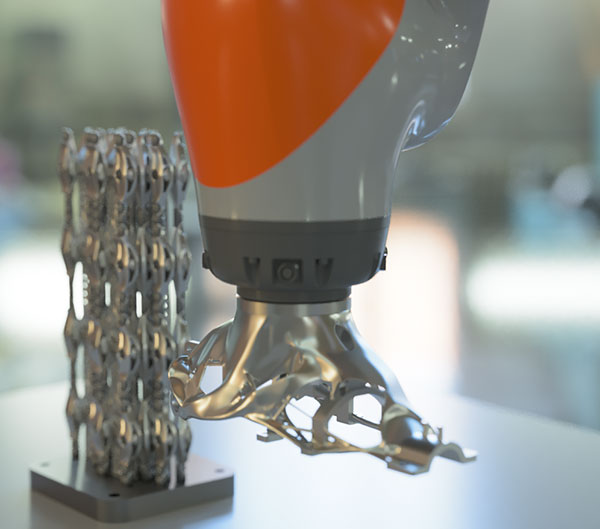
To save time, weight and costs when producing metal aircraft components, Airbus Helicopters in Donauwörth, Bavaria, part of the Airbus Group, recently turned to additive manufacturing. The company not only develops and produces a range of helicopter models such as the H135 and H145, but specialises in the manufacture of more than 4000 doors for passenger and cargo aircraft every year.

To separate the titanium parts from their 400 x 400 mm titanium base plates rapidly, economically and without damage after they have been 3D printed, Airbus Helicopters recently purchased an automatic KASTOwin AMC bandsaw from Kasto. The base plate with 3D printed shafts weighing up to 40 kg is transported from the 3D printer by forklift truck to the saw and bolted securely to a clamping mechanism.
After the machine door closes, the mechanism rotates through 180° so that sawing of the components to remove them from the base plate is performed upside down. This design offers considerable advantages in additive manufacturing as, after being cut, the parts cannot topple over or buckle, preventing the risk of damage that could lead to time-intensive reworking or even expensive scrap.
As the plate is ground flat after each build so it can be repeatedly reused, it becomes progressively thinner. With this thought in mind, before sawing begins, an employee has to measure its thickness when clamped and enter the figure into the job wizard of the AdvancedControl CNC. The bandsaw blade, actuated by a precision ballscrew drive, then moves precisely to the programmed height. When cutting is complete, the shafts fall into a padded container to prevent damage and are removed through a flap.
For further information www.kasto.com

12 kW fibre laser exceeds expectations

The most powerful flat-bed laser-profiling centre ever to be installed in the UK for processing sheet metal has started operation at subcontractor ESP Laser Cutting, a specialist in producing components from 3 x 1.5 m sheet in an array of materials to a thickness of 30 mm. ESP’s investment follows the development of a 12 kW fibre laser source by Bystronic, which has delivered a machine of that power, a ByStar Fiber 3015 to the contract machinist’s factory in Rotherham.

Delivering one-fifth more energy to the metal sheet than the previous most powerful fibre laser (10 kW), the new source was expected to be 20% faster at cutting. What ESP’s joint owners Steve McMillan and Paul Short actually experience is a typical productivity increase of 33%.
For processing one particular job, chain links from 10 mm mild steel sheet, a three-fold productivity improvement was gained on the 12 kW machine. When formerly profiling the parts on the ByStar Fiber 10 kW machine that is still in use at the Rotherham facility, 200 components per hour was the maximum output, as there was not sufficient laser power to employ nitrogen as the assist gas. Instead, oxygen had to be used, requiring the cutting speed to be reduced so that acceptable edge quality could be achieved.
By contrast, the 12 kW machine produces 600 parts per hour, as the higher power allows the use of nitrogen and hence full profiling speed. There is the added advantage that cut edges are better, especially on the underside of the sheet, than when formerly using ‘active’ oxygen, as ‘inert’ nitrogen does not react with the sheet material. ESP employs a profiling speed of 6900 mm/min when producing the chain links, although the machine is capable of 150 m/min on thin gauges.
For further information www.bystronic.co.uk

Sales record for Trumpf UK

In the UK, Trumpf recorded an order intake of £65m and sales of £60m in 2018/19, a 29% increase on the previous year’s figures.

“We continued, for a second consecutive year, to see a high number of customers purchasing more complex solutions,” explains managing director Lee Moakes. “There was also very strong growth in bending, especially automated bending. Trumpf is now providing its most comprehensive package ever to ensure customers get the best return on their investments. We’ve also increased our technical service capacity by more than 15% this year, ensuring we are prepared for further growth.”
Overall, the Trumpf Group recorded a renewed increase in sales in the 2018/19 fiscal year, which ended on 30 June 2019. Total sales rose by 6.1% to €3.78bn. Revenues for the Machine Tools division climbed by 1.2% to €2.39bn.
For further information www.uk.trumpf.com

Dugard appoints sales trio

Dugard Ltd has appointed three new sales engineers to support rising demand for the increasingly diverse ranges of machine tools that are now available from the company.

At the tail end of 2018, Dugard became the sole UK and Ireland sales and distribution outlet for the Korean brand of Hanwha sliding-head lathes, a move which was rapidly followed by the company being named as the sales and distribution outlet for the Kitamura brand of machines. Since taking on this added responsibility, sales enquiries have risen significantly.
To support the sales growth, Dugard has recruited Mark Anson, Alex Clarke and John Brimblecome as the respective area sales managers for the Midlands, southwest and northwest. All three are apprentice-served engineers with decades of experience to successfully service the Dugard customer base.
For further information www.dugard.com

Small quick-change interface

Hainbuch’s established Centrotex quick change-over interface is now available in a version for smaller spindles. Thus, the company says that Centrotex S is the smallest system available on the market for setting up clamping devices in a matter of seconds.

Offering a diameter of just 224 mm, Centrotex S is well suited to quick change-over system for machines with a small work space. Offering repeatability to ≤0.002 mm on the interface – without having to align – the latest version of the Centrotex quick change-over system can also withstand rigorous operating environments.
The machine adapter is mounted on the spindle, and the clamping device (equipped with the adapter counterpart) can be exchanged for another clamping device in less than a minute. As a result, long set-up times are a thing of the past.
Hainbuch’s smallest Centrotex version does indeed incorporate the proven technology of its big brother, however, it is superior in terms of convenience. The Centrotex S is actuated via just one radial locking screw, while ergonomic operation has been significantly improved thanks to the fewer tightening turns required. In addition, the Monteq changing fixture unburdens the machine operator and contributes to a faster clamping device set-up.
For further information www.hainbuch.com