

Tornos bites into productivity and innovation

Before he became a practicing dentist – and even longer before his entrepreneurial spirit gave rise to PartMaker, a West Heidelberg, Australia-based precision part manufacturing firm – native Australian Dr Chris Hart had already fallen in love with Switzerland. Swiss dental training improved his scope of practice and now, Tornos’ Swiss-made single-spindle lathes are helping him redefine Australian manufacturing.

An experienced prosthodontist specialising in pioneering practical and cost-effective solutions, Hart has made a name for himself as an innovator and leader in his profession. Once he has gained his Bachelor of Dental Science from the University of Melbourne, Hart built up expertise in a variety of patient care environments by working as a dentist. After earning his Master of Dental Science degree, he was selected to be part of an international team of implantology scholars, an accolade that took him to the University of Bern in Switzerland, where he was mentored by world-renowned faculty member Professor Daniel Buser, both at the university’s dental medicine clinic (ZMK) and its department of surgery.
Upon returning to Australia and working in both private practice and hospital settings, Hart discovered that he could not find adequate prostheses to serve the functional needs of oncology patients. So, he decided to make those parts himself. Thus, PartMaker was born in 2012. Describing himself as ‘an engineer trapped in a dentist’s body’, Hart’s entrepreneurial spirit is driven by his passion to make a real difference in the appearance, comfort and confidence of patients.

“Before we started making our own components, we were heavily modifying existing parts,” he states. “That means we were basically butchering really well-made parts in order to remedy simple problems, like patients not being able to open their mouths wide enough to accommodate available screwdrivers.”
The solution was obvious. Hart started making his own parts and instruments.
“Back in 2012, we started making everything with milling machines,” he says. “I even went to night school and earnt a certificate in CNC programming, so I could get a better understanding of manufacturing technology.”
Hart never intended to buy a lathe, but he found that the dental implants and maxillofacial hardware he needed to produce, were beyond the capabilities of simple milling.
“With so many dental parts being too long or too short, and with existing systems going in and out of fashion, I really saw a need for bespoke, custom dental and biomedical parts,” he says.
Implants require turned components, so among PartMaker’s early purchases were a Tornos ENC 264 four-axis lathe and a Tornos Delta 20.

“Being new to Swiss-type turning and CNC machining as a whole, we had a pretty small wish list of parts to make. Peter Staebner at Tornos agent SwissTec Australia was instrumental in helping me get our first few parts made with the Delta 20. I would go into the shop after work and Peter helped me at the weekends, and we got our wish list accomplished.”
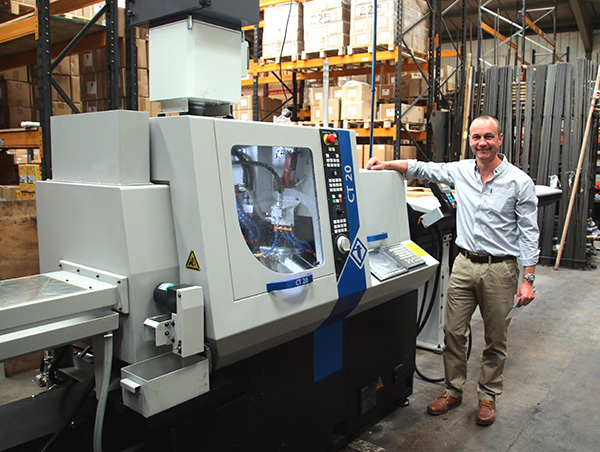
Before too long, Hart saw that Tornos Swiss-type technology opened up a whole world of possibilities. However, even running the Delta 20 all day, the company was limited in the parts it could produce. Enter the simple and ergonomic Swiss GT13, offering easy access to all tool positions and designed to drive the successful production of long and short parts.
“It has six linear axes, so it allows us to make some parts that we can’t produce on the Delta 20, and we can use 99% of our existing programming with the new machine,” says Hart. “The Swiss GT13 is so much easier to use than our old machine.”
Accommodating up to 30 tools, including 12 rotating tools, the Swiss GT13 has a Y axis that increases machining capability in secondary operations and allows some complex workpieces to be produced without reworking.
Hart points out that the new machine is slashing PartMaker’s cycle time on many parts simply because of the additional access it provides: “It’s easier to set up and its cycle times are significantly faster. In fact, because of the easier access, we’re saving 40% in cycle time on a lot of components. I know we’re not using our Swiss GT13 to its fullest capabilities yet, but that’s the goal. It’s already optimising our manufacturing. Now that we have two machines running, our ability to keep on top of orders is significantly improved. It has enough tool positions that we’ve got it set up to produce families of parts for our three main lines.”
Moreover, Hart is impressed with Tornos TISIS communication and programming software: “With TISIS, it’s a lot easier to generate programs for our parts because we’re really just assembling programming modules. The software is easy to use and I estimate that it is saving us 50% in time spent on programming because we’re not writing a new program for every different component to be produced.”
To say that Hart is pleased with his purchase is an understatement. One example, he says, is the “amazing job” the new machine does with an original PartMaker dental abutment featuring a complex taper geometry, external threading and a milled octagon. The component, with its M1.4 thread to a depth of 4 mm through a 1.2 x 1.5 mm deep hexagon, is easily executed with the addition of the Swiss GT13. In fact, PartMaker has become so productive with its Swiss GT13 that Hart has ordered an optional bar feeder.

“We’re achieving results that we thought existed only in technical drawings,” he says. “For the past five years, we’ve been relying on our own homemade bar feeder, but today we’re chewing through the bars a lot faster.”
With Tornos technology, SwissTec expertise and his own ingenuity, Hart looks to the future with confidence: “I have a dream for PartMaker to end up with six Tornos lathes and four milling machines. Of our customers, half are international, from the US, Canada, Taiwan and Mexico. With the increasing uptake of CADCAM in dentistry, dentists are realising the possibilities of what’s available from dental implant companies, so we know the potential for custom machining is there.”
For further information www.tornos.com

Mitutoyo helps navigate automotive sector changes

Specialising in the production of prototype components and complex small batch runs for the automotive sector, Birmingham-based Advanced Engineering (UK) Ltd has always maintained its ethos of investment in technology to deliver quality components in lead times beyond the capabilities of its competitors. This philosophy has resulted in the company placing its trust in metrology equipment from Mitutoyo.

As a manufacturer that works primarily with automotive OEMs, as well as others in the Formula One, aerospace, defence, rail and nuclear sectors, Advanced Engineering prides itself on quality management systems that include ISO9001. In addition, the company can comply with requirements from other industry-specific standards, from TS16949 to AS9100.
Spending over £3m on new equipment in the past five years, two of the most recent arrivals at Advanced Engineering include a Mazak Variaxis i-700 five-axis machining centre that arrived in November, and a Mazak Quick Turn 250 turning centre. These investments now give the company a total of 19 Mazak machines that undertake everything from complex prototype work through to automotive production projects, which include all levels of PPAP, APQP, FMEA, SPC and full supply chain management. Mitutoyo is central to these strategies.
Producing everything from CAM covers, cylinder blocks, control arms, pump housings, decorative door linings and prototype wheels for automotive OEMs, turnaround times are a critical factor for Advanced Engineering. This is why the combination of Mazak five-axis machine tools, hyperMILL CAM software and a complete suite of Mitutoyo inspection equipment are central to expediting high-quality components through the business at a fast pace.

The relationship with Mitutoyo dates back over 20 years, with a complete range of hand tools and the first Mitutoyo CMM, a Crysta Apex 9106, arriving on site some 15 years ago. Still reliably running up to 12 hours a day, the Apex 9106 was followed by a smaller Crysta Apex 574 CMM over 8 years ago. The second machine was acquired to relieve the bottleneck of work that was building on the company’s first CMM.
As the quality manager at Advanced Engineering, Andrew Stevens, says: “All our work is based around customer requirement. We deal with a one-off prototype product, through to support, NPI products and new product model launch. Also, we work closely with tier-one manufacturers and OEMs.”
The smaller, more cost effective Apex 574 CMM has not only relieved capacity, it was the perfect product for the changing market demands of the automotive sector, as Stevens explains: “Our work initially evolved beyond cylinder head and engine blocks into turbos and other small, complex powertrain parts, and the Apex 574 proved an excellent solution with its compact footprint. However, our workload has continued to evolve even further, with more body-in-white work and, in particular, suspension parts. With the requirement for additional measurement capacity, we once again opted for a Mitutoyo solution, the Crysta Apex-S CMM. We bought the Apex-S as we wanted the new CMM to be capable of mirroring the Apex 9106 machine, something that would give our metrology team more flexibility, reduced set-ups and extra capacity as and when required.”

Commenting upon the continual changes in the automotive sector and how Advanced Engineering is addressing the issues from a measurement perspective, Stevens says: “We got to a point where our Apex-S and Apex 9106 have been working side by side, with the smaller Apex 574 being reserved for smaller parts, providing much needed capacity at busy periods. However, a lot of our OEM customers and their cylinder-head work have taken on a new level of dimensional tolerances over the years.
“To facilitate this, we swapped out the TP20 touch probes that operate on a touch-trigger mechanical mechanism, with the new continuous contact SP25 Renishaw system,” he continues. “Mitutoyo fully retrofitted the system to both our Apex 9106 and Apex-S CMMs, and this gives us precision to 2 µm. Furthermore, by continuously scanning the complex features of parts, we’re getting a full 3D scan of the components, which can be compared directly with the CAD model. All this is innovatively done with the Mitutoyo MCOSMOS operating software, with full certification and traceability for our customers.”
With 85% of work at Advanced Engineering passing through the metrology department, Mitutoyo was once again on hand when yet more demands filtered downstream.
“Surface finish has become more prominent in the automotive market, with seal seat surfaces and waveforms on engine blocks and cylinder heads taking on more stringent controls,” says Stevens. “To measure surfaces, we approached Mitutoyo and they recommended the SurfTest SJ-410 portable surface roughness tester. OEMs are now placing more 100% inspection demands on critical features like cylinder-head bores and, to once again relieve capacity and reduce set-ups on our CMMs, the SurfTest SJ-410 was the perfect addition.”
Referring to the relationship with Mitutoyo, Stevens says: “Our tie-up with Mitutoyo goes back many years. We’ve always used Mitutoyo due to the reliability and quality of the products which they supply, and that goes right the way through from hand tools to CMMs. We have an amazing service contract with Mitutoyo and they carry out all our calibration work. We wouldn’t trust anyone else to calibrate our equipment. It’s a long-standing relationship that has been based on trust, good service and the level of product innovation.

“We chase microns on the shop floor and we need to be able to repeatedly measure microns and be confident that each measurement is accurate. With the type of products we’re producing here, we are pushing the bounds of our CMMs through varying customer requirements. So, when we see new customer demands, and we need the CMMs to do something slightly different to meet those requirements, Mitutoyo have engineers on the end of the phone, so we can get their technical support to resolve challenges very quickly.”
For further information www.mitutoyo.co.uk

Making light work of lights-out milling

UK manufacturing lags behind the productivity performance of fellow G7 members and that of other major global economies. A lack of investment and shortage of skilled staff are widely considered to be major contributing factors to this lamentable situation. In addition to being regarded as an effective means of UK manufacturers achieving productivity improvements, the implementation of advanced automation technologies invariably helps solve skills shortages.

Hertford-based Qualiturn Products is a prime example of a forward-thinking business that has achieved world-class levels of productivity by embracing the use of automation systems and developing efficient new working practices.
Established in 1974, and now run by second-generation managing director, Nick Groom, Qualiturn Products says it has grown to become one of the UK’s leading suppliers of precision mill-turned components. In 1990, the company became one of the first subcontractors to operate its mill-turn machines in a ‘lights-out’ manner. The use of barfeed systems and other advanced production aids means that since that time, the business has operated 24 hours a day, seven days a week, 365 days a year, with only daytime staffing.
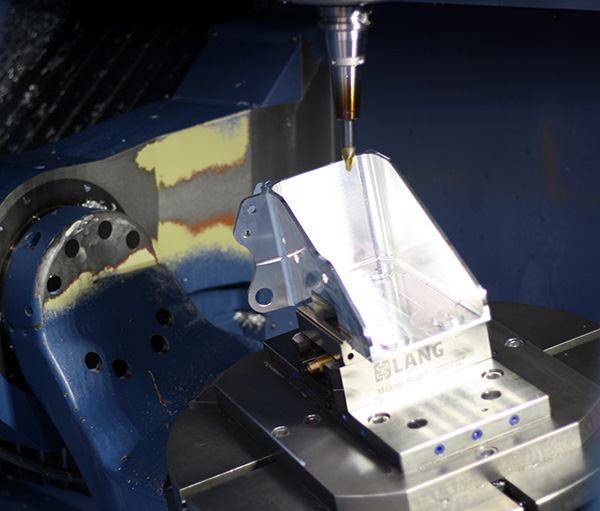
Prompted by the success of Qualiturn Products’ 24-7 production of precision turned components, in 2014 the company established Qualimill, a subcontract milling division that embraces similar, highly efficient, lights-out operating methods. Just as the application of innovative technologies facilitated a lights-out mill-turn manufacturing regime, the implementation of advanced automation aids, such as the Lang Robo-Trex system, supplied by Thame Workholding, has enabled Qualimill to operate milling machines ‘lights-out’, and helped the division to become a successful subcontract manufacturer of milled components.
To satisfy the rising demand for Qualimill’s services, the company recently moved into much larger premises and installed several additional production aids, the most recent of which is a second Robo-Trex robot automation system. The productivity gains made possible by the use of Qualimill’s first Lang Robo-Trex robot systems was a major factor in the decision to purchase the second system that now feeds a Doosan DVF 5000 machining centre.

Qualimill’s two Lang Robo-Trex robot systems each use two trollies that act as mobile storage mediums. These trollies are loaded with multiple vices that hold workpieces which are ready to be loaded into the machine by the systems’ robots. The robots pick workpieces from the trollies, load them into the machine tools and, when they are fully machined, return them to the trollies. When filled with machined parts, each trolley is removed, and a replacement loaded with multiple workpieces ready to be machined is added.
Working unattended and fed by the Lang Robo-Trex systems, the company’s machining centres run throughout the day. Before the end of each manned shift, the Robo-Trex trollies are replenished with full consignments of workpieces, enabling each machining centre to run unmanned through the night.
Robo-Trex trollies are available in two sizes, the smaller version has a capacity of 30 vices to accommodate parts up to 120 x 120 x 100 mm, while the second, larger model has a capacity of 42 vices for parts up to 120 x 100 x 70 mm. The Robo-Trex system is able to handle four automation trolleys. Therefore, depending on part size, the available storage capacity increases to 120/168 vices.
The patented, edgewise mounting of the system’s vices ensures maximum space utilisation, while accessibility to the clamping devices allows workpieces to be exchanged, without removing the vice.
An intuitive, easy-to-operate touch panel enables straightforward control of the automated system and, as external access to the trolley is possible, production remains seamless because machining cycles do not need to be interrupted. Control of the zero-point clamping system can be performed either pneumatically through the machine tool, or mechanically via the system’s robot.
“Increasing demand from our mill-turn customers motivated the launch of our Qualimill division,” says Groom. “To ensure that we were able to replicate the success of our Qualiturn operation, when setting-up the new division we put into operation advanced automation systems – where possible – and applied similar efficient working practices to those used in our mill-turn operations.
“Soon after the formation of Qualimill, in an effort to gain maximum milling efficiencies, we looked for an advanced technology that would allow lights-out running of an existing CNC milling machine,” he adds. “We found the answer in the Lang Robo-Trex automation system from Thame Workholding. Having been impressed by the performance of our fist Lang Robo-Trex robot system, to help satisfy ever rising requests for our milling work, we recently purchased a second system.
“Our decision to launch Qualimill and employ highly-efficient production technologies has been validated by the division’s success. Our new Lang Robo-Trex automation system now feeds a recently purchased Doosan DVF 5000 machining centre and further extends our lights-out production capabilities.

“By releasing the full, latent productive potential of the machine tools they serve, our two automatic handling systems release skilled staff for more technicality demanding work. In addition, our Lang Robo-Trex automation systems are helping us to accelerate production throughput and reduce our lead times. They also enable the generation of cost-effective quotes and help us to attract further business.”
Thame Workholding’s sales manager Gareth Barnett adds: “As well as providing industry with a range of cost-effective, standard work-holding systems from several of the world’s leading manufacturers, we also design and manufacture bespoke solutions in-house. Our experience and expertise in all aspects of work holding allows our staff to fully understand customer needs, then to provide optimum, cost-effective solutions.
“Our grasp of Qualimill’s brief, relating to the division’s quest for efficient lights-out working, enabled us to recommend the Robo-Trex automatic handling system with confidence,” he adds. “Now that the company’s first system has delivered on all of the promises we made, we were delighted to receive an order for a second system.”
For further information www.thameworkholding.com

XYZ LR machines prove convincing at Alken

Alken Engineering is a long-term user of XYZ Machine Tools’ ProtoTRAK mills, being an early adopter when the ProtoTRAK control was introduced to the UK in 1993. The company now has 10 XYZ ProtoTRAK mills and three XYZ ProTURN lathes on its capacity list, but for many years resisted purchasing any XYZ ‘full CNC’ machines; until now.

Alken Engineering, part of the four-company Alken Holdings Group, is a specialist machining and fabrication company that counts many blue-chip companies, such as Bentley Motors and Volvo, as customers, as well as working in the aerospace, power generation and general subcontract sectors. While the majority of its work involves the machining of steel and more exotic materials, Alken also gets involved in components manufactured from aluminium and nylon, and this work led to the purchase of its first XYZ LR (linear rail) machining centre.
“Even though the ProtoTRAK mills and lathes had provided flawless service, I hadn’t considered XYZ machining centres as I didn’t believe they could compete quality-wise,” says Paul Coverley, managing director. “However, when I had a demo of the new LR machines and the Siemens ShopMill control, my eyes were opened.
“In addition to the capability of the machines, the ShopMill control appealed as we get involved in machining from one-off to batch production, and the Siemens control is perfect for that,” he adds. “And, while I still needed to be persuaded about the full potential of the XYZ LR machines for heavier machining work, that would soon change.”
That persuasion came about when the Alken Group won a contract to machine a series of connector blocks which would be used in the construction of a bridge linking the mainland to Tintagel Castle, the fabled birthplace of King Arthur. These connectors are machined from solid blocks of Duplex stainless steel, with the finished parts measuring up to 460 x 237 x 237 mm, with slots that are 135 mm deep in places.

The work came to Alken after 10 other subcontractors had withdrawn from the contract due to the difficulty in machining these parts. As a result, Alken was faced with a tight deadline, as well as a capacity issue.
“We knew that any delay would put the bridge project back, which was unacceptable to the main contractor, American Bridge, and its customer, English Heritage,” explains Coverley. “However, our initial concern was that the parts could have been described as ‘un-machineable’. Following discussions with our customer, Underhill Engineering, changes were made to the design. Once those issues
were overcome, we were then faced with machining Duplex, including those slots.”
Initially, machining was carried out by two other companies within the Alken Group on what Coverley describes as ‘high-end’ machining centres: “These companies had what I thought was the experience and equipment to handle the work, but we found ourselves falling behind schedule as the machines struggled with the volume and complexity of the parts, so we had to bring work into Alken Engineering. The only capacity we had available was on our XYZ LR 500, 750 and 1000 machining centres. At this point there was still doubt in our mind that the XYZ LR VMC machines had the capability to handle materials such as Duplex, even though XYZ were telling us otherwise.”
With each of the connector blocks requiring between 70 and 80 hours of machining, there was a lot at stake, and Alken, along with assistance from XYZ Machine Tools and the tooling supplier, began to test the capability boundaries of the LR machines.
To produce the slots, the tooling involved an overhang of 4xD using an indexable insert cutter with 12 mm button inserts running at 140 m/min cutting speed and 0.3 mm/rev feed rate. Considering the material being cut, both the machines and tooling produced the quality and finish required.
“Once we got our collective heads around the machining of Duplex we haven’t looked back, and the XYZ LR machining centres are producing these parts better and quicker than those high-end machines we started with,” says Coverley. “As a result, we’ve got the project back on schedule and any doubts that I had about the capability of XYZ machining centres have disappeared. I’ve nothing but praise for the capability of these machines and the Siemens control.”

The XYZ LR range was introduced in 2017 and was the first full series of machining centres equipped with linear rail technology. XYZ had held off developing a linear rail machine as it did not believe that early systems were robust enough to meet its stringent quality standards. However, recent significant developments in linear rail technology saw these concerns eliminated and, as the example at Alken proves, these are highly capable machines with the ability to remove high volumes of material, even challenging metals such as Duplex stainless steel.
There are three machines in the LR range, these being the XYZ 500 LR, XYZ 750 LR and XYZ 1000 LR, with the number equating to the X-axis travel. All machines feature an 8000 rpm/13 kW spindle; 20 m/min traverse rates; and a 12-position carousel-type tool changer on the smallest machine, with a 20-position carousel (24 position arm-type optional) on the two larger variants. Also included in the XYZ range are the heavier duty, more powerful, HD VMCs. The XYZ 660 HD, XYZ 800HD and XYZ 1100 HD have boxway slides and are available with a Siemens or Heidenhain control.
For further information www.xyzmachinetools.com

Getting a ‘Gripple’ on green maintenance

Sheffield is renowned for the way it has shaped British industry over the past 300 years. While the mines and foundries may no longer be the driving economic force they once were, one manufacturer – Gripple – has set-up shop in the city and generated a fixings empire reaching as far as Australia.

Gripple was founded by former wire salesman, Hugh Facey, in the 1980s after discussing the woes of connecting fencing with a frustrated farmer on a Welsh hillside. Setting his mind to finding an easier, safer and more efficient way of joining two wires together, the concept for the first Gripple wire fastener was born.
Fast forward 30 years and Gripple now has three sites in Sheffield, and sells products to agriculture, viticulture and construction markets around
the world.
“We’ve now manufactured over 500 million Gripple fasteners, all using production equipment we have designed and manufactured ourselves in house,” begins Tim Barker, engineering site leader for Gripple’s Old West Gun Works site. “This is no mean feat, and to keep pace with demand, we employ a robust planned maintenance strategy for all of our production equipment, to ensure it is able to maintain its maximum operational capacity.”

Parts washing forms a fundamental part of the company’s maintenance plans. Yet, up until four years ago, like many manufacturers and machine shops up and down the country, Barker and his team relied on hydrocarbon-based solvents and aerosol cans to clean and degrease the parts. This meant the team was exposed to some quite harmful cleaning products, simply because that was the only real way of getting the job done.
“Sustainability is a massive part of the Gripple ethos, and where possible we look to keep our impact on the environment to an absolute minimum,” says Barker. “For example, one of our sites is located next to the River Don, which has undergone massive ecological regeneration in recent years. It used to be a dead river 25 years ago, but now there are guys fly-fishing there; the kingfishers are back and it’s an abundance of life, and that’s how it should stay. As such, we have to be extremely careful when it comes to waste removal, and it was one of the key drivers for revaluating our parts washing processes four years ago.”
With a view to eliminating any potentially environmentally-harmful chemicals from its parts washing processes, Barker and the Gripple team turned to Safe Solvents in 2015. Following an initial trial of the company’s Typhoon parts-washing system, he quickly realised the huge impact it could have; not only in improving the company’s environmental credentials, but in eliminating maintenance technicians’ exposure to the health and safety risks often associated with hydrocarbon-based cleaning solvents.

“When we first brought Safe Solvents in, I so impressed by the system – how easy it was to operate, and how switched-on the guys were – that I immediately rolled it out across the other sites,” says Barker. “The Typhoon system means all parts washing is done in a controlled, safe and environmentally-friendly way, rather than just sticking parts in a bowl or sink and using aerosol-propelled solvents.”
The Typhoon system is a modern take on an old sink-on-drum manual parts-washing machine. It provides a trio of cleaning options: tap, flow-through cleaning brush, and soaking tank, as well as trays and working areas to scrub or soak both small and large components. What really sets the offering apart from other solutions however, is the cleaning fluid.
Safe Solvent’s Advanced Parts Wash Fluid (APWF) is a water-based degreaser for general parts. Comparable with standard hydrocarbon-based solvents, it gets to work quickly on cutting through grime and includes a built-in rust inhibitor which acts as a protective barrier for most metals. Crucially, the degreaser works at ambient temperature, meaning there is no need to heat the fluid during the wash process; and it is both non-flammable and non-carcinogenic.
Says Barker: “Compared to the traditional methods we used in the past, making the switch to a modern, greener and safer cleaning solution was a no-brainer. You really can’t compare the cost, there’s a massive saving compared with aerosol-based solvents. Also, the health and safety impact is huge. In the past, all the propellants we used came with a huge stack of COSHH listings, whereas the Typhoon system is the polar opposite.
“The rust inhibitors are great from a maintenance perspective, too,” he continues. “They help prevent oxidisation forming on the surface of materials, as if a part is not fully clean it can be quite difficult to spot a surface defect or fault which could in turn impact production once that part is refitted within a machine.”
As well as helping to de-risk Gripple’s maintenance programmes, up to 80% of Safe Solvent’s cleaning fluid can be recycled as a traffic film remover.

“Once we’ve used the fluid and it’s been recycled, any excess is offered to the team to be used as a cleaning product for their own garages at home,” explains Barker. “It’s great for cleaning car alloys. From my perspective, it’s fantastic to be able to recycle the fluid, but I’m also confident in the knowledge that I’m not sending anything out there that is harmful to the environment.”
He concludes: “Ultimately, making the switch to Safe Solvents’ parts-washing system has been a huge tick in our environmental box. I know that any fluid spillages are safe and will do no damage to our employees or the environment. They’re a company I want to grow with us, so that when we introduce new ways of manufacturing parts, they can help us do so in a safer, easier and ultimately better way.”
For further information www.safesolvents.co.uk