Supercar benefits from 3D-printed component

So, how can the production of a fully functional air intake prototype be reduced from two weeks to just a few hours using a Stratasys F900 3D printer? Well, for the answer, just ask Briggs Automotive Company (BAC), the British manufacturer of the recently launched Mono R, which has revealed the impact that additive manufacturing is having on the design and production of the latest edition to the BAC elite supercar offering.
When faced with detrimental delays to the design process of an essential airbox, the team at BAC turned to Stratasys FDM additive manufacturing to produce fully functional prototypes in record time and improve final, on-road performance.

The Mono R is the company’s most complex car to date, comprising years of thought and thousands of hours of research. Mono R weighs just 555 kg and is the first production car in the world to incorporate the use of graphene-enhanced carbon fibre in every body panel. In order to meet the necessary criteria, the design had to be lighter, more efficient and slicker than any preceding supercar. The team faced a significant challenge, one which could not afford any hiccups.
One such challenge was the design and testing of the Mono R’s innovative air intake. Essential for the car’s cooling and on-road performance, the airbox features extremely complex and unique geometry, with the final part needing to be produced entirely in carbon fibre. Such rigorous demands meant that the production of a prototype using traditional methods presented a huge hurdle for the team. Naturally, the aim was to avoid lead times and costs from potentially spiralling, while ensuring no compromise to the performance and functionality of the prototype itself.
The final design of the airbox required expensive tooling, while the carbon-fibre production process proved labour intensive. It quickly became apparent to the design team that creating a prototype using traditional machining was simply unfeasible.

Ian Briggs, BAC design director, explains. “The lead time to produce one prototype of the airbox using traditional machining methods surpassed two weeks. If there were any problems with the prototype produced, then any design iterations would add double that amount of time. This was a delay we just couldn’t afford.”
The team at BAC turned to additive manufacturing as the solution, and sought the help of Stratasys and its UK platinum partner, Tri Tech 3D. Using the Stratasys F900 production 3D printer, the team produced the airbox in just a few hours, which was then fitted to the car and put through its paces to assess the part’s design and performance.
“Access to quick, efficient, industrial-grade additive manufacturing was a game-changer for this development process,” states Briggs. “Within hours we were able to produce an accurate 3D-printed prototype of the airbox and install it on the car for testing. This enabled us to reduce our design-to-manufacture time significantly.”
However, it was not just turnaround times that the team had to consider. The Mono R can reach top speeds of 170 mph, with its power surpassing 340 bhp and its power-to-weight ratio reaching 612 bhp-per-tonne. As such, every aspect of the design was crucial to the success of the car. With temperatures expected to surpass 100°C degrees, any prototype produced needed to withstand intense conditions during test drives.
Thanks to the engineering-grade materials accessible on the Stratasys F900, the team was able to produce the prototype in Stratasys’ Nylon 12CF material. A carbon-fibre reinforced thermoplastic that
can endure temperatures of over 140°C, Nylon 12CF offered the design team the chance to test the prototype in as close a material as possible to the real thing.
“Access to the carbon-fibre reinforced Nylon 12CF was integral for this development process,” explains Briggs. “The prototype was as close performance-wise as if we had produced the prototype in carbon-fibre reinforced plastic made from a mould. It also withstood the tests on the track with ease.”
The overall appearance of the Mono R is 20 mm lower and 25 mm longer than its predecessor, meaning that every single millimetre matters. In order to effectively test the airbox, it needed to be accurately fitted to the car, with no room for error. However, the geometry of the airbox was complex – and incredibly large.
“The freedom of design offered by Stratasys’ industrial 3D printers was essential for the airbox,” says Briggs. “We were able to tweak the design and not worry that the final 3D-printed version wouldn’t match the exact size or geometry we needed. Today, our team at BAC has shifted its mindset to design with additive manufacturing in mind.

“The development of the Mono R needed ultimate precision, something to which additive manufacturing lends itself perfectly,” he adds. “We saw this first-hand with the use of Stratasys’ industrial system in the production of the airbox, and for the first time its effects were felt throughout the car. This is just the beginning for BAC in discovering what additive manufacturing can offer us as a design team, and how we can continue to push the boundaries of our industry.”
For further information www.stratasys.com

Turning centre brings pinpoint precision

When Pinstructure opened its doors for business in 1982, the business was little more than an ‘industrial shack’ producing clevis pins and dowels. However, investment in sliding-head turning centres from Tornos has helped the company to enter new market segments, manufacture new product lines and fulfil the potential of its current 28,000 sq ft factory.

Nowadays, the Redditch-based company manufactures and distributes keys, pins, clamps, fixings, springs, circlips, dowels and washers of all types in a huge variety of sizes and material types. With the increasing advent of bespoke customer requirements and increasingly complex product lines, the company invested in a second-hand sliding-head turning centre in the late 1990s. With the machine approaching the end of its service life almost 10 years ago, the company investigated the available options and opted for the Delta 20/4 turning centre from Tornos UK.
Commenting upon the purchase of the Tornos machine, Pinstructure’s technical director Mathew Tracey says: “We investigated numerous sliding-head suppliers, but Tornos stood head and shoulders above the rest. The quality, capability and value for money were the perfect match for what we needed. We got our guys trained on the Tornos and were instantly flying. The machine was initially used for machining dowels and taper pins in quantities from 100-off up to 10,000. We then started to produce clevis pins of all sizes and the machine afforded us the facility to offer our own range of product lines.”

Running alongside an existing and ageing sliding-head machine from a Japanese machine-tool manufacturer, the Worcestershire manufacturer realised the long-standing workhorse was coming to the end of its service life. This led Pinstructure to once again turn to Tornos for a viable solution.
Tracey recalls: “When we were looking for a second sliding-head turning centre, we went straight to Tornos. We wanted something that offered a quick and easy platform for programming and setting, like the Tornos Delta 20/4 with interchangeable tooling and collet configurations. Above all, the Tornos Delta 20/4 had been an extremely reliable and productive machine with great back up from the Tornos UK office for both service and applications; we didn’t see the need to look anywhere else.”
Pinstructure decided to invest in a Tornos CT20 turning centre.
“Our business was growing and the Delta machine was running around the clock,” says Tracey. “Unfortunately, our old machine wasn’t reliable and we knew its time was up. Some weeks, the Delta would be running 24/7 producing pins and relying on an old machine with reliability issues wasn’t feasible for a growing business. The arrival of the Tornos CT20 in 2018 gave us the absolute flexibility to make very small batch sizes, while also giving us the option to select the most suitable Tornos machine for each individual job.”

With upward of 1400 product lines, the 30-employee business manufactures vast ranges of fasteners, fixings and pins for the automotive and aerospace industries, mostly from materials such as stainless, hardened steels and exotic alloys.
“Although the Delta 20/4 machine initially gave us the reliability and productivity to move parts from an ageing machine, the new CT20 has not only provided added capacity, it has given us the flexibility to move small batch work from our manual machining section. This has really boosted productivity, precision, consistency and reduced our manual workload.
“As a business, we have grown by an average of 10% year-on-year for the past 5-6 years and the Tornos Delta has played a considerable role in this growth and diversification,” continues Tracey. “What the CT20 has done is protected our company from losing business, while also winning new orders from Europe, India and Asia. This influx of new work is the result of us being able to offer more competitive prices at significantly reduced lead times when compared to overseas competitors.”
From a programming perspective, the family-run business is utilising the Tornos TISIS programming platform extremely effectively.
“We have an apprentice learning the ropes with the TISIS package and his work is being confirmed by our skilled programmer,” says Tracey. “The TISIS system is very easy to use and we are continually building a portfolio of component programmes. Using the TISIS library feature where we can save repetitive and complex operations to use in new or existing programs helps to speed up the programming times of both simple and more complex parts. Ultimately, once we have a comprehensive library it will be a case of just downloading programs to the machines ‘as and when’ repeat orders arrive. As our business moves forward, we’ll be investigating the many avenues of opportunity that lie within the Tornos TISIS suite.

“Looking to the future, Pinstructure has enthusiastic employees that are supported by a young and forward-thinking management structure,” he concludes. “With an energetic and innovative team from shop floor to top floor, we have ambitious expansion plans in place with opportunities for significant growth. Who knows, we may not stop at two
Tornos machines.”
For further information www.tornos.com

VMC performance creates development opportunities

When Mounts and More originally started in 1996 it was intended to be a part-time enterprise, but the business quickly morphed from being a small distributor of products for wheelchair users, into a service and support centre for not only individual users, but hospital groups across the UK and Europe.

From this experience of being what managing director Ian Bullock describes as being the “middle-man” he began to develop his own ideas, which initially were passed straight back to Daessy, the Canada-based supplier of the equipment he was selling.
“As part of that agreement we were precluded from selling other products, but they gave us their blessing and support to start designing and making our own accessories and custom parts to complement the Daessy mounting system,” says Bullock. “As many of these designs were unique to our local requirements, it made sense to invest in our own manufacturing capability. Also, as a manufacturer, we would be able to access greater export support from the Government.”
Mounts and More’s core market is the supply of mounts to assist wheelchair users in the use of augmentative and alternative communication (AAC) systems. The most familiar user of such equipment was the late Professor Stephen Hawking. Through its longstanding association with Daessy, Mounts and More has built a strong business supporting higher dependency wheelchair users, which equate to around 10% of the market, where funding is more readily available to purchase accessories that make life easier for these customers.

“The other 90% of wheelchair users find it increasingly difficult to access funding, which is why we are focussing on developing products that allow them to adapt off-the-shelf technology to meet their needs,” explains Bullock. “For example, a fully specified Eyegaze communication device can cost well over £10,000, but we’ve developed a bracket that allows an Eyegaze camera to be used with a Microsoft Surface Pro to create a basic Eyegaze device.”
To develop these products, Mounts and More initially invited quotes for machining work but could not find anyone interested. As a result, the decision was taken to invest in some machining capacity. Budget and space restrictions limited the choice and capability of the first Chinese machines, which also came with their own issues in terms of reliability.
These factors would open the company’s eyes to the potential of investing in more robust and quality machinery. Therefore, when additional floor space became available, Bullock and his son William, looked to invest again, with the first requirement being increased machining centre capacity.
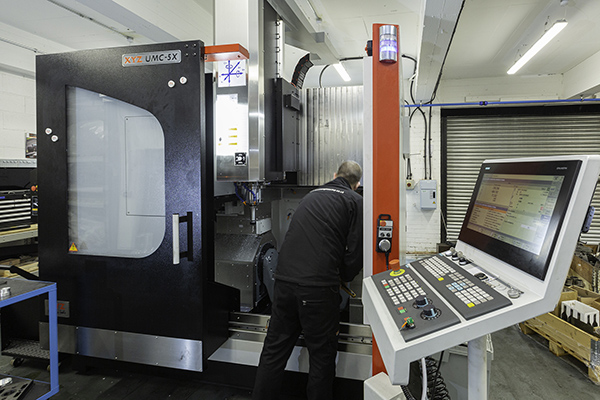
Initial research by William Bullock identified the XYZ 750 LR as the ideal machine, and his investigation confirmed that the quality and performance of the XYZ machine, along with service and support, would meet requirements. Price was also a factor, with Yorkshireman Ian Bullock’s reaction being “how much?” However, with subcontractors now refusing to quote for the volumes needed, or giving extremely long lead times, he knew it was the right investment.
“We initially considered buying a used machine, but the security provided by a new machine in terms of the back-up we could call on if we had any questions related to programming and operating the machine, or in terms of service, convinced us that a new model was the way to go. With the arrival of the XYZ 750 LR we have got back control of production. We could no longer be dependent on others; we had to have the ability to make things ourselves.

“The machine also allows us to provide a much more bespoke service, as we can modify designs quickly to suit customer needs. New product development is enhanced as we can produce prototype parts when we need them. We have hundreds of ideas, such as our recently developed mini floor stand, which takes just 40% of the floor space required by conventional systems. This has proved to be a success and having the XYZ machine means we can turn ideas like this into reality, sooner rather than later.”
The speed and build quality of the XYZ 750 LR linear rail-type machining centre has brought significant productivity gains. An example of this are the riser blocks used on the new Mounts and More mini floor stand. Previously, on the company’s old machine, it took seven minutes to produce a one-off. Now, thanks to the 13 kW, 8000 rpm spindle and up to 20 m/min feed rates, four of these risers are produced each cycle in just over six minutes, a near 80% saving per part.
In addition to cycle time savings, Mounts and More is also seeing an improvement in surface finish thanks to the build quality and performance of the machine’s linear rail construction.
“We can certainly push the XYZ machine harder and faster than before, and achieve better quality products,” says Ian Bullock. “We can now manufacture bespoke systems and further develop our own product range with a view to expanding our market reach to beyond the 10% of the sector that we already serve.
“One unforeseen advantage of the XYZ 750 LR was the effect it has on customers,” he adds. “We regularly get visits from NHS trusts and wheelchair manufacturers, and the machine makes a distinct impression on them. We’re selling them a premium product and having the XYZ machine enhances that perception in their eyes.”
For further information www.xyzmachinetools.com

Bandsaw is twice as productive

Established in 1892 and employing more than 200 staff, family-run firm Thomas Graham & Sons, now in its fifth generation, operates a multi-faceted business in Carlisle. One division is devoted to steel stockholding, which has seen a significant rise in cutting capacity following the purchase of a new KASTOwin A 4.6 bandsaw built by Kasto, Germany and supplied through its Milton Keynes subsidiary.

The machine was installed in 2018 specifically to fulfil a new contract for cutting 350 tonnes of mild steel alloyed with boron, every year. Used by a forestry industry truck manufacturer for producing chain links, the lengths of flat bar need to have a high boron content to promote hardness during heat treatment.
Bundles of 24 bars of 50 x 20 mm cross section and with two bevelled edges are sawn into 280 mm lengths, each cycle comprising 10 cuts, producing 240 billets. The bars are removed from the output roller table before the next cycle starts.
Thomas Graham’s operations director Phil Barnes, who has been with the company for 17 years, says: “The KASTOwin is our first bandsaw from this supplier but our 11th on site. Boron steel isn’t especially difficult to cut using a standard bimetal blade, so it’s a simple contract to fulfil, but the automatic Kasto saw does it extremely well, day-in day-out, easily holding the required ±1 mm tolerance.
“We were expecting each bundle cutting cycle to take eight hours, but in fact it is completed in just three and a half hours,” he adds.

He goes on to explain that the high performance is partly down to the 10 minutes per cycle that is saved by the Kasto saw’s ability to start the trim cut automatically when each new bundle is loaded. On other machines it is necessary first to cut the bundle to level the face, then measure the bar before production can start.
More important for achieving the high level of productivity is the adaptive down-feed on the bandsaw, which is called KASTOrespond. This function allows a band feed rate that is higher than would otherwise be feasible, as it is automatically backed off momentarily if the built-in pressure sensor detects a rise in cutting force. An unexpected spike in cutting force can occur as the blade reaches transitions between layers of bars in the bundle, or if it encounters a hard spot in the material. Optimal force on the blade is therefore maintained throughout the cycle, ensuring a good quality of cut and avoiding damage to the blade.
Barnes says: “When it came to buying a new bandsaw for this work, bearing in mind we use three makes other than Kasto, we benchmarked various options and asked the potential suppliers to process a sample batch of our boron steel. Our welding division manager Jim Hunter and I were impressed with the Kasto demonstration at their Milton Keynes showroom, added to which the price of the machine was acceptable. In particular, we appreciated the consultative nature of their sales approach, which prompted us to place the order.”

The fully-automated bandsaws from the KASTOwin range have been designed for mass production sawing of solid material, tube and profile. Designed in Germany and manufactured on state-of-the-art production flow lines at assembly plants in Achern and Schalkau, KASTOwin machines are said to create the conditions for optimum efficiency.
Each machine can be customised to the specific application using a modular design system, while rapid motion is said to be assured using servo drive and ball-screw spindle technology for the material feed and linear guided saw frame. Further features include: automatic band guide arm adjustment; quick and easy programming via a colour touchscreen; SmartControl to ensure high bandsaw blade lifetimes; and incremental feed for cutting batches of short workpieces.
Since the bandsaw was installed at Thomas Graham & Sons, the higher-than-expected productivity on the boron steel job has provided spare capacity for general purpose cutting of engineering steel bar, such as EN8 and EN24T, from 10 to 300 mm in diameter, either singly or in bundles. Barnes advises that work transferred from other machines onto the Kasto is completed in approximately half the time, commenting further that when the operator returns to the saw, the job is nearly always finished and ready to be unloaded.
The stockholder’s management is in no doubt that the KASTOwin is highly beneficial to business, not only due to the bandsaw’s productivity on the contract for which it was purchased, but also because of the machine’s ability to cut other materials, including stainless steel and aluminium, so precisely. A tolerance of -0, +1 mm is held routinely, saving wastage by not having to program extra allowance, as would be the case on the company’s other, less accurate saws.

In conclusion, Barnes says: “We have an evolving customer base, more than half of which requires material cut to size, so bandsawing is a crucial function for us. Certainly the KASTOwin has been a revelation in terms of its productivity and accuracy of cut.
“We’ve also been impressed with Kasto as a company and feel that we have entered into an alliance whereby we can consult with them on bandsaw technology and receive unbiased advice,” he states.
For further information www.kasto.com

Laser-cutting subcontractor witnesses rapid growth

After completing his apprenticeship and gaining an HND in mechanical engineering, as well as an NVQ Level 3 in AutoCad, Iain Summerfield found himself at a sheet-metal subcontractor in 2001 sweeping the floor and loading material on to four Bystronic CO2 flat-bed laser-cutting machines. Within the first three months he had reorganised the firm’s production processes, started programming and operating the lasers, and took a course in the nesting, programming and simulation software, BySoft.

Seven years later, in mid-2008, he decided to use a small inheritance, re-mortgage his house and join forces with co-director Paul King to set up their own company, Laser 24, to provide similar subcontract services. In a little over a decade, the subcontractor has grown to employ 26 staff and has added CNC bending to its capacity.
Due to the reliability of the Bystronic machines at his previous company and, in particular, the user-friendliness of the software, Laser 24’s first purchase was a second-hand BySprint 1.8 kW CO2 3015 (3 x 1.5 m) laser-cutting machine, which ran 24-7 in a 3500 sq ft factory unit in Wickford, Essex. At the time, one of the early contracts was the production of 5000 decorative snowflakes from 0.5 mm aluminium sheet for a Christmas display at Harrods department store in London.
Various permutations of more powerful CO2 laser-cutting machines were operational on the shop floor over the next seven years. However, it had become apparent that for cutting stainless steel and aluminium, it was impossible to be competitive with a CO2 laser as fibre lasers were so efficient at processing these reflective materials. Copper and its alloys, which previously could not have been considered at all, can additionally be cut as there are no conventional optics to be damaged by back reflections.
So in 2015, one of the CO2 machines was exchanged for Laser 24’s first fibre laser cutting machine, a Bystronic 3 kW ByStar Fiber 3015. The machine was automated with a ByTrans Extended sheet-handling system purchased two years earlier with a previous machine, shortly after the subcontractor moved into new premises near the original unit and almost double its size.
The effectiveness of fibre laser cutting was immediately apparent, and the wider range of materials that could be processed resulted in new work being won. Fibre technology had matured by then into one that was supplanting CO2 in almost all application areas, and was clearly the future. By mid-2018, the subcontractor had attached a 10 kW ByStar Fiber to the ByTrans Extended, which was joined by a second identical production cell six months later. Laser 24 is the only company in the south of England to operate a pair of 10 kW sheet-metal cutting centres.

Summerfield says: “With our latest machines we opted for the PowerCut feature in the BySoft 7 control software, as it produces a clean cut edge on thicker, even reflective materials up to 30 mm. It is also economical, as it more than halves the volume of assist gas consumed.
“The 10 kW fibre laser is twice as fast as our previous fibre machine and over three times more productive than our old CO2 equipment,” he continues. “We now cut 10 mm mild steel sheet at around 5 m/min on the 10 kW machine, whereas on our CO2 machines, the best we could achieve in the same material was 1.5 m/min.”
Summerfield adds that the company mainly uses nitrogen as the assist gas, rather than oxygen, as it results in an un-oxidised edge that does not need to be finished before it is painted or powder coated.
A further advantage of having a 10 kW fibre laser source is that there is sufficient power to use air rather than oxygen as the assist gas for certain jobs. This strategy results in an edge quality that is indistinguishable from oxygen when cutting material up to 1.5 mm thick, and is still acceptable for thicknesses up to 3 mm. In fact, Laser 24 is currently considering air cutting, which avoids the cost of using bottled gas, as an economical alternative to plasma cutting for applications that do not require top-quality edge finish. Trials are currently being performed.
A further significant benefit of the higher power laser is its ability to guarantee the edge quality on both sides of a sheet when cutting coated material. Normally, due to the coating on the underside, a burr results that needs to be removed by hand, but the 10 kW fibre source eliminates this problem and leaves a clean edge.
Coupled with the use of ByTrans automation, which avoids the risk of manual handling damage, parts delivered to customers require no buffing or cleaning. A case in point was the supply of mirror polished stainless steel frames that supported glass displays and were visible from both sides at this year’s Chelsea Flower Show.
Maximum cutting capacities of the 10 kW fibre laser are 25 mm mild steel, 30 mm stainless steel and aluminium, 15 mm brass, and 12 mm copper. Summerfield makes the point that the ability to tackle thicker plate overlaps with the use of waterjet cutting, compared with which laser processing is half the cost. Unless a heat-affected zone at the component edge created by the laser (but not the waterjet) is a problem, for the aforementioned gauges of material, the 10 kW Bystronic ByStar Fiber is the obvious choice.
At the end of 2017, Steve Westgate was employed by Laser 24 as operations manager to oversee a gradual transition to a paperless working environment, which included the replacement of a wall-mounted T-card planner. Two additional software modules within BySoft 7 that are accelerating this process are ‘Plant Manager’ and ‘ByCockpit’.
Plant Manager is an analysis, planning and monitoring module that automatically assesses machine and job data so that parts can be cut and bent more quickly, at a lower cost and without errors. As manual data input is no longer necessary, processes run more reliably. The software provides comprehensive statistical data on production efficiency, which Westgate says exceeds 90% OEE at Laser 24.

Within the Plant Manager suite, ‘Parts Removal’ software is especially popular with the production staff. Among other abilities, Parts Removal allows the suction cups on the ByTrans to be positioned such that individual components within a sheet can be picked up and stacked on to pallets, with the skeleton also being removed, all of which reduces handling time and cost.
ByCockpit is a more recent introduction that monitors, in real time, all processes taking place within Bystronic laser-cutting machines and press brakes. Running on a laptop, smartphone or tablet, the software collects data without manual intervention, evaluates it and generates status reports while machines are actually producing parts, allowing production output to be continually optimised. Westgate says that the app allows all KPIs (key performance indicators) to be managed within the Wickford facility.
For many years, customers had been asking for laser-cut parts to be bent, a service that was fulfilled by putting the work out to other subcontractors. This situation changed in September last year with the arrival of Laser 24’s first press brake, an 80-tonne, 1.5-m capacity Bystronic Xpert 80. The press brake is of a design that allows a robot to be attached to the front so that loading and unloading can be automated. Such a retrofit is being seriously considered, since as many as half of current customers have expressed interest in having their parts bent.
A particular strength of BySoft 7 is that it is used to program not only laser-cutting machines, but also press brakes, so only a single program is needed for producing a bent part from a flat sheet. Having one program speeds the end-to-end manufacturing process and virtually eliminates the possibility of mistakes, so even the first-off part is right.
Summerfield states: “The Xpert press brake is the fastest and most advanced on the market. Its high productivity allows us to add value to parts quickly and undercut the competition.
“BySoft does the majority of the thinking for you and has taken the trial-and-error out of press braking,” he adds. “An internal database allows bend allowance, spring-back angle and punch stroke to be calculated automatically according to the type and thickness of material. High accuracies are routinely achieved, typically ± 0.25°.”
Laser 24’s customers are to be found in a wide range of sectors, including automotive, aerospace, marine, yellow goods, construction, retail, catering, signmaking and general engineering. Due to a high level of interest in the provision of additional services, the company is considering expanding the extent of its in-house processing capability to include fabrication and painting, and perhaps additional machining operations such as milling, tapping and countersinking.
For further information www.bystronic.co.uk