

Filtering out secondary operations

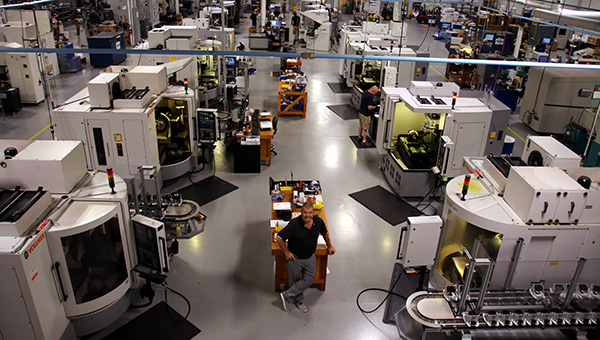
Headline Filters in Aylesford, Kent has taken a big step towards streamlining the manufacture of its components by adopting twin-spindle turning and five-axis machining to reduce set-ups and take advantage of lights-out operations.

New process routes for around half of the factory’s production of bonded microfibre filter housings involve four new CNC machines installed between September 2018 and July 2019: three turning centres with Y axes from Biglia, Italy, and a German-built Spinner machining centre with trunnion-mounted rotary table. All of the machines were supplied by UK agent Whitehouse Machine Tools.
A backlog in multi-operation turning and milling of a particular filter part, a complex stainless steel head designated ‘112’, prompted the manufacturer to look for a more productive solution. The obvious choice was a lathe with powerful driven tooling and twin-opposed spindles to enable in-cycle machining of the reverse end of the component.
Space is limited on the shop floor in Aylesford and the machine initially considered was too large to be conveniently installed. Whitehouse demonstrated how the more compact Biglia B565-YS lathe, which was also half the price, could do the job – provided it was fitted with double, triple and quad tool holders in its 12-station turret so that the requisite number of tools could be deployed.
Programs were written and time studies carried out at Whitehouse on this part, as well as two other components, and the feasibility of all processes was confirmed. The first Biglia B565-YS was installed in September last year and ran for several months to clear the ‘112’ component production backlog.

Rob Hibberd, director of Headline Filters says: “As soon as we saw the lathe producing the stainless steel components in one hit, we knew it was the way forward and quickly ordered a second identical model, which arrived at the end of last year. The previous production method involved turning on two separate single-spindle lathes and three set-ups on a three-axis vertical machining centre, so five ops in all. Total cycle time was 17 minutes, including three minutes for repositioning the part on the VMC.
“The new cycle time of 16 minutes on the Biglia is not much different, as its driven tooling cannot compete with the milling power of a machining centre,” he continues. “However, the big advantage now is that there is no inter-machine handling or work-in-progress, and production is minimally attended, so the operator can look after several machines. Even more importantly, we can take advantage of unmanned ghost shifts for extra production output. We gain up to eight hours overnight when machining aluminium and brass parts, and a couple of hours when running stainless steel before the tips become blunt and the lathes shut down automatically.”
He adds that a further advantage of single-hit production is the ability to better hold tolerance, as no cumulative errors are introduced by repeated re-clamping. Run-out is improved and ±0.05 mm tolerance is easily held on O-ring seal faces. Surface finish is also enhanced due to the stability of the Biglia lathes and the ability to run modern tooling at the recommended feeds and speeds, so less subsequent polishing is needed. It is also notable that tool life is prolonged on these lathes due to their rigidity.
In another before-and-after example, an aluminium ‘360’ filter head previously needed turning on a lathe and prismatic metal cutting on a machining centre, taking 12 minutes (including handling between the two machines). The part is now produced in one hit in an 11-minute cycle on a B656-YS bar auto. Again, the main benefits are a reduction in work-in-progress, better accuracy and the ability to automate production.
Whitehouse facilitated unattended running by fitting to each lathe a Hydrafeed MSV80 bar magazine for feeding 1 m stock through the spindle and providing a Rota-Rack rotary parts accumulator to collect finished components delivered via a parts catcher and conveyor. The B565-YS lathes were supplied with a bigger spindle bore than usual, 75 mm rather than 65 mm, to enable the production of Headline Filters’ larger parts in high volumes.

Above this diameter batch sizes are lower, but recently the manufacturer’s US distributor started to request bigger products in higher quantities, which put pressure on the company’s single large-capacity turning machine. Positive experience with the first two Biglias again pointed Hibberd in the direction of Whitehouse, which in April 2019 supplied the largest capacity version of a twin-spindle Biglia 750-YS with Y axis and C axis.
The Biglia 750-YS is capable of turning components up to 552 mm diameter by 765 mm long, far larger than needed. More pertinently for Headline Filters, it is possible to use a bar puller in the turret or, alternatively, the counter spindle to feed stock up to 100 mm diameter through the bore of the main spindle into the working area to simulate the advantages of having a bar feeder. A 38 kW main motor, 17.5 kW driven tools in the 16-station turret, rotational speeds up to 10,000 rpm, plus the availability of high-pressure coolant, promote productive machining.
An early example of time advantage using this machine involved the production of a ‘380’ aluminium filter head in one operation in a cycle time of 15 minutes 50 seconds. Previously, using the other large lathe, which is of single-spindle design without driven tools, the part had to undergo two operations and then be transferred to a machining centre for milling and drilling. The three operations took 21 minutes 15 seconds, plus handling between machines.
As 15,000 of these parts are needed annually, the production cost saving is considerable. Work-in-progress is eliminated, avoiding the need to have batches of typically 400 part-finished components in storage. Moreover, as Hibberd points out, each part can be assembled into a filter for delivery and invoicing straight away, not days or weeks after machining operations have been completed.
A previous difficulty in the factory was that six lathes with limited or no live tooling were feeding components to a pair of overloaded, entry-level VMCs with 7000 rpm spindles for milling and drilling. That problem was alleviated by the arrival of the three Biglia lathes with their driven cutters, so the machining centres were able to cope. However, with an eye to the future, Headline Filters decided to invest in its first five-axis machining centre to boost prismatic metal-cutting capability.
The Spinner U5-630 five-axis VMC supplied by Whitehouse in July this year with 12,000 rpm BT40 spindle, provides more productive machining as higher rotational speeds increase metal removal rates and enable the use of more capable, contemporary tooling. A large magazine for 32 cutters, high-pressure coolant and Blum probing for setting tools and workpiece datums, form part of the production package. The extra power and rigidity will help when producing filter parts from tough materials, not only stainless steel, but nickel and titanium alloys.

Jason Rose, engineering and workshop manager, says: “We use the Spinner mainly in 3+2 axis mode for automatic workpiece positioning to reduce the number of manual set-ups. Nevertheless, we have a certain amount of contour milling to do and, when I design new products in future, I’ll have greater flexibility to incorporate features that would be uneconomic or impossible to complete on a three-axis, or even a four-axis VMC.”
He also advises that the U5-630 is significantly faster at cutting metal than the other machining centres on site. In one example, a 12-minute cycle was reduced to seven, and in another, 45 minutes was reduced to 20. There is potential to improve on these times further as Headline Filters’ operators become more familiar with the new cutters they can now use, as well as the Siemens control system, which is the first on site.
For further information www.wmtcnc.com

Gearbox casings produced up to 66% faster

Replacement of an ageing, single-table, horizontal-spindle machining centre with a new, German-built Burkhardt + Weber (BW) twin-pallet model supplied by UK agent, Kingsbury, has revolutionised the machining of industrial gearbox casings at Rochdale-based Renold Gears. The gearbox casings are produced mainly from iron castings and fabrications, but also from steel and aluminium.

The resulting savings in floor-to-floor times of between one-half and two-thirds are due to increased metal removal rates during cutter engagement, significantly reduced non-cutting times through faster axis movements, fewer operations due to better fixturing methods and faster component changeover through offline set-up on the second pallet.
Furthermore, with the twin-pallet configuration, if there is an issue during the machining of a component it can be brought out of the working area for inspection, allowing production of the next part to commence. Such troubleshooting would have resulted in a lot of unproductive time on the previous machine.
Renold’s gearboxes are large prismatic components that can measure more than 2 m in height and weigh up to 3 tonne. Around 20% of the products manufactured are standard, with the remainder being customer-specific designs that are produced in quantities of between one-off and 30-off per month. Fast, flexible machine tools are needed to produce such relatively low batch sizes in a cost-effective manner and allow the manufacturer to compete in world markets.
When the company’s CEO was appointed in 2013, he instigated modernisation initiatives that started with the factory infrastructure. A programme followed of drive and control retrofits and mechanical upgrades to what are fairly specialised machine tools, such as worm screw and wheel production centres.

Three years later, the company’s production workers were asked which machine on the shop floor they would most like to replace, and the large horizontal machining centre was almost unanimously chosen. By then, this machine’s unreliability was resulting in sometimes having to outsource machining to meet production deadlines. After several twin-pallet HMC options had been considered, the decision was taken to purchase a BW MCX 1400 with a 3200 by 2200 by 2000 mm working volume and B-axis NC table.
A senior manufacturing engineer at Renold Gears says: “During trials, the BW machine proved capable of more than halving the cycle times on the old HMC, and was also more productive than the other four-axis machines with pallet changers that we considered. We gave two test parts to each potential supplier: a gearbox casing for a heat exchanger and another for an escalator drive. On average, they were machined around 15% quicker on the MCX1400.”
Key elements of the machine specification that deliver this high productivity are acceleration of up to 5 m/s² to rapid traverse speeds of 60 m/min, and a 60 kW/3500 Nm/5000 rpm spindle with HSK-A100 interface.
The engineer at Renold Gears adds that other factors favouring the chosen machine were its availability on short delivery, as well as its ergonomic design, which promotes safety when personnel approach to access the working area or carry out servicing while it is running. Additionally, the 180-pocket tool magazine (extendable to 330) is helpful, as a large number of cutters are needed to cope with Renold’s wide range of gearbox casing sizes and materials. A majority of these tools can be permanently resident in the magazine.
Drawing tolerances are tight for such large components, down to 20 µm in total for certain machined features like gear centres and shaft bores, some of which are produced by interpolation milling. The reliability and repeatability with which this level of accuracy is achieved on the MCX 1400 means that downstream benefits are experienced in the metrology department. CNC inspection is faster, as it requires less comprehensive routines and fewer components need to be checked.

Kingsbury prides itself on providing a production solution rather than a machine tool. While the BW installation at Rochdale was not what the supplier would class as a full turnkey project with tooling and fixtures, which Renold provided itself, it nevertheless entailed significant early support.
Initial test programs were converted directly into cycles for production parts covering two families of casing, while further programming support was provided along with on-site operator training. Service is carried out by Kingsbury’s own engineers via the company’s divisional LPM (Large Prismatic Machines) offices in Warwick.
The engineer at Renold Gears concludes: “We’ve also been migrating the machining of our custom gearboxes and some standard product across to the BW machine to take advantage of its high productivity. It already does the work of the old horizontal machining centre and another machine, and we’re looking to consolidate jobs on the BW that we currently put on a third machine. Once a process is in place on the MCX 1400, it eats the work.”
For further information www.kingsburyuk.com

Takumi takes off with hyperMILL

A name established from the Japanese term for craftsman or artisan, ‘Takumi’ Precision Engineering has been delivering both craft and artisanship to the shores of Ireland for over 20 years.

The Limerick-based company has invested heavily in recent years with a new factory expansion that has taken floor space to 50,000 sq ft, and over €5m invested in new machine tools and CAM software to further extend its market position on the Emerald Isle.
Takumi Precision is a prominent figure in the medical device, pharmaceutical, aerospace and precision engineering sectors in Ireland. The company manufactures orthopaedic implants and instruments, cardiovascular assembly aids, medical grade rasps, balloon moulds, and delivery system components, as well as aluminium wing and fuselage components for the aero industry, and electrical, electronic, mechanical and optical engineering parts for the precision machining sector.
Down the years, Takumi has invested in turning centres from Tornos, Doosan and Miyano with three- and five-axis machining centres from Doosan, Spinner and, most recently, Matsuura adding to the plant list. One of the company’s core investments has been hyperMILL CAM software from Open Mind Technologies, which was driven by the onset of barrel tool technology, an influx of five-axis machines and challenges with previous CAM systems.
Commenting on the changes at Takumi, managing director Gerry Reynolds says: “Only five years ago, 90% of our work was in the medical industry, with the remaining work being across a number of sectors, including the aerospace market. We had an opportunity to enter the aerospace segment in a more positive way, increasing volumes from 1 to 3-offs, to continuous batches of 10-15-off, on the Airbus A220, previously known as the Bombardier C-Series. We had to invest in five-axis technology to accommodate the ramping-up of this complex aerospace work, so we bought 13 five-axis machines in the past five years.”

The investment has paid dividends, with aerospace work increasing from 5% of turnover to almost 60% in less than five years. However, this success is not to the detriment of the medical business, as Reynolds continues: “Our business has doubled in size over the past three years due to the increased aerospace work, but the medical sector remains crucial to Takumi. Medical components are now 40% of our business; the volume of work has not reduced, it just hasn’t grown at the level of the aerospace work. We now have 87 staff and are targeting a monthly turnover of €1m.
“Around 10 years ago, I didn’t understand CAM and would have argued against it,” he adds. “However, there was a necessity for CAM to run our machines and at the time I called it ‘finger CAM‘, as we were programming at the machine. We progressed to a more comprehensive CAM system and eventually installed eight seats. However, a visit to the AMRC in Sheffield introduced us to Ceratizit’s barrel tools and Open Mind’s hyperMILL CAM system, which changed the game.”
After investing heavily in CAM software, Reynolds was naturally apprehensive at the prospect of changing software again.
“Over the past 5-6 years, we’d spent a lot on CAM packages and what we had, worked relatively well, but there were a few issues with processing speed, occasional crashes and some feature limitations,” he says. “It was the barrel-tool machining features within the hyperMILL MAXX High Performance Strategy that appealed to me, but I wanted my team to take the lead, as they would be the ones using the software.
“The team did their due diligence, taking in hyperMILL demos and then asking our existing CAM vendor if the barrel-tool feature and the mirroring package were available,” adds Reynolds. “Our CAM supplier and other vendors all said ‘it’s on its way’ or ‘it’s in development’ regarding more than just these two features in hyperMILL. That told us all we needed to know about the various vendors in the market, but it told us a lot more about hyperMILL. They are clearly streets ahead of the other CAM developers. We have rapidly moved to hyperMILL; we bought our first seat 18 months ago and now have six seats. Our previous CAM system is currently being phased out.”
Primarily, the reason Takumi Precision invested in hyperMILL was the potential of barrel tools to significantly improve productivity.
Commenting on this capability, Reynolds says: “The hyperMILL MAXX Machining High Performance Package and the respective barrel tools with their innovative geometry allow us to step-down 5 to 10 mm, as opposed to 0.4 to 0.8 mm, when finishing pockets, walls or profiling features. This has instantly reduced finishing cycles by at least 70%, giving us a minimum overall cycle time improvement of 30% on every component.”
However, the benefit is not just the cycle time improvement.

“We’ve historically had a number of staff undertaking finish-polishing of parts to ensure our surface finishes exceed customer expectations,” he says. “Despite the increased speed and step-over rate with hyperMILL MAXX High Performance Machining, the surface finishes are much better than before. This is because the barrel tool has a higher engagement rate that keeps the tool in constant contact with the workpiece.”
Another feature that persuaded Takumi Precision to invest in Open Mind CAM software was the mirroring function, as Reynolds explains: “In the aerospace industry, almost everything is manufactured with a left- and right-hand component. The mirroring feature in hyperMILL is remarkably comprehensive and, with the touch of a button, we’re reducing our programming times on most components by 50%. We have eight programming staff and the mirroring feature in hyperMILL is effectively doubling the productivity of this team.”
Although hyperMILL has reduced cycle times on the shop floor by over 20% and reduced programming times by upwards of 50% in the office, the benefits reach much further.
“Open Mind’s hyperMILL is much faster than previous CAM systems and it handles ‘big data’ much better than we’ve previously witnessed,” states Reynolds. “This has eliminated unforeseen PC crashes and massively improved the reliability, processing and delivery of our data to the
shop floor. Furthermore, Open Mind’s hyperCAD, which is integrated into hyperMILL, is an excellent platform that has eliminated our reliance on CAD packages such as Inventor. We can now expedite jobs through hyperCAD to hyperMILL with ease.”
For further information www.openmind-tech.com

Gritter manufacturer goes from strength-to-strength

For those finding themselves driving behind a gritter or salt spreader in the UK this winter, there is an 80% chance it was bought or hired from Econ Engineering by the local council or highways contractor. The company is the largest British manufacturer of such vehicles, producing 360 units per year at its 88,000 sq ft factory, which opened in 1980 in Ripon. Additionally, Econ operates a growing hire fleet of currently more than 800 units, which has boosted annual turnover to over £34m, making the firm a major contributor to the local economy.

In fact, in its 50th year, Econ is experiencing an unprecedented order book, partly fuelled by recent harsher winters, but also due to the multi-body products that allow customers to utilise one chassis for multiple tasks, such as road repair and winter maintenance, making the investment usable throughout the year.
The 220-employee company’s dominance in the market is down to the premium quality of its products, with all design and manufacture carried out in-house, including the painting of components. For nearly one-third of its 50-year existence, Bystronic has been helping Econ to maintain the high level of component accuracy that underpins its reputation for quality.
Initial credit for this success story goes to the late Bill Lupton, who single-handedly started a business towards the end of the 1950s in a barn on his family’s farm to make flail mowers and hedge trimmers. Exceptionally cold and freezing weather during the winter of 1962/63 brought England to a standstill, with many being cut off for weeks. This turn of events inspired Lupton to develop the first salt-spreading vehicle that would keep the country moving and the wheels of industry turning.
To manufacture the salt spreaders, he started Econ Engineering in the autumn of 1969 on an old brewery site in Ripon. By then, the M1 motorway had opened, as well as sections of the M2, M4 and M6, and local councils, notably Lancashire and Westmorland, were expressing considerable interest in winter maintenance operations such as salt spreading and gritting.

Fast-forward 34 years and 2003 saw the second generation of Luptons – Jonathan and Andrew – take over the company. They were instrumental in developing contract hire for gritters and snowploughs at a time when public spending cuts were making new equipment purchase difficult. Underlining their commitment to building up this side of the business, in 2005 the brothers increased the fleet size through the acquisition of a major competitor, Municipal Hire Services.
It was in the early 2000s that the first Bystronic laser machine replaced a turret punch press and a plasma cutter for processing the majority of components made from mild steel plates. In addition to being used in the manufacture of gritting and salt-spreading equipment, the components also find their way into snowploughs, as well as bodies for highway maintenance and road patching that Econ mounts to lorry chassis, often Mercedes and DAF.
The laser machine, a ByStar 4020 with a 4 kW CO2 power source supplied by Bystronic UK, greatly increased production efficiency and component accuracy. Sheet metal up to 4 x 2 m could be processed on the machine, but its 4.4 kW and then 6 kW successors were able to accept sheet up to 6.5 x 2 m (nominally – in practice 1.83 m wide). Larger body panels can be produced without welding and the productivity of smaller components is boosted by the ability to nest and cut more parts in one sheet, at the same time reducing the amount of wasted material in the skeleton.
Installed in 2014, the current laser machine works 24/7, processing up to 35 tonne of steel a week into any of 87,000 different components produced in batch sizes ranging from 5 to 30, and to an accuracy in some cases down to ±0.5 mm. With such a large variety of part numbers, extensive use is made of modern MRP software, as well as colour coding of components on the shop floor according to their material, thickness and product type.
Bystronic’s own BySoft offline programming software automatically nests the components for maximum sheet utilisation. The software then produces the cutting plans, in this case up to 14 days in advance of scheduled production to assist ordering of material, and monitors the manufacturing processes in real time. The effectiveness of these procedures is evidenced by an above-average OEE of 63%, representing the proportion of time the laser is actually cutting metal.
More than 70% of the output from the laser machine is folded. The press operators create folding programs for the three Bystronic press brakes directly at the machine controls. Two of the machines, installed around a decade ago and rated at 320 tonne/4.1 m and 150 tonne/3.1 m, are positioned side by side. These machines are used either independently or in tandem for bending very large components. Also in use is an Xpert 40 tonne/1 m capacity press brake, which arrived in 2018 for bending smaller parts more efficiently and hence cost effectively. The Xpert 40 can easily be relocated within the factory to where it is most needed.
Other machines in use from the Swiss manufacturer are a VR 10×4000 jobbing guillotine and, for deburring components, a belt grinder from German firm Weber, for which Bystronic acts as UK sales agent. The latter is used for removing sharp edges from laser-cut components and to descale them ready for shot blasting and painting. Every item of production equipment in the metal preparation area, except for the sawing machines, has been supplied by Bystronic.
Colin Trewhitt, who has worked for Econ for over 30 years and is currently factory manager, says: “When we bought the first Bystronic laser cutter back in 2003, we spent a lot of time reviewing alternatives on the market. We drew up a check sheet detailing everything from cost of ownership to production output and service support. Of the three potential suppliers on our shortlist, Bystronic came out on top and we’ve stayed with them ever since.”

Jonathan Lupton, joint managing director adds: “We’ve always tried to innovate and strive for excellence, and nowhere is that more apparent than in our use of the laser to cut steel in our body shop. Despite the machine representing a considerable expense at the outset, it was another example of how we always lead the way in our industry. The investment has more than paid off in terms of higher production output, while improved accuracy has almost eliminated fit-up during assembly and cuts costs further.
“We’ve gone from strength-to-strength by focusing not only on quality but also on the needs of our customers,” he continues. “That is why we have a UK-wide network of depots for servicing and recalibrating our equipment in the field, including a new one that opened recently in Alloa, and another due to open in Cardiff in spring 2020.”
Innovation is the watchword at Econ. The company was the first in 1989 to invent the quick change body (QCB) system that allows a single chassis to have multiple applications, for example by the addition of an asphalt hot box for road repairs or for use as a tipper, crane or gulley emptier. This innovation reduces capital investment by a council, which no longer needs multiple vehicles to satisfy the same range of year-round tasks.
A recent Econ invention was a ‘Spargo’ system that controls grit or salt spray and width patterns from the cab, automatically optimising the amount of product used and hence saving cost as well as protecting the road surface. The system also provides one-touch control for lowering the snow plough, turning on the gritter’s beacon bar and performing other functions, making the driver’s tasks easier and less tiring. For greater efficiency, the Spargo system is connected to the vehicle’s GPS to help plot the most effective route. New technology in the company’s sights include driverless vehicles and liquid de-icers, intended to be less harmful to a road surface.
For further information www.bystronic.co.uk

Supercar benefits from 3D-printed component

So, how can the production of a fully functional air intake prototype be reduced from two weeks to just a few hours using a Stratasys F900 3D printer? Well, for the answer, just ask Briggs Automotive Company (BAC), the British manufacturer of the recently launched Mono R, which has revealed the impact that additive manufacturing is having on the design and production of the latest edition to the BAC elite supercar offering.
When faced with detrimental delays to the design process of an essential airbox, the team at BAC turned to Stratasys FDM additive manufacturing to produce fully functional prototypes in record time and improve final, on-road performance.

The Mono R is the company’s most complex car to date, comprising years of thought and thousands of hours of research. Mono R weighs just 555 kg and is the first production car in the world to incorporate the use of graphene-enhanced carbon fibre in every body panel. In order to meet the necessary criteria, the design had to be lighter, more efficient and slicker than any preceding supercar. The team faced a significant challenge, one which could not afford any hiccups.
One such challenge was the design and testing of the Mono R’s innovative air intake. Essential for the car’s cooling and on-road performance, the airbox features extremely complex and unique geometry, with the final part needing to be produced entirely in carbon fibre. Such rigorous demands meant that the production of a prototype using traditional methods presented a huge hurdle for the team. Naturally, the aim was to avoid lead times and costs from potentially spiralling, while ensuring no compromise to the performance and functionality of the prototype itself.
The final design of the airbox required expensive tooling, while the carbon-fibre production process proved labour intensive. It quickly became apparent to the design team that creating a prototype using traditional machining was simply unfeasible.

Ian Briggs, BAC design director, explains. “The lead time to produce one prototype of the airbox using traditional machining methods surpassed two weeks. If there were any problems with the prototype produced, then any design iterations would add double that amount of time. This was a delay we just couldn’t afford.”
The team at BAC turned to additive manufacturing as the solution, and sought the help of Stratasys and its UK platinum partner, Tri Tech 3D. Using the Stratasys F900 production 3D printer, the team produced the airbox in just a few hours, which was then fitted to the car and put through its paces to assess the part’s design and performance.
“Access to quick, efficient, industrial-grade additive manufacturing was a game-changer for this development process,” states Briggs. “Within hours we were able to produce an accurate 3D-printed prototype of the airbox and install it on the car for testing. This enabled us to reduce our design-to-manufacture time significantly.”
However, it was not just turnaround times that the team had to consider. The Mono R can reach top speeds of 170 mph, with its power surpassing 340 bhp and its power-to-weight ratio reaching 612 bhp-per-tonne. As such, every aspect of the design was crucial to the success of the car. With temperatures expected to surpass 100°C degrees, any prototype produced needed to withstand intense conditions during test drives.
Thanks to the engineering-grade materials accessible on the Stratasys F900, the team was able to produce the prototype in Stratasys’ Nylon 12CF material. A carbon-fibre reinforced thermoplastic that
can endure temperatures of over 140°C, Nylon 12CF offered the design team the chance to test the prototype in as close a material as possible to the real thing.
“Access to the carbon-fibre reinforced Nylon 12CF was integral for this development process,” explains Briggs. “The prototype was as close performance-wise as if we had produced the prototype in carbon-fibre reinforced plastic made from a mould. It also withstood the tests on the track with ease.”
The overall appearance of the Mono R is 20 mm lower and 25 mm longer than its predecessor, meaning that every single millimetre matters. In order to effectively test the airbox, it needed to be accurately fitted to the car, with no room for error. However, the geometry of the airbox was complex – and incredibly large.
“The freedom of design offered by Stratasys’ industrial 3D printers was essential for the airbox,” says Briggs. “We were able to tweak the design and not worry that the final 3D-printed version wouldn’t match the exact size or geometry we needed. Today, our team at BAC has shifted its mindset to design with additive manufacturing in mind.

“The development of the Mono R needed ultimate precision, something to which additive manufacturing lends itself perfectly,” he adds. “We saw this first-hand with the use of Stratasys’ industrial system in the production of the airbox, and for the first time its effects were felt throughout the car. This is just the beginning for BAC in discovering what additive manufacturing can offer us as a design team, and how we can continue to push the boundaries of our industry.”
For further information www.stratasys.com