

Sutherland Gen2 Mark series shines at WIHG

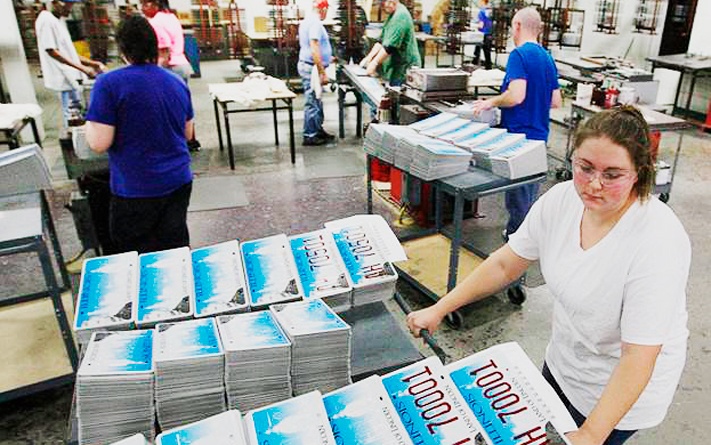
Waldale Irwin Hodson Group (WIHG) is North America’s largest private manufacturer of licence plates, servicing 20 American states and Canadian provinces. The combined output of WIHG’s multiple factories results in 11 million plates printed per year in nearly 1000 different designs. The licence plate manufacturing process begins with massive coils of aluminium, which are fed into a press line that stamps out standard blanks of 6” x 12” rectangles with rounded corners. These blanks go on to a traditional embossing process. 

Sutherland Presses has been a manufacturing partner for WIHG since 1996. Jean Bourque, WIHG’s engineering manager for tooling, relies on Sutherland to meet the high standard of quality and efficiency that such a high volume of output demands: “I like it when I can deal with the owners directly. I also like that the presses are made with North American parts.” 

In March of 2016, one of WIHG’s factories was in need of a new press for its blank stamping line. Bourque knew that Sutherland was his best bet: “I didn’t do a lot of shopping around.”

Sutherland and WIHG agreed that the right press for the job was the next generation of the Mark series press.

The Gen 2 Mark series single-point gap-frame press exemplifies Sutherland’s commitment to innovation in metal forming, with numerous improvements made over the first generation. Featuring more steel in the C-section of the frame, angular deflection is reduced under full stamping loads, allowing for better performance in bottom coining, and permitting WIHG to form the letters of the plate with reliable high definition. Furthermore, the slide guides are designed with a taper wedge to assure long die life during production runs.

More information www.sutherlandpresses.com
Press hardening of large, complex components

Electrification, multi-part integration (MPI) and a higher share of recycled material: the shift in technology in the automotive industry is driving new developments. AP&T’s new press-hardening line, AP&T Skylines, has been developed to meet these challenges and lead the way to more effective, flexible and sustainable vehicle production.  

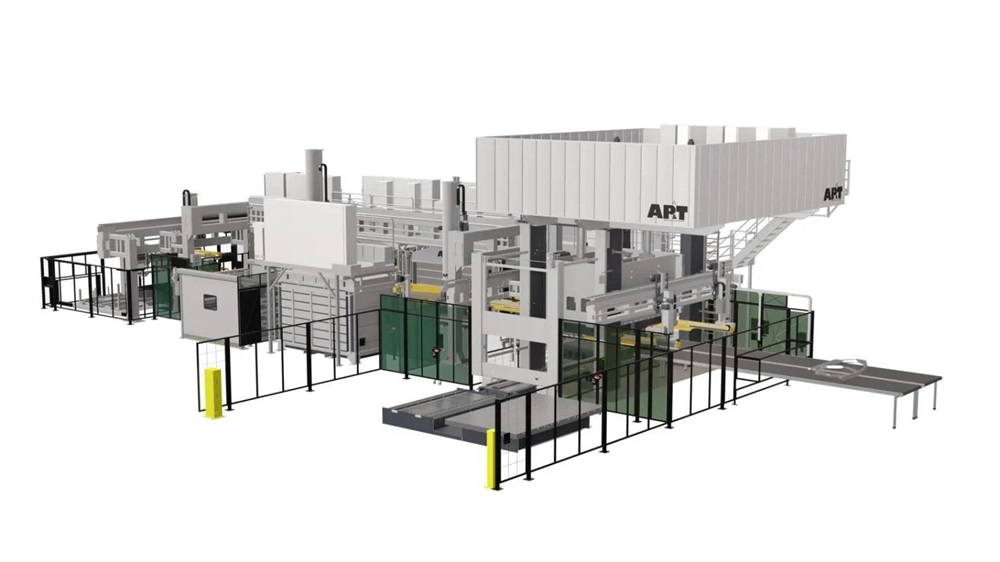
Skylines is a fully automated line that has been specially designed for effective press hardening of large and extra-large sheet metal and MPI, even in material with a high recycling rate.

To maximise production capacity for large-scale sheet metal with minimal energy consumption, AP&T Skylines has a flexible, vertical design that uses a modular and scalable solution. The line thus requires little floor space even though it includes energy-efficient servo presses, compact multi-layer furnaces, linear automation with Speedfeeders, and tools. Each modular section has been developed to meet customers’ specific needs and ensure long-term performance.

Says Magnus Baarman, managing director and CEO of AP&T: “Skylines is a result of our commitment to help customers meet both technical and environmental requirements. With Skylines, we provide them with a solution that combines sustainability and efficiency without compromising on performance.”

One of the most prominent features of AP&T Skylines is its compact and energy-efficient multi-layer furnace system. Unlike traditional roller hearth furnaces, this vertical system can handle significantly larger sheet metal and more complex components without being limited by the furnace’s dimensions. In addition, it offers significantly lower energy consumption and CO₂ emissions, which makes it a central part of a sustainable production process.

“With this flexible and scalable technology, we make it possible for manufacturers to meet both technical and environmental challenges,” concludes Baarman. 

More information www.aptgroup.com

Fully customised licence plate production line

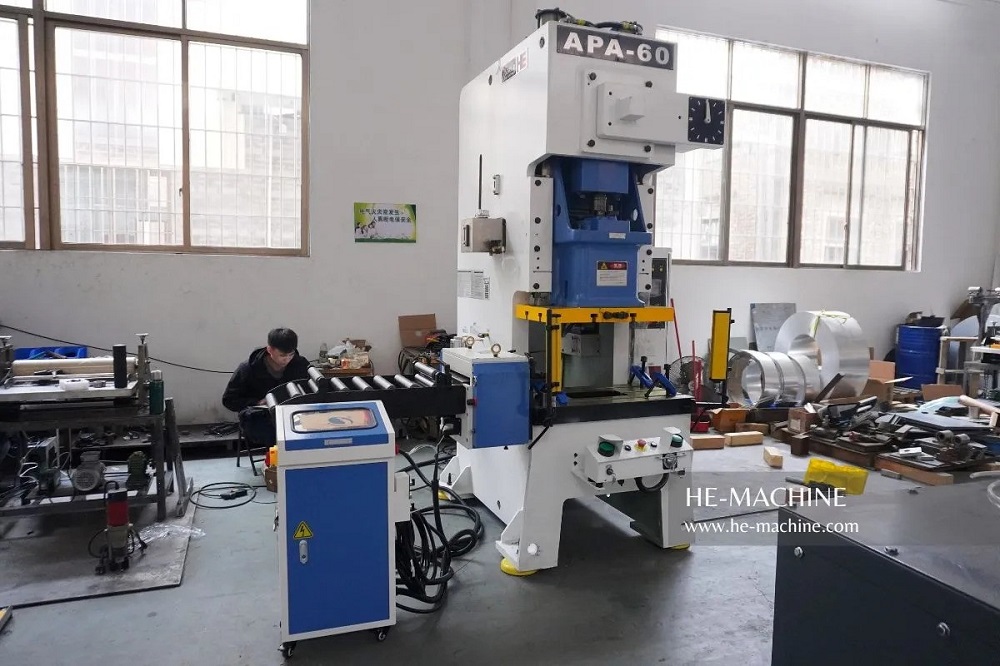
With years of experience in the licence plate production line industry, HE-Machine is
committed to offering customised turnkey solutions to clients worldwide. A recent example
sees the precise collaboration of five machines: decoiler, straightener, automatic laminating
machine, servo feeder and gap-frame press. The implementation of this project has led to

the successfully optimisation of the production process, improving both efficiency and
product consistency.
The smooth unfolding of raw materials is crucial for the successful operation of a production
line. The HE-Machine decoiler handles various specifications of metal coils, ensuring stable
material unwinding.
Next, the straightener plays an essential role. Any bending or warping in the metal materials
during production can negatively impact the quality and accuracy of subsequent processes.
The straightener, designed for precision levelling, effectively eliminates these issues.
After straightening, the automatic laminating machine applies a protective film to the metal
surface, enhancing both durability and surface quality. The auto laminating process reduces
manual intervention, increasing production efficiency while ensuring uniform coating on
every licence plate.
As the production process moves forward, the servo feeder plays a crucial role in precisely
feeding the material into the next stage. Using a servo motor drive system, the servo feeder
ensures that the metal material is delivered accurately to the next process, ensuring smooth
progression in stamping, and other operations.
Finally, the gap-frame press provides the stamping force required for the production line.
Equipped with multiple mould sizes and a conveyor system, the press precisely performs the
stamping, minimising defects and ensuring the efficient production of high-quality licence
plates.
More information www.he-machine.com

Automating material handling and storage

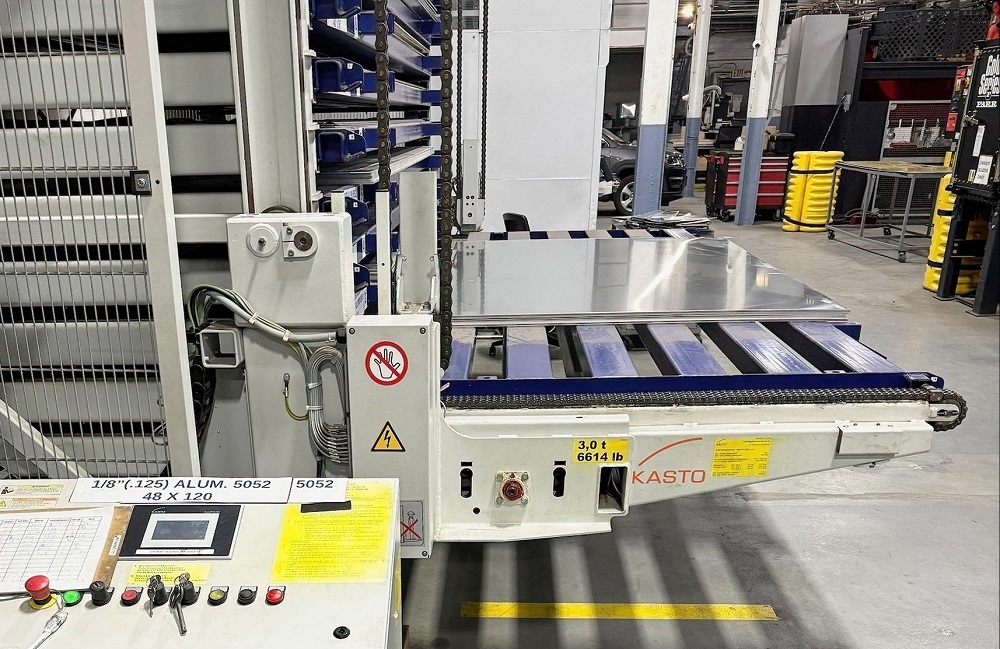
Architectural Grille manufactures in its Brooklyn, New York City factory an extensive range
of custom architectural metalwork from materials that include aluminium, brass, bronze,
steel and stainless steel. With such a wide variety of sheet metals to process, the company
wanted to streamline storage of its large inventory of materials, with an eye to optimising
material flow and maintaining operator safety.
For the solution it turned to KASTO, installing UNITOWER and KASTOecostore tower storage
systems. The systems were deemed the ideal way to alleviate the previous inefficient
manual storage arrangement. Architectural Grille has now significantly improved its logistics
processes, enhancing both efficiency and safety at its workstations.
More information www.kasto.com

Small diameter boring bars from Mitsubishi

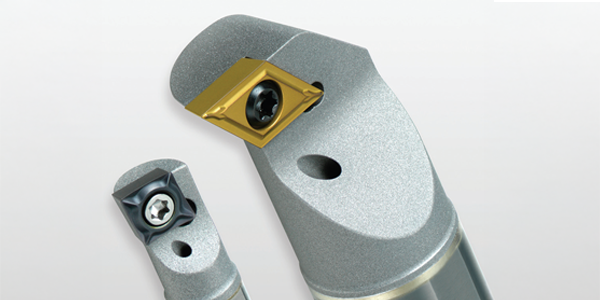
Mitsubishi Materials has launched a range of small boring bars for Swiss-type automatic lathes. The whole series of these new boring bars is available in both solid carbide and steel. The inclusion of both types provides a choice for end users and offers the benefits of deeper boring capability due to the extra rigidity of the carbide type. Additionally, not all components need an extra deep hole carbide shank, so the cost-effective steel bar is also available in all types.

The lengths of the tools are compatible with Swiss-type automatic lathes. This ready made to length feature negates the costly and time-consuming process of cutting the shanks of standard tools to a shorter length to prevent interference.

A comprehensive selection of hard steel bars has recently been introduced to the range. Notably, the hard steel body is effective in preventing damage and wear caused by chip evacuation. The  hard steel types are available in diameters ranging from 4 to 10 mm for the 7º SCLC, STUC, SDUC, SDQC and SWUC types of holder, and for the 11º types SCLP and STUP.

A vast range of different carbide bar diameters, ranging from 4 to 32 mm diameter with a minimum pre-boring diameter of 5 to 34 mm are available for the 7º SCLC, STUC, SDUC,

SDQC and SWUC types of holder, and for the 11º types SCLP and STUP.

Steel bars ranging from 12 to 32 mm diameter with a minimum pre-boring diameter of 14 to 40 mm are also available in 7º SCLC, STUC, SDUC, SDQC and SWUC types of holder, and for the 11º types SCLP and STUP.

More information www.mmc-carbide.com