

Leadership transition

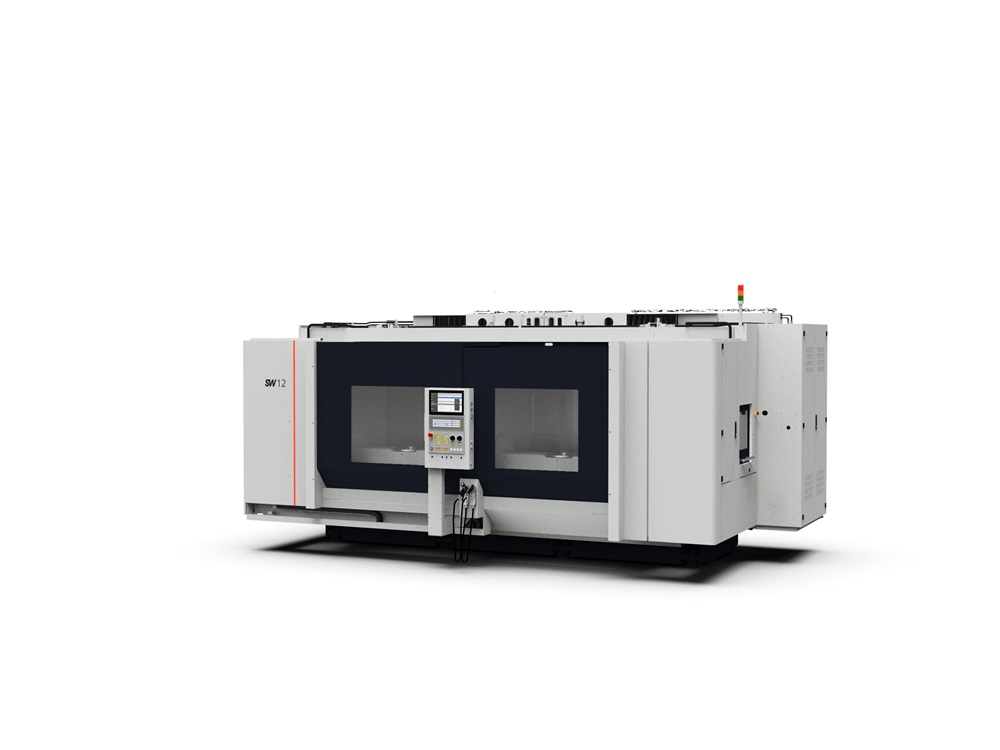
Machine tool manufacturer Weingärtner Maschinenbau GmbH is entering a new chapter. After decades of dedicated leadership, Friedrich Weingärtner has retired and handed over the company’s management to his son, Dominik Weingärtner. Dominik now leads Weingärtner Maschinenbau alongside his uncle, Andreas Weingärtner. With a deep understanding of the company and its values, Dominik is committed to driving innovation and ensuring sustainable growth. His vision is to expand Weingärtner’s expertise in high-precision machining solutions while embracing digitalisation.

More information www.weingartner.com

New management at Fritz Studer AG

Jens Bleher, CEO and chairman of the Board of grinding machine manufacturer Fritz Studer AG since 2018, has joined the United Grinding Group’s board of directors as COO. Replacing Bleher, Sandro Bottazzo, the long-standing managing director and chief sales officer of the Swiss precision cylindrical grinding machine manufacturer, has been appointed CEO and will thus take over the responsibility as chairman of Studer’s board. Bottazzo has held various management positions for the United Grinding Group and Studer for over 25 years and has been a member of the latter’s management team since 2018.

More information www.studer.com

Even better user experience with latest Tebis

For over 40 years, Tebis has provided CAD/CAM/MES software solutions and related services to a wide range of manufacturing sectors. Its knowledge-based machining technology supports database libraries of machine tools, clamping devices, cutting tools with machining parameters, machining features, advanced CNC tool-path templates and machining process templates. This allows the optimal machining practices of customers to be built into Tebis database and shared among CAM engineers, which reduces the work pressure on CAM engineers while ensuring the best results.

Tebis automation combined with Tebis Virtual Machine technology supports machining set up and planning, as well as collision-free CNC tool-path calculation, simulation and verification. This capability is especially beneficial to customers for 2.5D to 5-axis milling, trimming, laser cutting and mill-turning, along with robotic machining.

With its latest release, Tebis has taken a significant step forward in improving user experience. The software is now more intuitive and accessible than ever before, thanks to thoughtful improvements across its interface and functionality.

A key highlight is the new ‘WebHelp’ feature, which allows users to access Tebis Help instantly through any internet browser. This functionality means that whether users are at their workstations or working remotely, help is always just a click away. In addition, the development team has carried out extensive optimisation of the software base and quality management – the processes are now more efficient than ever.

Another advance involves high-efficiency adaptive roughing, where cavities can now be machined more cost-effectively with an adaptive path layout without full-cut machining. This capability ensures constant material contact, resulting in shorter machine run times and longer tool life.

More information www.tebis.com

Vericut cuts granite machining risks at Reitz

Reitz Natursteintechnik KG is an expert in the planning, design and manufacturing of highly precise machine components made from granite. To ensure efficient and above all safe processing, the company takes advantage of Vericut simulation software to deliver process-reliable production and reduced workload for employees.

Christopher Reitz is the company’s fourth generation managing director. His mission? To place customer needs even more at the centre of the 140-employeee company, which serves sectors such as semiconductor, optics, general mechanical engineering, automation, metrology, printing and medical technology.

The granite workpieces vary in size up to 13 m, weighing up to 65 tonnes. Processing such blocks precisely means Reitz relies almost exclusively on machines developed and built in-house: four gantry-type milling machines and two five-axis gantry machines, all controlled by Siemens 840D. To ensure safe, fast and precise machining, the company uses Vericut simulation software.

“Granite is a natural product, so the surface is never perfectly flat,” says Reitz. “To prevent tool collisions during processing, we developed a process with Vericut that virtually eliminates this risk.”

Adds René Maschlanka, responsible for sales and project management at Reitz: “Vericut eliminates the need for manual set up, saves valuable operator time and protects our machines. Now our programmers and operators are far more relaxed – they know their programs will run safely, with no crashes.”

Some machining processes at Reitz can take over 40 hours. Previously, the operator had to stand by the entire time. Now, they run the simulation on a PC, press start and only check in occasionally.

More information www.vericut.com

ModuleWorks unveils 2025.04 Software Components

ModuleWorks has launched the 2025.04 release of its software components for digital manufacturing. This latest release of the ModuleWorks SDK (software development kit) includes new and enhanced features designed to enhance process safety, improve tool-path generation efficiency and increase part quality.

For example, take multi-axis edge finishing in deburring operations and the introduction of a user-defined edge sequence. With automatic sorting, it is often difficult to meet the deburring requirements of each part because the pre-defined order does not always match the specific needs of the job. The ModuleWorks 2025.04 release introduces a practical alternative to automatic sorting: users can now preserve the input order of the curves, with the resulting tool path sorted accordingly. This capability gives users more flexibility, enabling them to machine edges in their preferred sequence to improve overall machining efficiency and precision. 

On the same subject, ModuleWorks 2025.04 introduces automatic machining direction. Previously, determining the appropriate machining direction for three- and four-axis tool paths often led to sub-optimal ordering, resulting in discontinuous tool paths. ModuleWorks 2025.04 contains a new option called ‘automatic machining direction’ that takes the contour direction into account to ensure optimal ordering. This makes deburring tool paths more user-friendly while also reducing cycle time. 

As a further enhancement, three-axis machining now benefits from corner peg removal for constant cusp. Generating a consistent surface finish in corner regions is often hampered by pattern collapse and corner smoothing. The intelligent corner peg removal solution tackles problematic cusps where the pattern collapses or corner smoothing shifts the tool path. This new approach automatically adds strategic peg loops in corner areas, ensuring smooth, consistent results and minimising the need for manual polishing.

More information www.bit.ly/43fBmT5