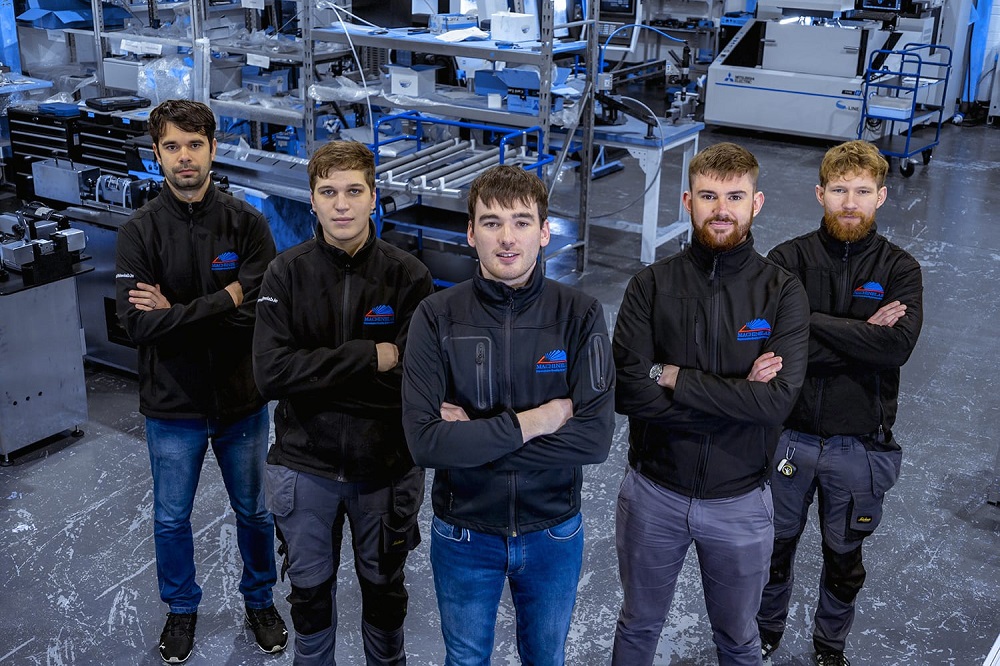
Founded in January 2021, Machinelab Ltd was set up when entrepreneur Sean Kehoe identified a gap in the market for a subcontract manufacturing business. Kehoe started a company that could provide everything from prototyping, design and machining,through bespoke automation projects, fixture design and manufacture, to consultation, 3D printing, reverse engineering and even post-project support. However, the Machinelab founder recognised that the fundamentals of the business needed to focus on lead time, pricing and quality – all aspects the company is achieving with the support of the Engineering Technology Group (ETG) Ireland. The company has recently invested in a Mitsubishi MV1200S wire EDM machine,quickly followed by a Nakamura-Tome AS200LYMT turn-mill centre.
Located in Wexford, the rapidly growing business now employs 17 staff. This rapid rise has come from the company’s ability to offer a full lifecycle design and manufacturing service for custom-built parts and assemblies required by pharmaceutical and medical device companies and other highly regulated industries. Machinelab recently moved to a new 15,000sqft facility and, with sufficient space to expand, the company installed the Mitsubishi MV1200S wire EDM machine.
Discussing the company’s rapid ascension to success, Kehoe says: “As an engineer with a background in machine, assembly line and jig and fixture design and build, I spotted an opportunity to deliver a level of service and quality beyond that of existing manufacturers. In Ireland, such a niche service and expertise has been lacking in the continually expanding medical and pharmaceutical industry.This gave our fledgling business a window of opportunity and we’ve fully embraced it.”
Starting out of nothing more than a shed with a router, Kehoe initially made medical vial trays and other components for the medical industry on a routing machine. From there, the company progressed to machining centres.
“I initially bought a router, as it was all I could afford,” admits Kehoe.“I then bought a few three-axis VMCs, a lathe, a surface grinder and a spark-erosion machine; some of these were pre-owned models. Just before Christmas, I bought a used ETG Vulcan 610L VMC [new Vulcan machines are available from ETG] and I was thoroughly impressed. We have several machining centres from a reputable leading brand and found the Vulcan VMC to be far more robust and rigid. The machine has a much better build quality and stability, along with a high-pressure through-coolant facility and a much faster tool changer.All-round, it’s a much better machine. We would certainly buy another.”
With the Vulcan came an introduction to ETG Ireland for service requirements. So, when the company was looking for a wire-erosion machine for precision holemaking and profiling, the company once again turned to ETG Ireland.
“We already had an older EDM machine, but needed exceptional levels of precision,” says Kehoe.“Instead of looking around the market, we asked our industry contacts, competitors and customers about the technology they used; they all recommended Mitsubishi. We ordered the Mitsubishi MV1200S and it was delivered just after Christmas.”
As well as production line projects, the company also manufactures mould tools and components from brass, stainless steel and D2 steel which require a high number of precision holes from 0.3 to 3mm diameter that can be up to 30xD. This demand was creating an issue with part scrapping and excessive set-ups.
“Some of these parts have very tight tolerances and for us to wire a 0.3mm diameter hole on our existing machine, we would have to drill at 0.27mm diameter initially,” explains Kehoe.“The issue here was broken drills and frequently scrapped parts. We were even drilling the holes from both sides of the part on our five-axis machining centres to evade potential drill breakages. We had a lot of parts that would need to be re-set, creating an overall production time of up to six hours. By using the Mitsubishi MV1200S, we can now process a six-hour job in less than 40 minutes. What we’re finding is that we can pre-drill small holes with limited precision – and then wire the holes to a tolerance of tighter than 5µm. We’re EDM profiling over 40 high-precision small holes every month, so the Mitsubishi is saving us a lot of time already.”
Another reason the Irish manufacturer invested in the Mitsubishi MV1200S EDM was for the profiling of components, something that could alleviate capacity bottlenecks on other machines.
“A lot of our machining is small runs of stainless to hard steel parts in quantities of 2 to 5-off,” says Kehoe.“The Mitsubishi MV1200S can be quickly set-up to profile these challenging parts, freeing-up capacity on our five-axis machining centres. Additionally, the Mitsubishi MV1200S can provide a level of precision beyond that of our other machines. We can profile parts to a tolerance of 4 µm with a surface finish of 0.2 to 0.4 Ra, again exceeding the surface finishes of our other machines.”
By purchasing the Mitsubishi MV1200S, Machinelab has improved its precision and surface finishes on components, reduced set-up times and eliminated scrap on particularly challenging parts that require small holes and improved throughput.
“We can set up the EDM and leave it to run while a machine operator is tending to other machines,” explains Kehoe.“The running cost of the EDM is minimal compared with a machining centre consuming lots of tools through cutting hard parts; it complements our machining department perfectly. The longer we have the machine, the more applications we find for it. As a relatively new company, ETG Ireland has offered us an excellent finance package that has made the Mitsubishi purchase possible. The terms are so favourable for start-up companies that we’ve just ordered another machine.”
At the end of March, Machinelab placed an order for a Nakamura-Tome AS200LYMT, which is now in situ.
Says Kehoe: “We have a semi-CNC turning centre and while it’s a capable machine, it cannot provide the precision or productivity we require for the increasing upturn in turning work. We have one regular part that requires 5 µm concentricity over the 5-inch length of the component. Our existing machine struggles with this, leaving us with excessive operator intervention to remain within tolerance.”
He adds: “The Nakamura AS200LYMT turning centre will easily meet our precision requirements. With driven tooling capability, we’ll be looking for this machine to take capacity from our milling department – as the Mitsubishi has. We were transferring jobs from the lathe to the mill and vice-versa for secondary operations. The Nakamura AS200LYMT will eliminate this bottleneck from our business. ETG Ireland are also able to offer us a full turnkey solution to our projects, something that we recently discovered in purchasing the Nakamura Tome. In addition, ETG has the right staff in Ireland, be it sales or technical service, where other companies would have support only from the UK.”
For further information www.engtechgroup.com