

Peiseler appoints exclusive agent in UK

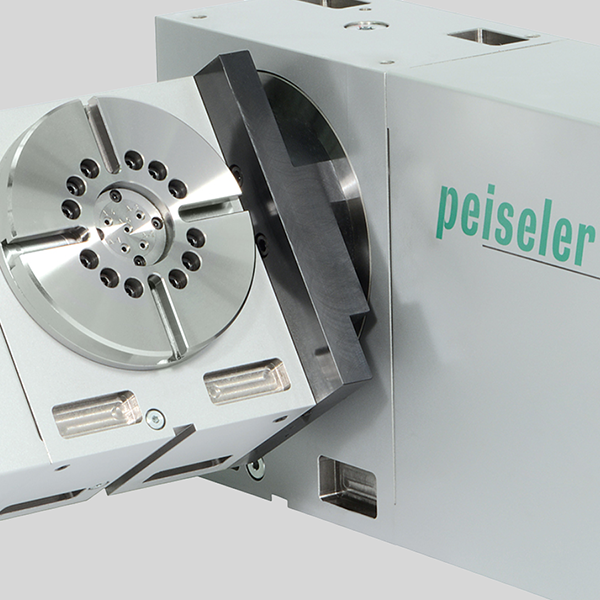
Brown and Holmes is now the exclusive UK and Ireland agent/distributor for Peiseler indexers, trunnions and special pallet systems. In addition, Brown and Holmes is supporting existing and future owners of Peiseler products with full service and repair provision using genuine manufacturer parts.

The Peiseler product range includes the ATC series of compact, high-performance and flexible NC rotary tables. These rotary table can be set up either vertically or horizontally, and come in various face-plate diameters and designs. Frame sizes include ATC 125, ATC 160, ATC 250, ATC 300 and ATC 350.
Further features of the Peiseler ATC rotary table range include: pneumatic or hydraulic clamping; motor attachment at left or right; motor attachment with elastic coupling; various motor makes; the availability of an IP67 version; gearbox to the left or right, 1:1 or 2:1; an optional rotary manifold, 4+1 ports; additionally integrated support bearing; an optional angle measuring system, Heidenhain RCN 2380, with a system precision of ±5”, or RCN 2580 with a system precision of ±2.5”; and an assembled cable set.
Also now available in the UK and Ireland from Brown and Holmes is the Peiseler WTC series of standard fixtures based on the modular ATC series. Here, ATC and counter-bearings are mounted on a steel base plate to a common centre height. A selection of counter bearings is available for the different ATC sizes.
A further element of the portfolio is the ZATC series of two-axis rotary tilt tables, a modular range that uses the cubic housing shape of ATC rotary tables. Special housing adaptations are available to suit specific applications. Frame sizes include ZATC 125, ZATC 160, ZATC 250 and ZATC 300.
For further information www.brownandholmes.co.uk
Compact rotary indexing table

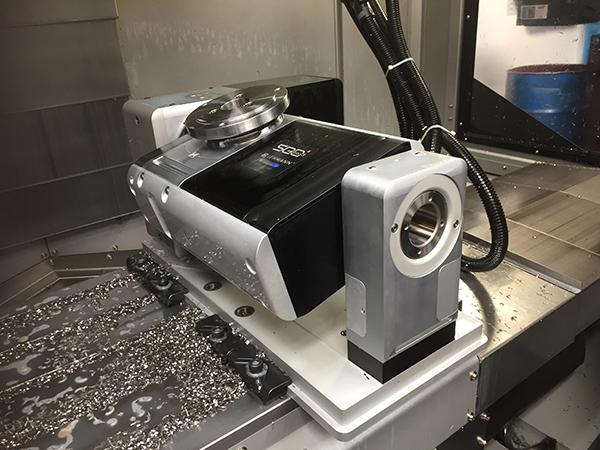
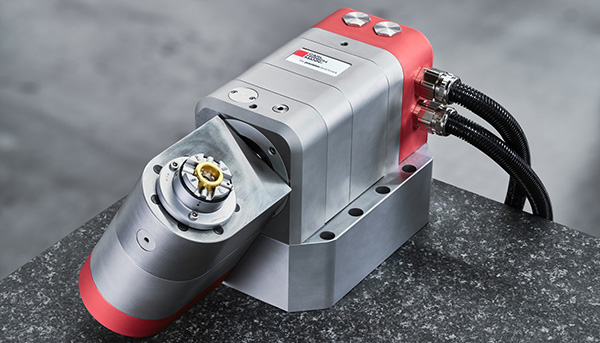
Carl Hirschmann has launched a compact two-axis rotary indexing table with direct drives that is designed especially for the production of small parts.

According to the company, this development for simultaneous machining and the exact positioning of workpieces is characterised by flexibility, as well as high speeds and acceleration profiles at the limits of what is technically possible – with maximum precision through the addition of the patented zero-point clamping system, µ-PrisFix-Nano. The Hirschmann µ-PrisFix-Nano is suitable for applications such as wire EDM, die-sink EDM, EDM drilling, laser machining and high-speed cutting.
Another special feature is the integrated compressed air supply for pneumatic connections. During internal pneumatic transfer, an air connection actuates the clamping system and opens the spring packs, which ensure stable attachment of the workpiece. The second compressed air connection is used to clean the installation surfaces, or to automatically check whether there is a workpiece in the machine. The innovation goes back to market enquiries for laser machining.
Notably, the rotary axis and the swivel axis are each driven by a torque motor, which transmits 1:1 rotary motion without reduction.
“Thanks to this concept, the rotary indexing table achieves extraordinarily high values for speed and jerk time on each axis,” explains Rainer Harter, CTO of Carl Hirschmann.
In laser processing, a feed rate is defined that must be precisely maintained, even with small radii and curves. This factor means that the axis must be able to act dynamically. And this with highest demands on the precision of material removal from the workpiece. The dividing accuracy on both axes is ±10 angular seconds.
For further information www.carlhirschmann.de

Clamp almost all part geometries

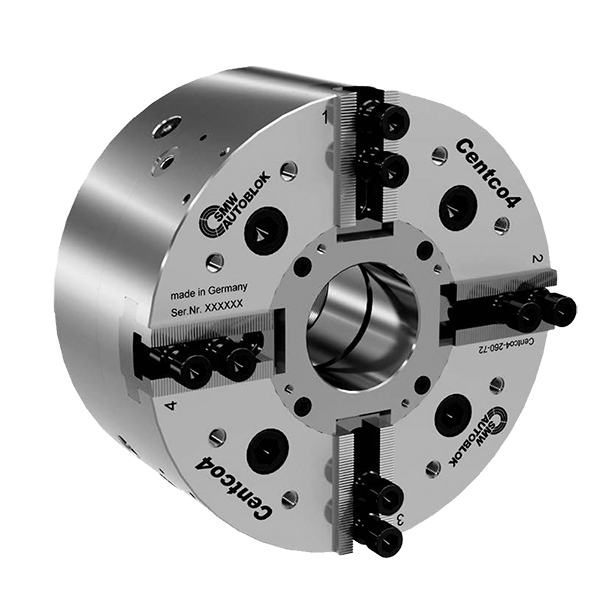
SMW Autoblok has introduced the four-in-one Centco4 2+2 self-centring and compensating chuck. According to the company, the Centco4’s engineering and flexibility enables it to securely and efficiently clamp virtually any type or shape of geometric part, including round, cubic, angular and irregular.

The Centco4 is available in both power and manual models, and is suitable for deformation-sensitive workpieces. With its four jaws, Centco4 provides four times less deformation compared with three-jaw clamping and can be used on all industry-specific machine tools. The ability to handle virtually any part shape means fewer chuck change-outs and reduced downtime. Diverse manual and hydraulic applications include turning, milling, inspection and
finishing operations.
Some of the many Centco4 benefits are that it features two independent self-centring and compensating jaws, and single wedge actuation that eliminates the need for a dual-piston cylinder. SMW Autoblok’s latest innovation is said to be suitable for aerospace and automotive manufacturers seeking a standard chuck that can clamp any part geometry.
The drive of the Centco4 moves toward or apart on two parallel axes, and needs only one standard-stroke, single-piston cylinder for actuation. This design allows for independent self-centring via both axes. Centrifugal force compensation permits maximum rotational speeds up to 210 kN of gripping force with an optimised lubrication system that saves both time and money in repairs and maintenance. Four sizes are available in the power version, while a variety of precision jaws is also offered.
For further information www.smw-autoblok.de

Compact second-operation vice

During rough machining first operations it is good to have a known datum, which is where WNT’s ZSG4 Centric vice system provides a suitable solution.

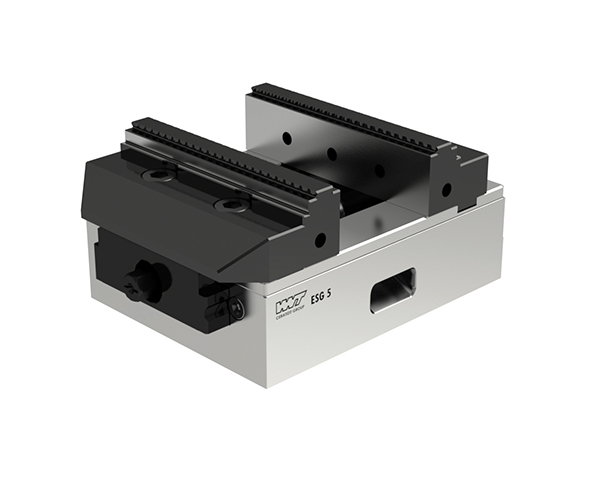
However, when it comes to second operation work, a known datum on the component has already been created, so the requirement for a centric-jaw system is reduced, and it is here that the newly developed WNT ESG5 fixed-jaw vice from Ceratizit fully complements the ZSG4.
Providing identical footprints, with the vice bases measuring 160 mm in length (and an overall height of just 83 mm), the ESG5 and ZSG4 can sit side by side either directly on the machine table, or on WNTs MNG Zero Point baseplate system. In terms of clamping performance, again, the two vices are identical with a maximum gripping force of 35 kN, allowing components to be gripped securely on as little as 3 mm of material.
According to the company, accuracy and repeatability of ±0.01 mm are achieved by the overall vice design with precision matched slides, and the use of a ball screw to control jaw movement. The ability to switch jaws between the two vice types adds further versatility and compatibility to the WNT work-holding system. This compatibility opens up the choice of jaw from the range, which includes: reversible jaws; pendulum plate jaws; combi jaws; aluminium jaws; five-axis jaws; smooth carbide-coated jaws; and stepped jaws.
Says Adrian Fitts, business development manager at Ceratizit UK & Ireland: “The WNT ZSG4 vice has proved popular as it provides a cost-effective, efficient and compact work-holding solution. With ESG5 we have listened to customers and created a vice that fully complements ZSG4 and enhances the work-holding systems available from Team Cutting Tools.”
For further information https://cuttingtools.ceratizit.com

Rotary tables at MACH

Rotary table specialist PL Lehmann is looking forward to welcoming customers on Stand 28 in hall 17 at MACH 2020 (Birmingham NEC, 20-24 April). Since 2018, the company has been directly represented in the UK and Ireland with sales and services. PL Lehmann prides itself on close relationships with partners from the machine-tool industry. Indeed, its scope of supply for rotary tables allows interface with most vertical machining centres and grinding machines.

The compact Lehmann rotary tables show their advantages by being light in weight and small in footprint, but strong when it comes to clamping torque and load weight. These attributes means users can still use quite a bit of space on their machine tables for three-axis operations as room remains for additional vices.
Lehmann’s modular system is based on four sizes of rotary table, which are expanded by a building kit to create customer solutions. With a clamping torque range of 250 to 5000 Nm, spindle load capacity between 17 and 1600 kg, speed from 40 to 300 rpm, and accuracy of 2 arc-sec, the company says its rotary tables are in a class of their own.
The range also permits the creation of different fourth-axis solutions with up to four spindles, tailstocks and counter bearings, as well as a five-axis solution featuring a strong and precise rotating and tilting axis. In addition, the modular systems allow a direct encoder and special labyrinth sealing for grinding applications.
For further information www.lehmann-rotary-tables.com