

Quickstep halves part set-up time

The combination of MSP’s NC-Checker and NC-PerfectPart software is delivering significant savings for five-axis machining processes at Bankstown-based Quickstep Technologies, the largest independent aerospace-grade composites manufacturer in Australia.

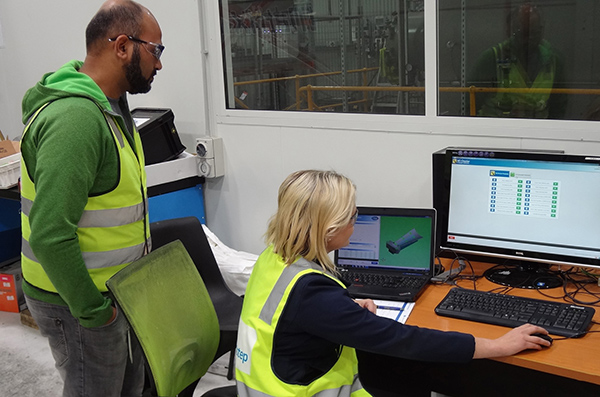
Implementation of NC-PerfectPart and NC-Checker software, supported by Renishaw probing technology, provides the detailed information required to ensure machines stay within specified parameters, improving set-up times for Quickstep’s freeform parts.
NC-Checker first carries out a calibration check on the probe. Once this is complete, the software performs five-axis checks of the machine tool to verify its accuracy, providing a subsequent report. This check takes just minutes to complete, meaning it can be run on a regular basis to provide routine monitoring of the machine’s geometry.
The parts being produced by Quickstep Technologies are complex in shape, so work holding is a major issue when using traditional manufacturing methods. Each part has a dedicated composite vacuum fixture with three or four fixed location tooling spheres. The centre points of the spheres are known relative to the part geometry, and this information is used to locate the fixture or part in a suitable work offset co-ordinate system for machining.
Prior to using NC-PerfectPart, these datums were generated using standard cycles within the Siemens control. While this achieved results, it was limited in that it was time consuming and open to human error. NC-PerfectPart fully automates this process and eliminates any human error. Furthermore, the software removes the need to precisely position the part, producing time savings of 50% per component.
For further information https://metsoftpro.com/
Nikon opens up about Quality 4.0

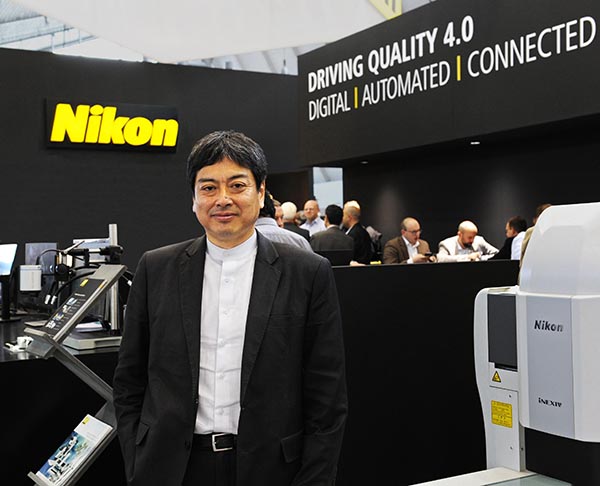
A recent interview with Nikon’s corporate vice president Tadashi Nakayama provides insight into the strategy of the firm’s Industrial Metrology Business Unit, of which he is deputy general manager.

In particular, he explained the company’s strategic focus on Quality 4.0, where digital, automated and connected inspection enables complete process control from design through to manufacture.
The core elements of a Quality 4.0 based process are the requirement for the automated measurement of key features on components, as close to real-time as possible, plus the need to acquire digital results and feed them back directly to machinery, thereby controlling production automatically. In this way, the quality function drives the manufacturing process, guaranteeing the best possible products.
Nikon Metrology is committed to ensuring that its measuring systems lead the field in Industry 4.0, and this policy was underlined by Nakayama. At the heart of Quality 4.0 is the interconnection of inspection and production. The goal is to enable manufacturers to produce better products at lower cost, accelerate their response to changes in demand, shorten the time to market and achieve greater overall competitiveness.
Nikon Metrology has already supplied Industry 4.0-enabled QC systems to customers in Europe, Asia and the US. One example in the German automotive industry involves rapid, automatic measurement of the position of studs on the underbody of cars in a production line. Accuracy is checked to within 100 µm using multiple laser radar systems.
Nikon Metrology’s strategy over the next few years will be two-fold. First, from a technical perspective, the collection of digital measurement data will be paramount to enable intelligent process control systems, whether locally or in the cloud. Secondly, Nikon is increasing its focus on building even stronger relationships with customers.
For further information www.nikonmetrology.com

GOM showcases latest ATOS addition

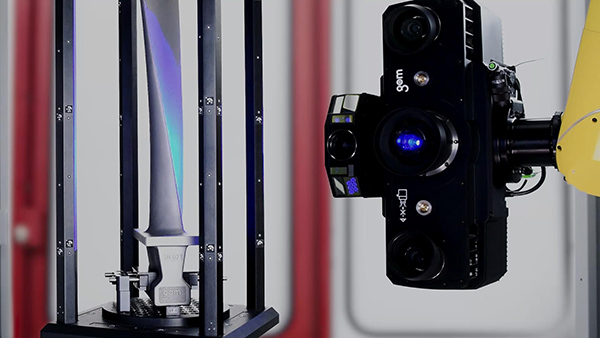
At the recent Advanced Manufacturing show in Birmingham, UK, GOM shone the spotlight on its fifth generation of ATOS sensors for 3D scanning over large measuring areas.

The ATOS 5 and ATOS 5X are fast and precise following the introduction of new features and developments. For instance, the Blue Light Equalizer has been developed especially for the light source in the ATOS 5 to make the system independent of ambient light conditions. The ATOS 5X takes this a step further with the introduction of a laser light compressor to generate ultra-bright light for the scanning process.
More speed and light in cameras allows for a shorter exposure time, with scan times down to 0.2 seconds per measurement and 100 frames per second.
As a result of this new technology, both systems achieve high-precision data for a diverse range of manual and automated applications, from tools and moulds, to plastic and metal parts. With the ability to scan small scale items such as aerofoil components, up to full car body inspection, the ATOS 5 is flexible and capable over multiple applications. At the same time, fixture design can be simplified as a larger surface is captured and fewer reference points are required.
The trend for automated measuring is supported by installing the ATOS system inside an ATOS Scanbox. This option combines all the functions in one automated measuring machine. What’s more, by utilising Virtual Measuring Room software, the measurement environment is represented in a virtual simulation. All robot movements are simulated and checked for safety before being performed in the actual environment.
For further information www.gom.com

Faro TracerSI boosts laser-guided assembly

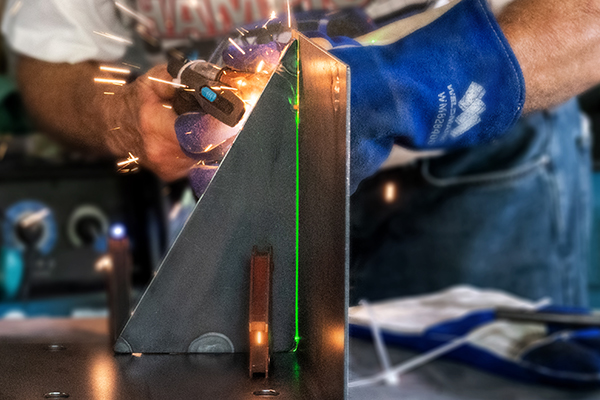
Faro has released the next generation of its Tracer platform for laser-guided assembly and verification: the TracerSI laser projection system. TracerSI is a fully integrated solution that includes improved hardware built upon the previous TracerM product and BuildIT projector software.

Like TracerM, TracerSI uses 3D CAD information to project 3D laser images on to a physical surface and provide a live, visually rich virtual template that assemblers can use to quickly position components with confidence. This solution can deliver significant ROI as organisations no longer have to invest capital in physical templates, such as wood or metal moulds or tools, which also have to be built, maintained, stored and sometimes repaired. Additionally, real-time manufacturing errors are minimised and, as a result, costly scrap and rework costs are reduced. There are actual, documented cases where rework and scrap savings alone lead to payback periods as short as 90 days, says Faro.
TracerSI is said to represent the first of its kind laser scanning camera, with projection and high-resolution image scanning capabilities throughout its entire projection volume. Since the laser scanning camera does not rely on lenses or conventional image capture, the depth of field is equal to the full projection range. In addition, there are no lighting limitations since it is laser illuminated, and there are no restrictions on frame size or resolution.
Faro’s TracerSI moves guidance assembly forward through its native support of feature-based alignment. As a result, retroreflectors (special targets that reflect light back to the original source) do not have to be placed on or around the object or assembly. This convenience substantially reduces the time required for set up.
For further information www.faro.com

Instant measurement system available from Vision

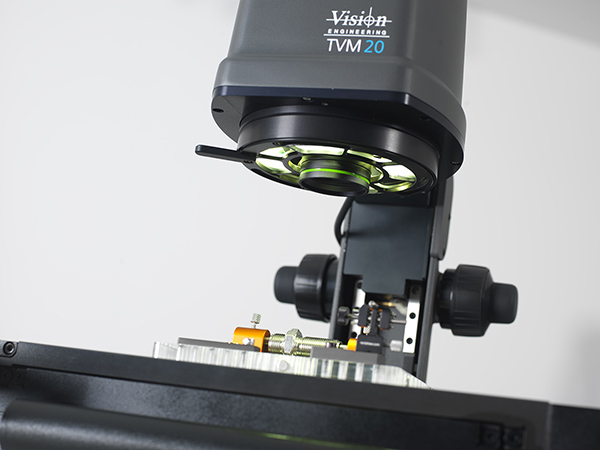
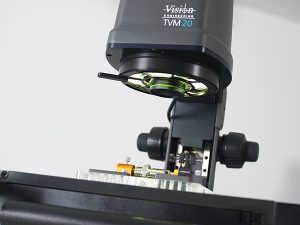
Vision Engineering has announced the general availability of its TVM field of view (FOV) video measurement system.

The non-contact TVM combines a small footprint with larger system performance and ease of use. Time-saving, instant FOV measurements and a moving stage allow larger components to be measured quickly and easily.
The TVM series includes the TVM20 and TVM35, with FOV sizes of 20 and 35 mm respectively. Both systems are designed to meet rigorous quality assurance applications in automotive, aerospace, medical and plastics manufacturing. Cylindrical, flat or square components can be measured instantly within the FOV at the click of a mouse.
As with other measurement and inspection systems from Vision Engineering, TVM systems can be configured to suit specific applications, including small pressed components, turned parts, injection moulded plastics, tubes and cables, while the addition of a manually controlled stage extends measurement for larger components up to 200 x 100 mm.
The combination of the TVM’s flat-field telecentric lens and collimated sub-stage lighting, featuring a newly developed quadrant LED ring light, creates a sharp image of components on the HD monitor, and significantly improves the video edge detection of complex parts such as threads and valves.
The TVM’s user-friendly software comprises a suite of features that includes simple data import/export, image stitching and reporting facilities.
TVM20 and TVM35 systems are manufactured in the UK at Vision Engineering’s global headquarters.
For further information www.visioneng.com