

SolidWorks 2018 available from Dassault

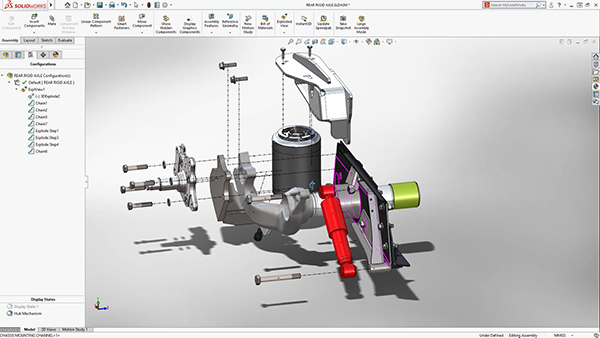
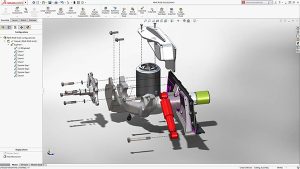
SolidWorks 2018 features an integrated, end-to-end solution for the design-to-manufacturing process that enables businesses of any size to rethink how components and products are made. Powered by Dassault Systèmes’ 3DExperience platform, SolidWorks 2018 supports a complete design through manufacturing strategy with solutions that simplify the interactions between disciplines across the product development workflow.

“Lots of designs involve welding plate and sheet-metal parts, and most people use ‘tab and slot’ techniques for self-fixturing the parts for welding,” says Edson Gebo, owner, Digital Detail & Design. “The new tab and slot feature saves a lot of time versus having to create these features manually, which helps get designs to the shop faster.”
With SolidWorks 2018, teams can collaborate concurrently to more rapidly and cost-efficiently design a product or part, validate its function and manufacturability, manage its data and related processes, streamline and automate its manufacturing, and inspect it. Any changes in design or manufacturing are fast and easy to manage, and automatically flow to all related models, programs, drawings and documentation, thanks to intellectual property embedded early on in the design process.
A key feature in the latest version of SolidWorks is SolidWorks CAM, a new application that provides rules-based machining with knowledge capture to allow for the automation of manufacturing programming. Designers and engineers can gain a greater understanding of how their designs are made, make more informed decisions, and quickly create prototype parts and manufacture in-house to control quality, cost and delivery. This application also enables teams to execute new build-to-order strategies with custom parts that are automatically designed and programmed in seconds rather than hours.
For further information www.solidworks.co.uk

Five-axis pioneer thrives with VISI

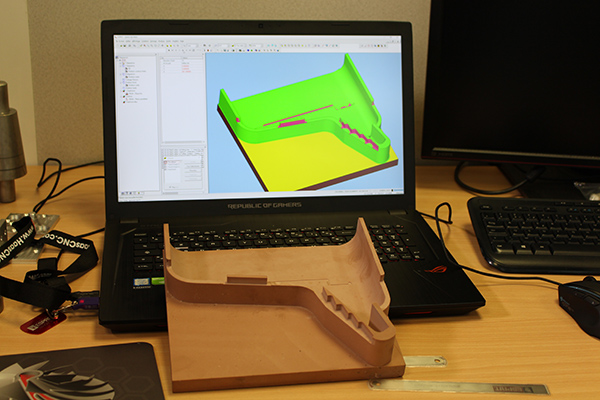
Among the companies to first introduce simultaneous five-axis machining into its region has chosen the VISI integrated CADCAM system from Vero Software to drive its CNC machine tools.

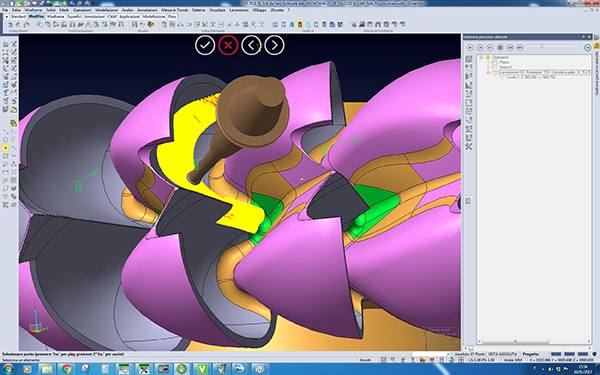
Modulo Tre, which was founded in 1995 by partners Alessandro Corà, Marco Dal Bianco and Gilberto Dal Pozzo, now has a large fleet of latest-generation machines. Adopting five-axis technology means the company can machine a range of components such as hollow and grooved profiles, with deep and sloping holes, without material constraints.
Here, the need for reliable and simple CADCAM integration led Modulo Tre – based at Schio, Northern Vicenza in Italy – to introduce VISI.
“For complex five-axis machining, it’s crucial to be able to drive almost with your eyes closed, avoiding collisions and tool issues that could compromise the entire workpiece machining process,” says Corà. “Machines often work round-the-clock, so a simulator is indispensable for operations in unattended areas.”
Among the most popular VISI functionality, according to Dal Bianco, is the ability to automatically recognise machined features such as holes and pockets, and generate the appropriate toolpaths. He says that as VISI is an integrated system, machining individual plates can be accomplished automatically through feature recognition: “All holes are recognised automatically and the correct machining cycle applied. For complex machining, VISI allows us to handle high-speed and five-axis operations, as well as traditional milling.”
VISI also delivers a wide range of multi-axis machining strategies suited to the development of turbine impellers, one of Modulo Tre’s main business areas.
For further information www.visicadcam.com

DXF – complex made easy with ProtoTrak

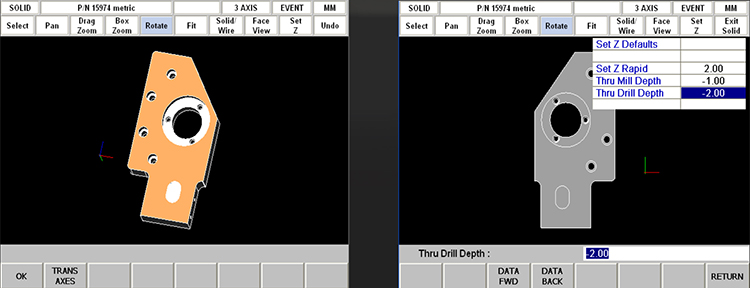
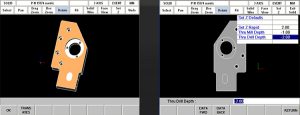
The ProtoTrak SMX CNC system available from XYZ Machine Tools is now available with an optional DXF file converter. By importing CAD files in DXF or DWG formats, via USB or a network connection, operators can quickly simplify the data by turning off layers such as borders and dimensions before choosing their initial datum point. Once selected, the standard ProtoTrak conversational programming language is used to create the machining path. The added advantage is that all points are taken from the CAD file, so no dimensional mistakes can occur as a result of the operator inputting incorrect data.

Once the program has been created, the operator can use the standard features of ProtoTrak to confirm the tool path or verify the part in 3D to show the machining process on screen.
For companies using 3D solid-modelling software, ProtoTrak is also able to import Parasolid data (.X_T format), which can be viewed in 3D with the ability to zoom, rotate and pan the drawing. Furthermore, using ProtoTrak’s ‘Inquiry’ function, the operator can interrogate the Parasolid file to ensure the correct tooling is used and that cycle times are minimised.
“The functionality and power of the ProtoTrak CNC control system, puts it head and shoulders above other systems aimed at one-off and low-to medium-volume production,” states XYZ’s managing director Nigel Atherton. “The option of the DXF converter and Parasolid model data takes the efficiency of ProtoTrak to the next level.”
For further information www.xyzmachinetools.com

Siemens services digitalise machine tools

At EMO 2017 in Hanover, Siemens exhibited new and expanded digital and classic services with capabilities for identifying and exploiting additional productivity potential for machine tools. Machining companies can use the new ‘Digitalisation Check as a Service’ to create transparency of the digitalisation capability of their machine shops. With ‘Virtual Commissioning as a Service’, machine tool OEMs use a virtual twin to accelerate both commissioning and time-to-market.

Auf der EMO 2017 in Hannover stellt Siemens neue und erweiterte digitale und klassische Motion Control Services für die Werkzeugmaschinenbranche vor – mit neuen Möglichkeiten, zusätzliche Produktivitätspotenziale von Werkzeugmaschinen zu erkennen und auszuschöpfen.
At the EMO 2017 in Hannover, Siemens is exhibiting new and expanded digital and classic Services for the machine tool industry – with new capabilities for identifying and exploiting additional productivity potential for machine tools.

‘Digitalisation Check as a Service’ examines how well machines, control units and processes can be networked. With this service, the data of the control equipment in the machine shop is recorded and analysed on site. This is followed by a recommendation for the optimal connection strategy on the path toward digitalisation.
‘Virtual Commissioning as a Service’ shortens time-to-market by using a virtual twin, whereby real commissioning can be accelerated by up to 70%, says Siemens. Moreover, the mechanical development and electrical design departments can save time by co-operating in parallel rather than sequentially as previously. Before the real machine is built, its virtual twin is connected to the real control system, and the machine is commissioned virtually.
These retrofit services include new Sinumerik and Sinamics control and drive technology, workshop-oriented programming with ShopMill and ShopTurn, as well as mechanical overhauls when required. According to Siemens, customers benefit from reduced downtimes, fast machining cycles, a more reliable spare part supply, improved precision and quality, as well as simplified programming and operation.
For further information www.siemens.com

Mastercam integrates CoroPlus ToolLibrary

CNC Software Inc, developer of Mastercam, has announced the integration of Sandvik Coromant’s CoroPlus ToolLibrary into the new release of Mastercam 2018. The move allows users to save significant time searching for desired tools and building 3D tool assemblies that can be brought directly into Mastercam via the ISO 13399 data format.

Mastercam developers worked closely with Sandvik Coromant product management to let users import 3D tool assemblies directly into toolpath operations. Customers benefit from having the correct tooling for the material and type of machining operation, plus an accurate 3D model that can be used for visualisation and collision checking.
“In the past, customers had to search through thousands of catalogue pages and cross-reference multiple sources to create the tool assemblies needed to machine their parts,” says Dave Boucher, director of product at CNC Software. “Now, they can save significant time and effort by quickly searching and building 3D, virtual tool assemblies using the CoroPlus ToolLibrary interface, and import them directly into Mastercam when they program their parts.”
Pernilla Lindberg, product manager – process planning at Sandvik Coromant, adds: “The tool library solution allows you to put the different tool items together – for example a milling cutter, the inserts and the holder – and then have an accurate representation of the actual tool.”
For further information www.mastercam.com