

Highest technical solution for QDM specialist

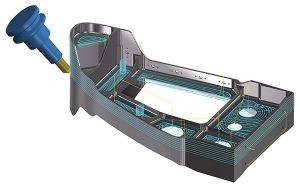
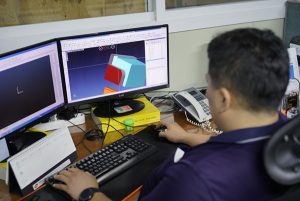
A quick-delivery mould (QDM) specialist says the ‘Draft Analysis’ function in VISI software from Vero is an important time saver for its business, and has played a major contribution towards meeting customers’ increasing demands for rapid turnaround.

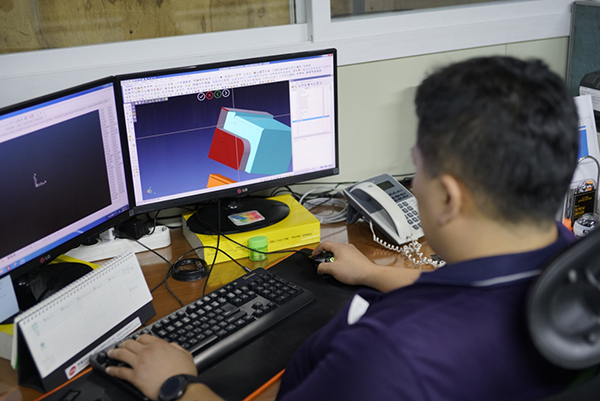
Based at Incheon in South Korea, Polyhitech uses VISI as its CAD system for designing a variety of plastic injection mould tools for medical, automotive and IT products, and says it has slashed surface editing time by up to half.
Polyhitech’s mould design manager Jisung Li says as well as fast delivery times, customers also demand high precision, and that is where VISI comes in.
“The main reason we invested in VISI was that our previous CAD system couldn’t fully deliver our customers’ needs for shorter delivery times,” he says. “When we received data from them, we used to edit the surface before starting the mould design process. However, we found it difficult to meet deadlines because we were spending a lot of time editing where surfaces were corrupt or missing, and working on complex geometry where a high graphic performance was required.”
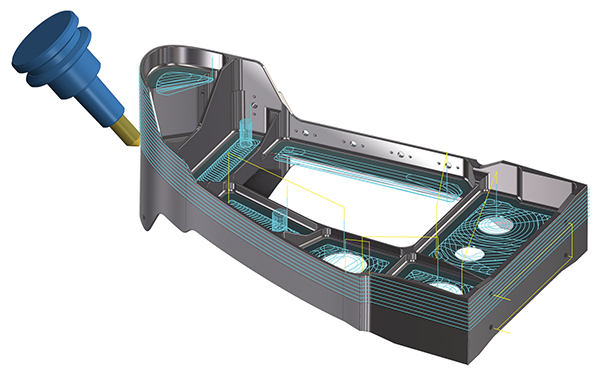
Li says the Draft Analysis function in VISI is perhaps the most important tool for the company’s mould design and production process. “I often use Draft Analysis after finishing the design. It’s so easy to check if there are any undercut areas. Our previous CAD system didn’t fully support that function, so I had to enlarge each part and check them one by one. Now, using VISI, I can quickly find any undercut areas through the colour display by draft angle, and it’s possible to split the parting line according to that.”
For further information www.visicadcam.com

Maintaining control choice for XYZ heavy-duty VMCs

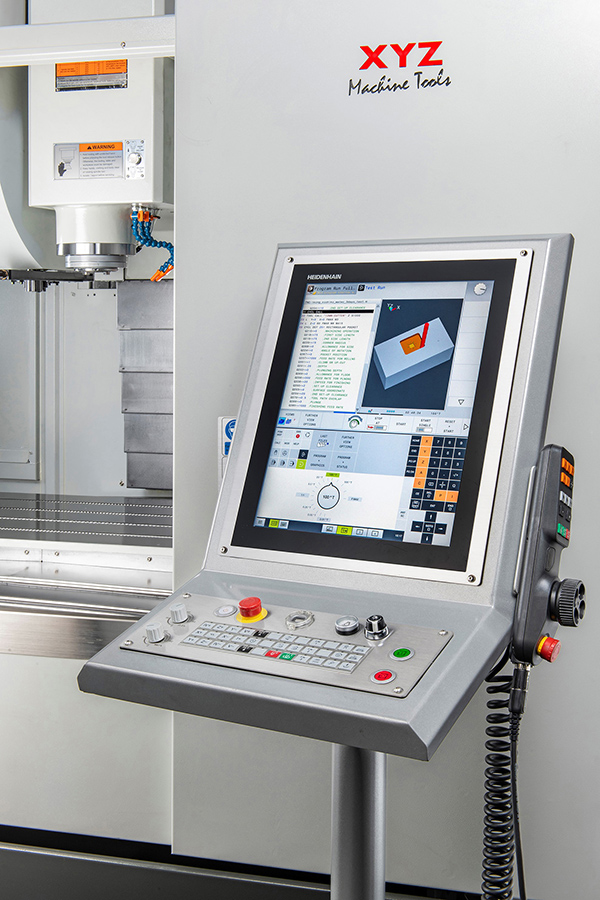
XYZ Machine Tools’ philosophy of offering ‘what the customer needs’ has led to its Heavy-Duty (HD) range of vertical machining centres being made available with the Heidenhain TNC 620 control.

“We offered Heidenhain as a control option many years ago, but found it a slow seller due in part to the additional cost and complexity of the system,” says Nigel Atherton, managing director at XYZ Machine Tools. “However, with recent changes to the Heidenhain control, such as the addition of touch-screen technology, along with a more modern and compact user interface, we see opportunities that fully justify adding it to our HD series of machines. Our independence as a machine tool supplier means that we are free to adapt our machine range to suit changes in customer demand, such as giving them a choice of control.”
The Heidenhain control option will initially be available on the XYZ 660HD, XYZ 800HD and XYZ 1100HD vertical machining centres. XYZ’s move will allow the company to access business from which it was previously excluded (where Heidenhain controls are popular), such as mould and die and aerospace, as well as in the education market.
“We recognise that control choice is important to customers, and that they tend to be loyal to a particular CNC due to their expertise and familiarity with it,” says Atherton. “Extending our use of Heidenhain controls to the HD series – we already offer Heidenhain on our flagship UMC-5X machine – was a logical step. It was encouraging that before the first machines arrived at our factory we had already received orders for machines with Heidenhain controls fitted, which fully justified our decision to pre-order 50 machines for stock.”
For further information www.xyzmachinetools.com

Widespread CAM software use at MACH

Partnership arrangements with machine tool manufacturers, along with considerable interest in its new Designer CAD for CAM system, were Vero Software’s highlights at the recent MACH 2018 exhibition.

With a total of 18 partner hotspots around the show, Edgecam programmed 12 CNC machines on nine manufacturer stands, demonstrating five-axis simultaneous machining, Waveform turning and milling, mill-turning, wire EDM and certified posts.
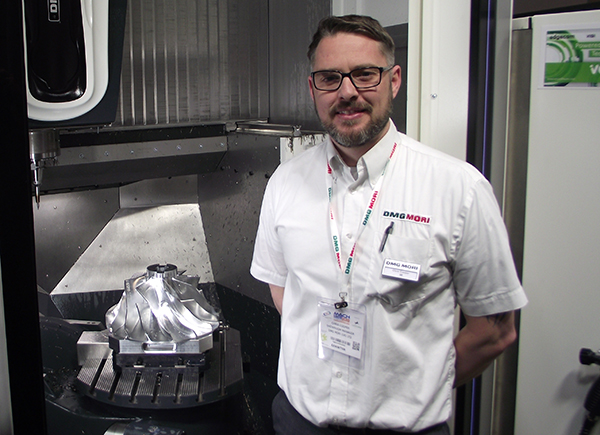
For instance, DMG Mori ran Edgecam on its DMU 60 Evo Linear machine with a five-axis simultaneous program, and an NTX 2000 for mill-turning operations.
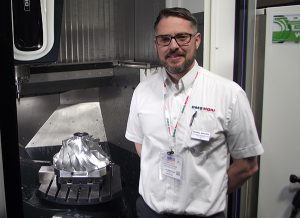
“The linear machine is especially dynamic, moving at 80 m/min, and we created an impeller from an aluminium block which was the maximum size for our handling system – 410 mm wide and 200 mm high,” explains DMG Mori’s UK showroom manager Christopher Cooper (pictured). “We used Edgecam to produce code which would show the machine’s full capabilities, moving the part around and removing material in the most efficient way.”
Edgecam also reported considerable interest in its new Designer module – a direct modelling system which is intended to fill the gap between CAD and CAM, focusing on the specific needs of machinist programmers.
As a stand-alone, optional application, Designer enables users to create new designs or modify existing geometry from third party CAD systems. As it
is not dependent on having a series of parameters that drive it, or a feature tree, it is said to provide a quick and dynamic editing and modelling environment, where users sketch, drag, hold, push or twist, to create and modify models.
As well as Edgecam, Vero also demonstrated VISI, Radan, WorkXplore and its ERP systems, generating strong leads from increased footfall in comparison with the previous MACH.
For further information www.verosoftware.com

Fast and simple tooling data solution

CNC Software Inc, developer of Mastercam, has collaborated with carbide tooling specialist Widia, to provide a solution that enables CAM users to quickly import tool assemblies from Widia Novo directly into Mastercam 2018.

Mastercam developers worked closely with Widia to let users import 3D tool assemblies directly into Mastercam, validate them, and save them in their Mastercam file and/or tool library. Features such as automated filtering ensure that the holders and tools which are selected can work together for the particular job. Users of Mastercam benefit from having the correct tooling for the material and type of machining operation, plus an accurate 3D model that can be used for visualisation and collision checking, in addition to the time savings.
“We found that in the past, our customers complained of having to search through big complicated catalogues to find related parts, then having to request or build the assemblies from scratch for use in systems such as Mastercam,” says Rich Taft, product owner at CNC Software. “With the integration of Widia Novo and Mastercam, customers save significant time searching for desired tools and building 3D tool assemblies that can be brought directly into Mastercam for easy use by most shops.
“Accurate tool definitions are a critical factor in modern CAM applications. Tool-path algorithms take advantage of these definitions to provide safe and efficient motion. In addition, the models that we import from Widia Novo help us to generate accurate in-process stock models that can be leveraged in subsequent operations. Customers can also make use of these models in verification and machine simulation to catch programming errors before the program ever gets to the machine tool.”
For further information www.widia.com/novo

Balancing automated and manual input

The 2018 R2 release of sheet-metal software Radan, includes newly developed functionality that gives users a greater degree of manual control whenever flexibility is required for certain aspects of their individual production processes.

According to the company, while full automation is ideal for simple parts, and plays an important role in manufacturing complex components, there is often the need for some complementary manual input. As a result, the company has added several more focused tools that allow users to better control this requirement.
One such tool is ‘Grid Nesting’, which gives additional flexibility for users wanting to create or manipulate a nest manually. For example, if a sheet is not completely full, users can either let the automatic nester take over or, if they have a clear idea of what is required, deploy Grid Nesting to provide an easy way of filling a space with a particular part. Users can even stipulate the component nesting direction. The previous version allowed users to manipulate automation to get the required result, but Grid Nesting achieves it much faster.
Moving on to new automation functions, a major update is an improved way of calculating the most effective remnants. Previously, the operator had to manually choose the shape of the remnant – square or rectangle – but the ‘Improved Remnant Handling’ function ensures the best possible option is always cut.
Another newly developed function, ‘Picker Arm Movement’, provides additional automation on the machine tool. Automated systems which manipulate the part after it is cut are becoming increasingly popular, even for large, complex components; Radan now automatically predicts the best way to handle the part, so the operator does not have to make that decision.
For further information www.radan.com