DRILL SHARPENER FROM 1 ST MTA PAYS FOR ITSELF WITHIN FIVE MONTHS

Anyone who has spoken with Danielle Toner, production manager of site drilling equipment
manufacturer Archway Engineering, about the company’s use of a drill sharpener would
wonder why every factory does not use one. When the savings are understood and, bearing
in mind that drilling is the most common machining process, the argument in favour of
investment becomes compelling.
A US-made Darex XT-3000 for repeatedly re-grinding carbide and high-speed steel (HSS) drill
bits to as-new condition was delivered by sole UK sales agent 1st Machine Tool Accessories
to Archway Engineering’s Elland factory in July 2023. By November 2023 it had already paid
for itself, as Toner had not purchased a single new carbide drill in all that time to replace
broken or damaged bits. The saving was between £700 and £1500 per month, according to
the work going through the factory.
“We didn’t previously send drills out for resharpening, so we discarded worn bits,” she
explains. “The cost was significant, especially in the case of solid-carbide drills. One
component we regularly machine involves using a 160 mm long, single-flute carbide drill and
we previously needed four to complete the part. If we ran out of bits, we couldn’t finish the
job until the next drill delivery, which delayed the assembly of our products.
She adds: “Now, we simply resharpen a bit four times and we’re certain that the component
will be finished on time. New carbide drills cost around £165 each, so the saving is
considerable and contributes to lower production costs.”
This example is by no means exceptional. Another job requires three new carbide drills to
make two parts. In a different process, an HSS taper-shank twist drill must pass through 30
mm thick EN19 high-tensile steel. A so-called TC shoe made from S355 hot-finish stainless
steel tube is drilled in up to 16 places using a split-point, single-flute carbide drill that
requires repeat sharpening before the component comes off complete-machined.
Toner explains that some bits can need resharpening a dozen times or more, depending on
their length, with no loss of tip quality. It takes about 60 seconds to sharpen the point, or
maybe a little longer if it is necessary to grind past a chip on a cutting edge. It happens quite
often due to the toughness of workpiece materials, and also because of a frequent need to
drill cross-holes at various angles into the wall of tubular components. This task has a
tendency to damage the cutting edges of a drill as it breaks through.
HSS jobber drills from the assembly department also see regular sharpening, which Toner
describes as “a massive saving”. It requires the replacement of the 220-grit diamond wheel
used for sharpening carbide drills for a 180-grit CBN grinding wheel. The process takes about

five minutes, so batches of around 20 HSS bits are set aside and undergo resharpening at
the same time.
1st MTA demonstrated the XT-3000 at the company’s Elland factory before Archway
Engineering purchased the unit, together with an attachment to enable the sharpening of
bits up to 30 mm diameter. The company can process left- and right-hand drills, while
attachments are available for sharpening step drills, countersink and spot drills, and others
with a 90° point.
Standard sizes of carbide drill used regularly by the company include 8, 10, 12 and 14 mm
diameter, and up to 6xD in length, although the Darex machine accommodates bits from 3
to 21 mm diameter in normal use.
The Darex resharpens bits in a three-step process. An operative places the drill in a finger
chuck and sets the length of protrusion at an alignment station. Carbide fingers enter the
flute to fix the rotational orientation before the operator tightens the drill in that position
by rotating the chuck clockwise. The grind motor starts and, at a second station, the drill
undergoes sharpening on both sides while clamped in the same chuck. In an optional final
operation, the chuck holding the sharpened drill is presented to a third station for point
splitting to shorten the chisel line and lessen the force required for drilling components.
“The savings that the Darex XT-3000 brings makes it an obvious investment, once you realise
the benefits – we just wish we had done it much earlier,” says Toner. “Our Darex sharpener
paid for itself in less than half a year, after which the ongoing monthly savings are
continuing to increase our profit margin on all jobs that require drilling operations, which is
most of them.”
She concludes: “The sales arguments that 1 st MTA make are difficult to ignore. We also
purchase Chick work-holding products from them, which have doubled productivity on one
of our machining centres. In addition, 1 st MTA has provided us with a new chuck for one of
our lathes.”
More information www.1mta.com

Vision Precision invests in driven-tool lathe

Nottinghamshire-based Vision Precision Engineering has complemented its two XYZ
machining centres, which include an XYZ 710 featuring a 4 th axis, with a new XYZ TC 320 LTY
driven-tool lathe. The machine will better help the company keep pace with rising demand
for its services. Prominent among existing orders is the machining of parts for coffee
machines in Costa Coffee stores.
“The ability to produce milled and drilled features on our turned parts was taking up
capacity on our XYZ 710, so it made sense to purchase a machine that could produce our
parts in one hit – hence the arrival of the TC 320 LTY,” explains managing director Ian
Gibson.

With the machine’s hardened box ways, Y and C axes, and driven-tool capability, Vision
Precision set about getting the most from its latest purchase. Indeed, the company is now
quoting for work previously beyond its reach, partly due to the maximum turned diameter
of 320 mm and maximum turning length of 550 mm. In addition, with a bar capacity of 78
mm, Vision can produce more parts from bar rather than billets. Thanks to its investment in
a bar-feed, lights-out machining has become a regular occurrence.
“The machine just seems to tackle everything we throw at it, and the material removal rates
are phenomenal,” states Gibson. “From 20 mm depths of cut when turning, to drilling a 70
mm diameter hole with a modular drill in super duplex material, I think we can justify our
nickname for the machine as ‘The Beast’. It’s a well-built lathe with great power and it holds
the tolerances we demand of it all day, every day.”
More information www.xyzmachinetools.com

MTL completes £10m facility

MTL Advanced, a UK-based engineering and manufacturing company, has completed a new 6225 m² factory adjacent to its existing 27871 m² unit in Rotherham. The expansion represents a £10m investment towards the future growth of the business, driven by the award of a long-term multi-million-pound contract in partnership with a key customer. Production will begin next month.

As part of the investment, MTL has enhanced its manufacturing capabilities with the acquisition of several new machine for this new ‘factory of the future’. Among the arrivals is a large-format LVD press brake, two Doosan horizontal machining centres with automatic pallet changers and seven Yaskawa robot welding centres.

More information www.mtladv.com

MACH 2026 space filling up fast

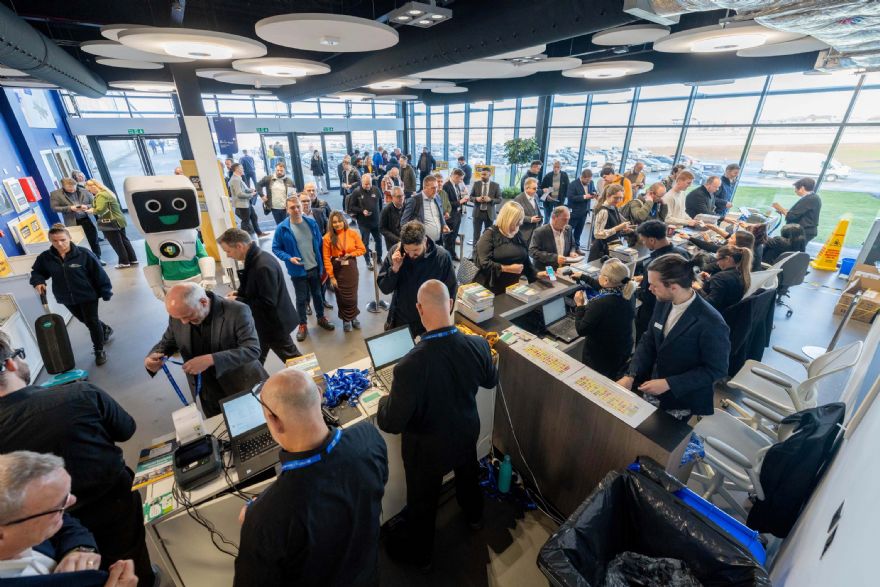
The ballots for MACH 2026 have concluded and the floor plan is filling up rapidly. With strong on-site sales, MACH 2026 is already well over 50% occupied. The organiser is now encouraging further potential exhibitors to book early to secure a prime location on the floorplan and spread the cost over several months with flexible payment options.

At the last show in 2024, exhibitors reported a £200m in sales directly attributable to the event. With over 26,000 attendees at MACH 2024, exhibitors tapped into an audience eager to discover the latest advancements. In fact, 93% of exhibitors generated significant leads, highlighting the potential for 2026 participants to forge lasting connections and increase their reach.

More information www.machexhibition.com

ENORMOUS ACCURL PRESS BRAKE BUILDS ON SUCCESS AT AYRSHIRE METALS

Ayrshire Metals Ltd, a leading manufacturer of cold-rolled sections for the construction
industry, has invested in a 14 m long, 640 ton ACCURL 6+1 axis tandem press brake from
Axe & Status. Featuring a wide range of advanced features, the new ACCURL press brake is
raising productivity, quality and traceability to new levels at this progressive and ambitious
manufacturing business.
The Ayrshire Group can trace its origins back to the 1800s, when it was largely a
manufacturer of ships on the west coast of Scotland. The company has come a long way
since then and is now a leading manufacturer of cold-rolled sections at its 6.5-acre owner-
occupied site in Daventry, Northamptonshire. The ISO9001 and CE/CA accredited company,
which also has a subsidiary sales and technical office in Munich, Germany, manufactures
most of its product range from S450 zinc-coated galvanised steel.
Five main product groups comprise the vast majority of manufacturing output. While
traditional business at Ayrshire Metals is purlins/rails, the company also manufactures
mezzanine floors, load-bearing steel framing systems and proprietary products like its
AyrFrame™ lightweight, high-strength modular system and SwagBeam™ portal frame
building system.
Until recently, Ayrshire Metals relied on a press brake that had been running since 1996.
With machine reliability levels falling, the company decided it was time to invest in a new
resource. Indeed, the new press brake is part of a five-year planned investment programme
at Ayrshire Metals.
“Rather than replace like-for-like, we wanted a slightly bigger press brake to provide more
capacity in both length and thickness,” explains managing director Scott Reilly. “We looked
at three potential suppliers, but the responsiveness of Axe & Status caught our attention.
Not only was their communication very clear from the outset, but Axe & Status also grasped
the urgency of our situation as it wasn’t economic to keep repairing our existing press brake.
Another major influence on our purchase decision was the value for money offered by the
ACCURL press brake against competitor machines.”
The ACCURL tandem CNC press brake from Axe & Status arrived in June 2024, with machine
operatives at Ayrshire Metals immediately commencing a programme of training.
“As you can image, the new ACCURL is very different to our existing 28-year-old press
brake,” says Reilly. “It’s akin to moving from a DOS operating system to Windows, such is
the contrast. We can now use the DELEM DA66T 2D graphical/3D visualisation touchscreen

control to draw the required profile at the press brake without having to create a program
manually. The difference is night and day.”
The ACCURL has also increased production capability at Ayrshire Metals. The company is
today able to bend lengths up to 14 m, compared with 12.6 m previously. In addition,
whereas its existing press brake is on the limit when bending metal at 3 mm thick, Ayrshire
Metals can now form sheet up to 4mm thick across material up to 14 m long. For shorter
lengths it is possible to bend much thicker material.
“We’re hoping this extra capability will allow us to access new markets. At the moment, we
focus solely on construction products for buildings, but starting from 2025 we want to
explore sectors outside of our traditional comfort zone.”
All products at Ayrshire Metals are made to order. The company holds no stock and there is
no minimum order.
Says Reilly: “While we make our high-running products on a rolling mill, the ACCURL gives us
the flexibility to manufacture bespoke items. Compared with our existing press brake, we
now enjoy more productivity and far greater reliability. Moreover, our uptime is 100%
compared with around 70% previously. Speed of response is vital in the construction sector
and we’ve seen a big boost in machine availability and OEE (overall equipment
effectiveness).”
Ayrshire Metals runs two shifts (day and night). Depending on workload, the company has
the option to run its ACCURL press brake around the clock if necessary.
“The construction market is very price-sensitive, both here in the UK and in mainland
Europe, where we export around 50% of production. There’s very little loyalty. So any
advantage in productivity and/or efficiency will help us remain competitive and potentially
improve our margin, which is vital for the future of the business.”
The 14 m, 640 ton ACCURL servo-hydraulic tandem press brake at Ayrshire Metals features a
throat depth of 750 mm and Y1, Y2, X, R, Z1 and Z2 axes. The company can switch quickly
between tandem or single-mode operation at any time, and transfer bending programs
between the two presses. Among many notable features is high dynamic Y-axis control for
over 30% higher productivity. Further features include LAZERSAFE light guard systems, Wila
crowning, quick-release clamping, a LAZERSAFE LZS-XL system with tandem adaptor system,
CE and CSA-certified LAZERSAFE-embedded IRIS block laser, and AP01-AP02 sheet followers.
Ayrshire Metals also has two licenses of ACCURL’s DELEM TL offline software, one at each of
its technical offices in the UK and Germany. The company can seamlessly send fully
simulated and tested data files between facilities. It is now implementing full networking in
support of direct file transfer to the press brake.
“Skills remain a big issue,” states Reilly. “A major advantage with our ACCURL press brake is
the ease of training operators. If you can draw a profile, you can program the machine. It
was a big selling point.”

Generating annual turnover in the region of £20m with 60 employees in the UK and a
further 20 in Germany, Ayrshire Metals wants to build on its success with further growth.
And the best way to meet this ambition is through investment.
“We’ve been around for many years and it’s easy to carry on as normal,” says Reilly.
“However, you sometimes need to take a step back and see what new manufacturing
technologies are available. It’s about improving our capabilities and efficiencies to provide
customers with the best value possible. With our ACCURL press brake we are more
productive, more accurate and have much better traceability. All of these factors benefit
our customers.”
With features such as the ACCURL Hybrid Servo ECO function and IE3 class high-efficiency
motor, the environment will also benefit.
“It’s too early to say, but we’re expecting a sizeable percentage reduction in energy
consumption. We’ve started our journey to net zero, so any carbon footprint reductions are
very welcome.”
ACCURL tandem press brakes from Axe & Status are available up to 6000 tons capacity and
24 m in length, with support from comprehensive warranty and service packages. A three-
year arrangement is in place with Ayrshire Metals, for example.
More information www.axestatus.com