Fast and accurate tooling

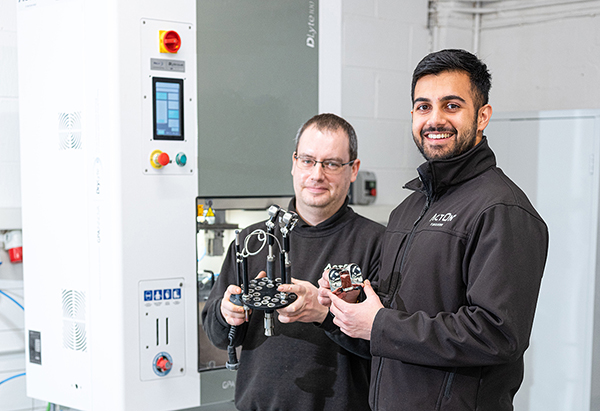
A high-precision, quick-change tooling system has been launched by Dormer Pramet for a variety of internal and external turning applications. Suitable for use on multi-tasking machines, the polygon shank coupling (PSC) is a spindle interface which promotes higher productivity through reduced set-up time and faster, more precise machining, reports the company.

Dormer Pramet’s PSC achieves this performance by deploying a tapered polygon cone shank and flange surface, which supports a high degree of rigidity. With accuracy in X, Y and Z of ±2 µm, PSC holders provide a high level of repeatability. In addition, a reduced overhang length minimises vibration and runout inaccuracy for a high-quality surface finish, making it suitable for both aerospace and general machining applications.
Connected by a triangular conical structure and cross section, which uses 1/20 taper, the PSC features internal coolant channels and a steel tool holder. More than 130 items are available, including a variety of tool-holder styles, internal tools, interface types and shank sizes.
For further information www.dormerpramet.com

10,000 blades

Rockwood Composites and Leonardo have marked the 10th anniversary of their partnership with delivery of the 10,000th blade for the towed decoy on the Eurofighter Typhoon.

All parts are fully CNC machined and supplied paint-ready on a just-in-time basis. Rockwood has also supplied Leonardo with connector plates for the wing. Holly Jones, senior subcontract buyer at Leonardo in the UK, says: “Our 10-year partnership with Rockwood is testament to their ability to deliver quality composite components, consistently, when we need them.”
For further information www.rockwoodcomposites.com

Threading with enhanced chip breaking

The 108 and 114 Mini tooling systems from Horn have been extended through the addition of new inserts with GM threading geometry that is suitable for turning ISO metric internal threads. Availability in the UK and Ireland is through the German manufacturer’s UK subsidiary, Horn Cutting Tools.

Horn’s chip-breaking geometry generates short lengths of swarf, even when processing what are normally long-chipping materials and those that are difficult to machine. The swarf is easier to handle, the risk of chip build-up is reduced and ‘bird nesting’ around the tool and component is avoided, reducing lathe stoppage time and increasing productivity.
Using the 108 system, users can produce metric internal threads from M10 with pitches of 0.5 to 1.25 mm, while the 114 system is suitable for pitches up to 2.5 mm. The inserts are available in partial and full profile design. Standard, low-vibration, carbide turning tool holders from the Mini system may be used, enabling the production of high surface finishes, even on deep threads, and ensuring high process reliability.
Mini-type inserts screwed on to the face of the holder are among Horn’s core products for turning and milling applications. The tools are especially suited to internal profiling and internal grooving. Furthermore, the Mini system range offers inserts with different geometries, substrates and CBN or diamond coatings in a variety of sizes for various internal diameters.
For further information www.phorn.co.uk

Precise truck engine cylinder bores

Modern truck engines are produced at the Mercedes-Benz plant in Mannheim, where the requirements for ideal manufacturing include extremely tight tolerances for the decisive dimensions of engine blocks. Thanks to close co-operation between specialists from Mercedes-Benz, the machine manufacturer and Mapal, significant progress was made when a new production line for machining engine blocks was designed and implemented.

The engine blocks have a complex geometry and numerous key characteristics for which the highest tolerance classes must be reliably observed. Depending on the engine type, these include multiple H7 fits, various areas with accuracy specifications less than 15 µm, and chamfers with tight tolerances, including a 20° chamfer with an outlet for which an angle tolerance of just ± 0.025° must be observed.
A first line for machining these engine blocks was commissioned in 2011. When planning a second line, the persons responsible drew on their experience with the first line. The team identified the machining of the bores for the cylinder liner adapters as particularly challenging. Machining was divided into two stations: one for pre-machining and one for fine machining.
To this end, Mapal has developed complex actuating tools that are equipped with up to 20 indexable inserts, including ISO inserts and custom inserts. The actuating tools feature a tool body in monoblock design, and the HSK-160 connection shows an enlarged face surface with a diameter of 200 mm. One tool weighs a total of up to 60 kg.
Despite the connection and a tool length of 380 mm, it must be ensured that the tool has a radial run-out accuracy of 3 µm. The slides are actuated by a drawbar via an additional NC axis in the machine controller that had to be integrated in the HSK connection and suitable for the automatic tool change. This challenge was solved with a high-precision bayonet coupling that is used to couple the drawbar automatically during a tool change.
For further information www.mapal.com

CMM used in novel zero transfer system

Mould maker Kavia Tooling is using a Hexagon co-ordinate measuring machine (CMM) to create an offline zero transfer system ahead of the manufacturing process for parts and electrodes. This strategy considerably reduces downtime on its CNC and EDM machines when setting up new jobs.

Production director Mark Cole says some components are particularly time-consuming to set up traditionally, and even simple parts mean the machines are idle during set up. However, Kavia’s unusual use of the Hexagon CMM means that machines are cutting one job while the set up for the next one is being carried out.
“Hexagon customised their PC-DMIS software, which comes as standard on their measurement devices, to enable us to use it to find offsets at the beginning of the operation,” says Cole. “Instead of having to put each part on the machine and then set it, we set it on the CMM, which gives us the X, Y, Z and U orientation. We only have to put the zero transfer plate, which is micron-accurate, into position on the machine, and it knows the exact location of the part.”
This approach can be done with any number of components, thanks to another piece of customised software that Kavia Tooling devised itself, and which engineers from its CAM system, Edgecam, developed for the company. Edgecam drives seven high-speed CNC milling machines with spindle speeds varying from 12,000 to 30,000 rpm, and a Sodick EDM machine.
“But it’s no ordinary machining process thanks to the customised software which we call Merge,” explains Cole. “It collates data from all programs for the job and merges them into a single file, many at 36 MB and containing around 1.5 million lines of code. Merge also includes the Edgecam NC code, datums to set the parts on, zero transfer, and cutter tool heights.”
He cites an example when the company was working on two cavity plates on one side of the machine, and four inserts on the other: “We put the individual Edgecam CNC programs for each component together into one file, and it all went to the machine as one large program.”

Merge also keeps cutting tools to a minimum, by looking at information such as duplication, length and quality of the tools in all programs.
“If there are two repeating cutting tools in the individually merged program, it selects the best one for the manufacturing process,” says Cole. “It goes through every single NC program and rearranges all the tools accordingly.”
The end result of using Merge with the zero transfer fixture plates created on the CMM is a CNC program which can machine several parts at a time without the need to use the machine as a set-up station, as all preparatory operations are carried out offline.
Says Cole: “If we were setting up a component to be square, directly on the CNC machine tool without the CMM, we’d have to ensure it was perfectly in line with the machine’s axis. Doing that for 10 components considerably increases the risk of error, especially where there are overhangs. In contrast, setting them on the CMM means everything is automatically correct, because it tells the machine the angle of each part.
“To set up six fairly difficult components directly on the machine may take one day, during which time it’s not running,” he adds. “However, it’ll only take about an hour on the CMM, and we can be confident that they’ll all be absolutely accurate.”
Cole says that while the Merge software combines with the CMM zero transfer system to get the best out of the company’s CNC mills, even greater benefits are gained from using it on the Sodick EDM machine.

“This machine used to be our biggest bottleneck,” reveals Cole. “We had to set the electrodes and the part on the machine, and program it by typing-in figures manually, which led to errors. It was an absolute nightmare. However, when we developed the Merge software it went from being the largest bottleneck to the fastest machine in the factory. And it’s all mistake-proof; there’s no typing as everything’s done from the CAD dimensionally. Moreover, all the offsets are set on the CMM so there’s no setting on the machine.”
Merge collates all the programs, zero transfers and information about the spark positioning. The software works with up to 12 electrodes at a time; brings all the CNC programs together; identifies the X, Y, Z and U orientation; puts everything in a format that runs on the Sodick EDM to the correct datum; automatically adjusts the tank height; and provides a setting sheet.
In fact, Merge is proving to be so beneficial for both simplifying and accelerating the work on the Sodick EDM that Kavia is now developing the software commercially for those machines.
“It’s currently being trialled in the field, and we’re aiming to start marketing it shortly,” confirms Cole.
For further information www.edgecam.com