

Free software for WorkNC customers

Hexagon’s Manufacturing Intelligence division has provided all mould and die shops using its WorkNC CAM software with immediate access to its model preparation software, integrating production workflows from any CAD model format to CAM so they can machine parts more efficiently and avoid costly errors.

The transition from engineering to production can be lengthy without the right tools to efficiently prepare solid models for manufacturing, impacting profitability. By providing WorkNC customers with access to its robust and fully featured CAD application, Designer Companion, Hexagon has made it easier to prepare any mould or die for machining while simplifying the challenge of working with a wide range of file types from different CAD suites.

For further information
www.worknc.com

New machining contract prompts significant investment

Mills CNC, the exclusive distributor of Doosan machine tools in the UK and Ireland, has supplied precision engineering specialist – Cambridge Precision Ltd (CPL) – with three new Doosan machine tools and a Doosan collaborative robot (cobot). The machines, comprising a DVF 5000 five-axis machining centre, a DNM 6700 vertical machining centre supplied with a Nikken five-axis rotary table, and a DNM 4500 vertical machining centre, were all installed alongside a heavy-duty Doosan H2017 cobot at CPL’s 24,000 sq ft St Neots production facility in February 2021. The H2017 cobot, with its 1700 mm reach and 20 kg payload, is integrated with the DNM 6700 machining centre to create, what is in effect, a ‘de facto’ flexible, automated manufacturing cell.

CPL acquired all three machining centres and the cobot to fulfil a new contract from an existing customer to produce, in relatively high-volumes and to high-precision, a range of innovative and highly-stylised enclosures for a high-end technical product.

Following initial prototyping and pre-production work in the late summer and autumn of 2020, CPL (at the same time) audited its existing machining capacities to identify if, and where, any pinch points and bottlenecks could occur once in full production.

Says Nick Raven, CPL’s general manager: “The audit revealed that we needed to significantly increase our milling capabilities and capacity in double quick time – and that a whole new dedicated machining resource would be required for the contract. Having scoped out the project in full – taking into account volumes required, machining operations, part set-up and cycle times – we decided that a high-performance five-axis machining centre would be ideal to produce the solid aluminium enclosures, and that a vertical machining centre integrated with a cobot plus another standalone machining centre would enable 24/7 continuous production.”

Building on its well established relationship with Mills CNC, CPL approached the company to discuss the new contract and the likely machining requirements.

“We have developed a strong relationship with Mills CNC and invested in a significant number of Doosan machine tools in recent years,” says Raven. “As a consequence, it was both natural and logical to get their take on what we wanted to achieve, and for them to help us identify the most appropriate machine tool and automation solutions.”

The DVF 5000 five-axis machining centre is equipped with a directly-coupled 17.5 kW/12,000 rpm spindle and a 40-station ATC. Further features include 40 m/min rapid traverse rates and integrated thermal compensation systems.

Says Raven: “We are no strangers to five-axis machine tools and have invested in several over recent years. We are always interested in new technologies that can make us more productive and efficient and, being a long-standing customer of Mills CNC, already knew about the DVF 5000 and its capabilities.”

As far as the new machining contract was concerned, the DVF 5000, situated in CPL’s milling department, would be used to machine the unit enclosures made from solid aluminium billets, each one having a cycle time approaching two hours.

The DNM 6700 is a large-capacity three-axis vertical machining centre equipped with a 1500 x 670 mm table, a 18.5 kW/12,000 rpm spindle, a 30-position ATC, the Doosan-Fanuc 0iMP control, roller LM guideways and thermal compensation systems.

“We are familiar with Doosan’s DNM series of machining centres and with the DNM 6700 in particular,” says Raven. “To help fully realise the machine’s productivity potential, the model ordered was supplied with a Nikken five-axis rotary tilting table, which would enable us to undertake five-sided machining of the fascia plate components.”

The H2017 is one of the biggest cobots in the Doosan range with its 1.7 m reach radius and 20 kg payload.

Says Andrew Barnard, CPL’s milling supervisor: “The H2017 is the second Doosan cobot we’ve bought the past 18 months: the first being the smaller and more lightweight M0617 that we acquired in July 2019.”

Similar to CPL’s first cobot, the H2017 is integrated with a Doosan DNM 6700 machining centre and programmed to perform machine tool tending.

“The cobot and the DNM 6700 are programmed to operate unattended during the day, overnight and at weekends,” says Barnard. “Billets awaiting machining are positioned on the table (24 at a time) and cycle time per part is between 45 and 60 minutes, depending on the required features and details.

“Cobots help free-up skilled labour by handling repetitive and less profitable tasks,” he adds. “Our first cobot and the new one have been welcomed by the team, and the arrival of both has enabled operatives to focus on other manufacturing and assembly tasks, while ensuring accuracy and allowing us to plan machine operation times accurately.”

The DNM 4500 is a relatively small three-axis vertical machining centre equipped with a 12,000 rpm spindle, a 30-position ATC and the Doosan-Fanuc 0iMP control. Situated within a stone’s throw of the DNM 6700 and H2017 cobot, the DNM 4500 finish-machines the products.

The expanded ‘cobotic’ machining facility is now tested and ready for full production, with consideration being given to further expansion. CPL is now actively seeking new premises and looking to invest in further machine tool technologies as customers continue to ramp up their production demands.
It is a far cry from the situation that the company, and many others like it, had to endure during March and April 2020.

Says Raven: “They were difficult times. Some large and high-value orders were cancelled, and we had to change the way we operated. We had new work coming in, but planning for the future was not possible with so many unknowns. We were involved in the ‘Ventilator Challenge’ and made some pre-production parts. It’s fair to say that it was a challenging period in the company’s history, but we always knew we would hit the ground running when the right time came to proceed with investment plans. It was around autumn 2020 that we felt the uncertainties were settling and, with our order book bursting, we hit the switch to roll out the redesign of our production hub and the expansion of the cobotic machining facility.”

Concludes Raven: “We, like the UK economy in general, have bounced back strongly. The high-performance multi-axis and multi-tasking machine tools we have at our disposal, combined with the skill and dedication of our staff and the robust systems and processes we have in place, have helped us to capitalise on the upturn.”

For further information
www.millscnc.co.uk

Chuck delivers precision and durability

SMW Autoblok is introducing its BP chuck, which the company says is the only standard fully sealed power chuck on the market with a large through hole for maximum lifespan, throughput and durability. Suitable for lathe applications, BP’s large through-hole provides flexibility for virtually any application that requires the use of a standard chuck, including OD and ID clamping, bar-stock clamping and shaft clamping. In addition, it is easy to convert the BP to a collet chuck using collet pads for small diameter parts.

A true workhorse, BP maintains high efficiency even in the harsh environments of dry machining, abrasive powders, high-pressure or corrosive coolants, and more. Constant grease lubrication provides clamping force consistency and reduced wear, reducing downtime and loss of productivity. With BP, daily maintenance intervals become a thing of the past as maintenance checks are only required every 2000 hours.

Being fully Proofline sealed from outside contaminants allows BP to maintain a consistent grip force for more repeatability at high speed in comparison with non-sealed chucks, which can lose more than 50% grip force if not maintained properly. Other advantages include a case-hardened body and internal parts for high resistance and longer life.

Available in 210, 260 and 320 mm sizes, BP series chucks accept all industry top jaws. SMW Autoblok’s BP-D utilises master jaws with inch serration, while the BP-M operates with metric serration (suitable for Japanese jaws). The American standard, tongue and groove master jaws are available on the BP-C.

For further information
www.smwautoblok.com

Vaillant expands UK facility

Having seen record demand for heat pumps as a result of its successful multi-technology strategy, Vaillant is to extend its UK manufacturing facility. Based in Belper, Derbyshire, Vaillant Industrial UK will begin manufacturing heat pumps alongside its range of high-efficiency boilers from 2022. The company believes there must be an urgent increase in support for installers within the industry. Only this way will it be possible to expand the skills base sufficiently to meet the Government’s target of 600,000 heat pumps sold per annum by 2028.

For further information
www.vaillant.co.uk

Rotary table puts subcontractor in pole position

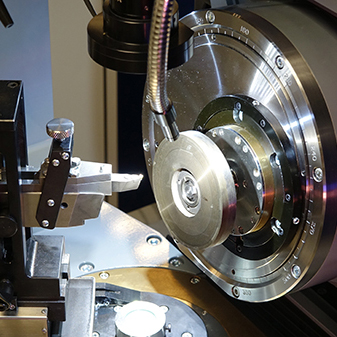
Oxfordshire-based specialist subcontractor CNC Techniques specialises in machining Formula One components from exotic metals such as titanium, Waspaloy, Inconel and Hastelloy. The mainstays of the company’s machining capabilities are its Hurco three- and five-axis machine tools. To provide an additional two axes to the three-axis machines, CNC Techniques recently invested in a rotary table from PL Lehmann.

“Although we are kept busy throughout the year, our workload more than doubles in the traditionally busy Formula One months of December through to February,” says company founder Paul Eden. “Therefore, at that time of year, apart from working around the clock, we need to work smarter and employ equipment with greater flexibility.

“As well as giving us the ability to achieve five-sided machining in a single set up, I was assured that a PL Lehmann CNC rotary table would withstand the high forces involved in machining exotics and deliver the required levels of precision,” he continues. “The installation of the rotary table was carried-out by knowledgeable technicians who made all of the connections to our machine tool’s control system. Then, whilst observing the rotary table’s try-out I realised how easy it was to operate. We now use the rotary table along with our Lang Technik work holding. In addition to standing up to the machining forces involved in machining exotics, our new CNC rotary table is simple and fast to operate, and is making a significant contribution to our 3+2 axis machining capabilities.”

As floor space is at a premium in most machining environments, mounting a CNC rotary table inside an existing three-axis VMC provides a major advantage over purchasing a large five-axis machine tool.

For further information
www.lehmann-rotary-tables.com