Tools for titanium with twice the expertise

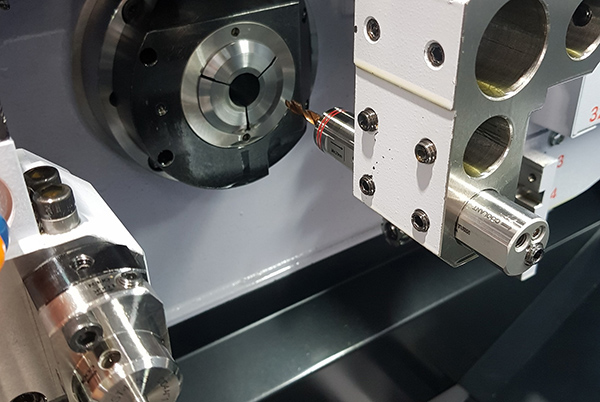
Walter has launched its MD377 Supreme and MC377 Advance solid-carbide milling cutters for the machining of titanium. Developed as high-end tools for the aerospace, motorsport and medical industries, the new arrivals are universal cutters for roughing, semi-finishing and finishing operations.

Incorporating a corner radius and central through-coolant supply, the new MD377 Supreme utilises Walter’s proven HPC Ti40 titanium geometry and new WTZ coating that makes it suitable for full slotting up to 1xD, ramping, shoulder milling and plunging. Also, the MD377 Supreme is suitable for dynamic milling processes.

The MD377 Supreme allows for tight tolerance machining and stands out thanks to its high metal removal rate. This high material removal rate is a credit to optimised cutting geometry and five cutting edges that can improve productivity levels and reduce vibration due to its differential pitch design.

Walter’s MD377 Supreme is available with a range of corner radii in diameters of 6, 8, 10, 12, 16, 20 and 25 mm, with a flute length of 13 mm on the 6 mm diameter tool ranging up to 45 mm on the 25 mm tool.

In contrast, the MC377 Advance is a four-flute titanium end mill that is also suitable for ISO P and M material designations. This diversity is credit to a tough AlCrN coating that works with Walter’s WK40EA substrate that makes the MC377 suitable for steel, stainless steel and titanium alloys.

The new MC377 Advance end mill without corner radii is available in diameters of 2, 3, 4, 5, 6, 8, 10 and 12 mm, while the MC377 Advance with corner radii comes with a 2, 3, 4, 5, 6, 8, 10, 12, 16, 20 and 25 mm diameter.

For further information
www.walter-tools.com

Change in leadership

Trumpf has completed a change in leadership at its Machine Tool Business Division. Stephan Mayer is now the new CEO Machine Tools (CEO MT) after succeeding Heinz-Jürgen Prokop, who left Trumpf at the end of the fiscal year on 30 June after reaching the age limit for members of the board. Mayer has been with Trumpf since 2012, initially as head of the Organizational Development and Production and Quality Management departments. Since 2019 he has been President China, where he managed the Trumpf locations in Taicang/Jiangsu and Jinfangyuan CNC Machine Co Ltd (JFY) in Yangzhou.

For further information
www.trumpf.com

DMG Mori continues support for F1 team

DMG Mori will continue its support for Formula One team Red Bull Racing Honda. The relationship has been in place since 2004, with the machine tool supplier becoming an Innovation Partner in 2012. There are currently more than 20 DMG Mori machines, predominantly five-axis machining centres, at the Formula One team’s manufacturing facility in Milton Keynes. Another large five-axis machine, a DMU 210P with 2100 x 2100 x 1250 mm axis travels, is due for delivery later this year.
With Red Bull Racing Honda’s manufacturing plant working close to 24/7 and dealing with an extensive range of materials and exacting delivery times, the requirement for robust and reliable machine tools is paramount. The five-axis machines provided by DMG Mori play an important role in the efficient and accurate machining necessary to meet the high demands of Formula One.

For further information www.dmgmori.com

EXN1 suits non-ferrous materials

Hofmann & Vratny is introducing its new EXN1 series for machining aluminium, plastics and other non-ferrous metals. ‘EX’ stands for expert, the company’s highest quality level, while ‘N’ is the ISO code for non-ferrous materials and ‘1’ stands for version 1.0.

In addition to extensive tests in the company’s own research and development department, wide ranging field tests have confirmed the performance of the EXN1 series, supported by positive feedback from enthusiastic customers in sectors such as food, automotive and aerospace.

H&V’s test phase showed that it is possible to reduce production times significantly by switching to the EXN1 series. With the use of the new Performmaker (end mill), one customer was able to reduce machining time per component by more than 50 % thanks to the application of larger depths of cut and higher feed rates.

During the development of the new series, H&V’s focus was on increasing tool life, surface quality and process reliability. The milling cutters feature a special cutting-edge preparation with defined edge rounding that ensures homogeneous cutting edges throughout, even cutting force distribution and – as a result – reduced wear. The manufacturing tolerances for radius and concentricity are now 0.003 to 0.005 mm, ensuring the best possible level of accuracy.

New high-performance geometry with refined grinding pattern and tuned micro cutting edge ensures a sharp cut and high chip removal. Furthermore, the milling cutters take advantage of a fine-grain substrate specially designed for machining non-ferrous materials. This interaction of geometry and substrate results in high performance, reports H&V.

The portfolio includes 35 article groups (645 individual articles) consisting of end mills, roughing mills, finishing mills, trochoidal mills, single-flute mills, torus mills, full radius mills and micro-milling cutters with diameters ranging from 0.1 to 20 mm.

For further information
www.hofmann-vratny.de/en

Eliminating chatter through vibration analysis

By monitoring the vibration of tooling and machinery set ups, manufacturers can avoid unexpected machining trouble and improve accuracy and output quality. To achieve this outcome, vibration analysis has four key principles – time domain, frequency domain, joint domain and modal analysis – each of which provides specific information on the working conditions and features of the vibrating part.

Time domain, for instance, measures the amplitude of a vibration signal. Alone, this can make it difficult to identify where the amplitudes happen and, subsequently, isolate and calibrate machines appropriately. This is where frequency domain comes in, looking at each of these signals – or waves – at set points to understand how its amplitude changes at distinct frequencies. As many vibration-related challenges occur at specific frequencies, its cause can be better identified based on variations in amplitude at certain frequencies, making these two principles of vibration analysis essential – both of which are paired through the third principle, joint domain.

Finally, modal analysis takes into account the natural frequencies of vibration based on the structural materials of the set up, the machine and the workpiece.

Now, with MSC MillMax – the milling parameter selection tool from MSC – it is possible to measure vibration frequencies and optimise setups in a matter of minutes. By equipping operators with accurate insight, machine shops can reduce set up and cycle times, enhance efficiency and elevate output quality.

MSC MillMax measures the frequency of each tool and, in almost real-time, displays the results on a digital dashboard which calculates the precise, stable speed, feed rate and width and depth of cut to maximise performance. Alongside this, the system determines the best speeds for the machine shop’s required levels of surface finish and accuracy.

For further information
www.mscdirect.co.uk/MSCMillMax