
MTC offers four-day week to staff

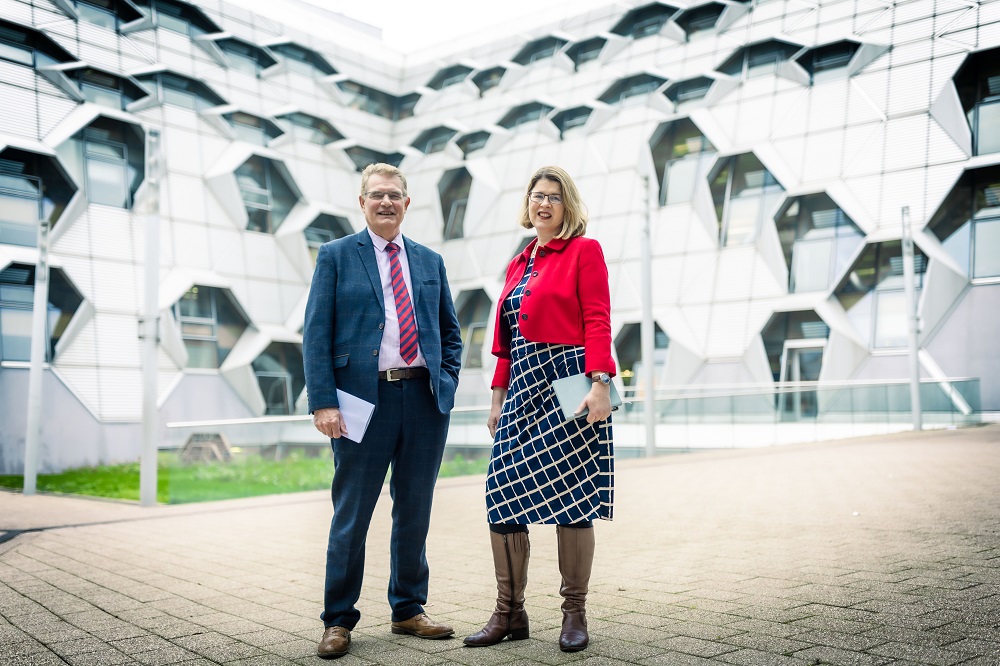
The Manufacturing Technology Centre in Coventry will permanently implement flexible working – including a four-day week – following a large-scale, two-year trial which saw more than half of employees report higher productivity. The MTC’s 820 employees can now opt for a four-day week under the centre’s fully flexible working week initiative.

“We’ve been operating flexible working patterns since April 2018, but employee engagement surveys have shown that staff wanted to extend this further,” says Vicki Sanderson, HR director at the MTC. “We explored a range of options, including researching what was important for millennials and generation Z, as 79% of our workforce fall into these categories. Work-life balance was the priority.”
For further information www.the-mtc.org

New Hainbuch system is ‘game changer’

The new Hainbuch System is said to be a ‘game changer’ for manufacturers seeking efficient and flexible work holding. This quick-change innovation allows manufacturers to clamp 1000 different workpieces without the need for a multitude of solutions. With the Hainbuch System, engineers now only need one basic clamping device, a chuck or a stationary chuck that remains on the machine tool. Whether it is OD, ID, prismatic components, jaw, magnetic or clamping between centres – the Hainbuch System provides a solution.

In short, the Hainbuch System is a new series of mandrels and adaptors that encompasses the complete range of Hainbuch products. This includes the TOPlus Premium chuck, which guarantees a runout of ≤5 μm without alignment, regardless of which clamping head is in use.

Also capable of working in harmony with the new Hainbuch System is the SpannTop mini chuck series. The Mando Adapt mandrel and corresponding jaw module already work perfectly with the new SpannTop mini, meaning complete autonomy for any small component clamping needs.

Unlike the SpannTop mini chuck, the configuration for the TOPlus system is a little different. Whereas the SpannTop uses an adaptor ring, the TOPlus system has a ring of attachment holes to secure the market-leading jaw module.

The SpannTop and TOPlus Mini series are available with a full through-bore plus a variety of standard lengths to suit all machine types and draw-tube configurations. For the customer, this range of possibilities gives flexibility with OD clamping via the clamping head and ID clamping with the mandrel-adapting Mando Adapt system, while complete jaw clamping can be accommodated with the new jaw-adapting module.
For further information www.hainbuch.com

Driven to succeed, with help from Ceratizit

In under seven years, Driven Engineering has grown from a one-man operation with just a second-hand three-axis machining centre into a thriving subcontract manufacturing business on the back of founder Ray Harris’s commitment to invest in the company’s future.

The type of components machined by Driven Engineering lend themselves to vices, rather than fixtures, which is where Ceratizit UK & Ireland plays its part. In addition to providing cutting tools, Ceratizit has also been instrumental in kitting out the pallets with its latest ZSG4 vice system. The ZSG 4 vice has several benefits, but key to Driven Engineering is the ability to grip billets on just 3 mm of material.

“Using such a small amount of material for gripping allows us to program the part using the bottom of the billet as the datum, while we also get great access to five sides of the part,” says Harris. “In addition, the vices deliver consistent grip and accuracy, making them ideal for unmanned machining.”

In total Ceratizit has supplied Driven Engineering with 75 ZSG 4 centric vices, in a combination of 125 and 80 mm widths. Each vice is capable of applying up to 35 kN of gripping force, which allows the minimum grip depth of 3 mm. A further advantage is the lack of any requirement for billet preparation prior to gripping, which Ceratizit says is unlike other systems on the market. Their suitability for pallet-based machining is enhanced by their compatibility with PNG, MNG and Lang zero-point clamping systems.

Further support is provided by the Ceratizit tool-vending system that Driven Engineering has installed, which helps to maintain production with 24-7 tooling availability.
For further information www.ceratizit.com

DMC partners Satellite Applications Catapult

The Digital Manufacturing Centre (DMC) and the Satellite Applications Catapult are partnering in a move that highlights an exciting future for the UK space industry. With the Government aiming to capture 10% of the sector by 2030, this new partnership marks an important development in establishing a national space supply chain for advanced manufacturing.

While the UK space sector currently generates around £16.5bn per annum, providing 47,000 jobs across 1293 different organisations, significant growth will be required to meet the Government’s ambitious target. Notably, there is a real need for the development of a comprehensive and advanced supply chain specialising in high-performance composites and additive manufacturing. The collaboration between DMC and the Catapult intends to kick-start these ambitions.
For further information www.digitalmanufacturingcentre.com

Simplifying gripper configuration and integration

The task of configuring bespoke vacuum gripper systems that will meet the specific requirements of individual applications has never been easier thanks to the comprehensive digital configuration services now available from Schmalz. This range of digital services helps end users, machine builders and system integrators to achieve quick configuration of products such as Schmalz SLG lightweight gripping systems for individual applications. Tools such as filters, configurators, ordering aids and apps simplify the process – regardless of the stage of the project, whether it’s product design, procurement or operation.

A simple and highly intuitive six-stage process guides users through steps such as: selecting the workpiece; defining the application; selecting the type, number, size and positions of vacuum cups; and finally choosing a vacuum generator and robot mounting flange. The proposed SLG lightweight gripper then generates automatically and is shown in 3D on the basis of users input and responses to this series of intuitive choices.

At the end of the process, a summary of all of the information used to specify the gripper is available for download, together with valuable information for the end user or machine builder covering gripper dimensions, weights, air flow and gripping force.

Additional digital services available from Schmalz make it possible to simulate your handling process with a digital twin of the products selected, and test the function of the system long before it is actually built. For example, it is even possible to obtain information about the behaviour of a suction pad in its operational state. There are also a series of software and function modules that help integrate Schmalz products even more quickly into the end user’s process and control system.
For further information www.schmalz.com