


Mills CNC has recently supplied STATS, a specialist supplier of pressurised pipeline isolation,
hot tapping and plugging services to the global energy industry, with a new, compact multi-
tasking lathe and a new large-capacity simultaneous five-axis machining centre.
The two FANUC-controlled machines, both manufactured by DN Solutions, arrived at STATS’
machine shop facility in Kintore, Aberdeenshire in September 2025. They comprise a 10”
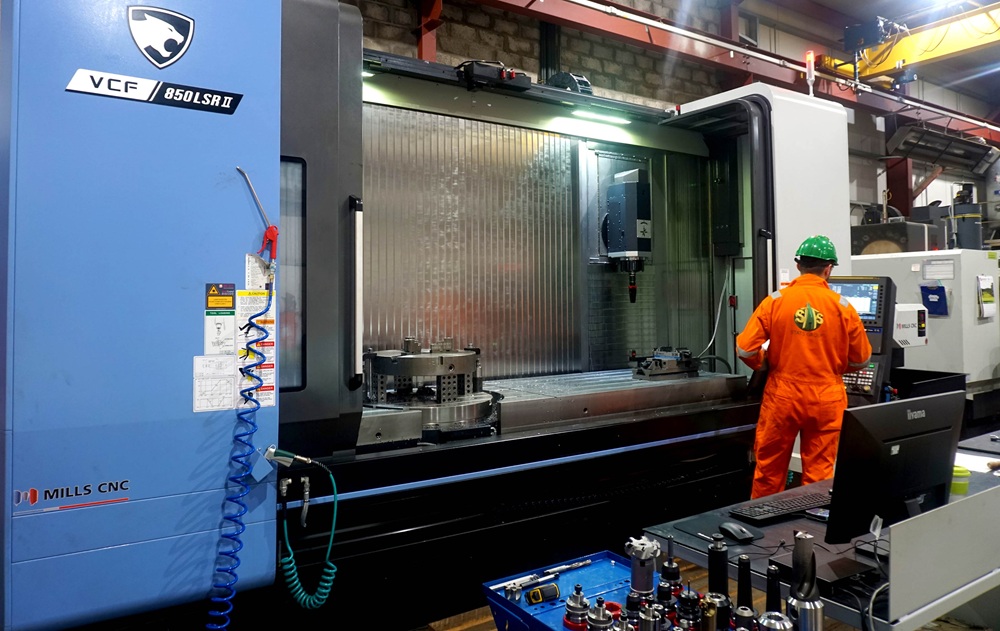
chuck Lynx 2600LY lathe with integrated Y axis and driven tooling capabilities, and a VCF
850LSR II five-axis machining centre with 3500 mm bed.
The acquisition of the machines has increased and improved the company’s in-house
machining capacity and capabilities. They are already enabling STATS to not only reduce its
reliance on third-party machining suppliers but also helping to eliminate production
bottlenecks, increase process and operational efficiencies, reduce costs, and improve
productivity.
Established in 1998, STATS Group has a growing international presence with operational
facilities – including manufacturing, workshop and engineering capabilities – in the US,
Canada, Australia, UAE, Qatar, Saudi Arabia and Malaysia. STATS, recently acquired by
Japanese conglomerate Mitsui & Co, is a major player in the global energy sector, designing,
manufacturing and supplying a range of innovative, patented pipeline isolation, intervention
and repair products and services.
STATS’ best-in-class engineering and client-centred approach has earned the company a
large and expanding customer base of national and international oil, gas, and petrochemical
companies, as well as pipeline operators.
The company excels in the servicing of large-diameter, high-pressure pipelines and, with the
demand for extending the life of aging infrastructure through planned and preventive
maintenance set to increase, STATS is well positioned for growth. Demand for its proven,
patented solutions – including the BISEP fail-safe double-block and bleed line stopping tool
and the Tecno Plug piggable inline isolation tool – is expected to rise significantly.
STATS’ extensive product range – which includes pipework and pipeline isolation and
intervention tools, hot tapping machines, and mechanical clamps and connectors – are all
designed and manufactured in-house, with the company’s machine shop playing a pivotal
role machining the many different high-quality components that go into every product.
Facing increasing demand and the need to support customers’ maintenance schedules
under tight deadlines, STATS undertook a comprehensive strategic audit of its in-house
machine shop. Driven by its commitment to continuous improvement, the company
reviewed operations to pinpoint current and emerging challenges related to quality, lead-
time delivery and cost efficiency.
Says Krzysztof Wozniak, STATS Group’s manufacturing manager: “Because we manufacture
all of our products in-house, and as we operate to such tight, non-negotiable deadlines, it’s
vitally important that we have access to advanced technologies and efficient processes that
improve our machining performance, reduce lead times and make us more competitive.
Although we have a range of CNC and manual tools at our disposal, some of them are
‘legacy’ machines whose processing speeds, accuracies and flexibility have been superseded
by more advanced machine tool models.”
Due to substantial business growth and a rapidly expanding order book, STATS recognised
that its existing machining capacity was no longer sufficient to meet demand. Ageing
equipment was also underperforming, creating bottlenecks and inefficiencies that required
urgent attention. Without investment in state-of-the-art machinery, a significant proportion
of work would require outsourcing to third-party machining suppliers, increasing costs and
lead times and ultimately putting critical turnaround times at risk.
The audit also highlighted inefficiencies experienced by STATS’ previous ‘mix and match’
approach to acquiring machine tools featuring different controls, and the difficulties this
presented in being able to transfer programs, seamlessly, between machines.
STATS made the decision to take pressure off its small turned part processing operation by
investing in a new multi-tasking lathe.
Explains Michael Forbes, STATS Group’s operations manager: “We had previously acquired a
used two-axis FANUC-controlled Lynx lathe a couple of years ago and were impressed with
its cutting capabilities, fast processing speeds, high precision and reliability. The machine
had been in constant use since being installed but, owing to the increase in demand for
small, high-quality turned components, it could not keep up with the volume of work now
coming its way.”
He continues: “Only having one small lathe at our disposal had created a serious bottleneck
that could only be alleviated by subcontracting the work out or by strengthening our in-
house machining capacity via investment in a new, high-performance machine. We opted
for the latter.”
However, rather than invest in another two-axis lathe to help clear the backlog and attempt
to put its small turned part operation back on an even keel, the company made the decision
to acquire a new FANUC-controlled multi-tasking machine with integrated Y axis and driven
tooling capabilities.
Says Forbes: “Having access to a lathe with full mill-drill capabilities, would not only enable
us to process small turned parts quickly and more efficiently in one set up and eliminate the
need to transfer parts to a milling machine for completion, it would also free-up time on the
small milling machine.”
The company’s positive experience with its first Lynx lathe led STATS to approach Mills CNC
to discuss its new turning requirements, and it was through these discussions where the
specification of the Lynx 2600LY and its availability were outlined to STATS’ representatives.
“The Lynx 2600LY ticked all the right boxes,” remembers Forbes.
As previously mentioned, STATS had several different machine tools at its disposal, one of
these being a relatively large bed mill that was proving to be unreliable and prone to
downtime. Not having access to a large and reliable milling machine had resulted in STATS
outsourcing this work, which was particularly frustrating as most of it was not complex or
particularly time consuming.
“Subcontracting the work out was expensive and meant that we were no longer in control
of our own production schedules,” says Wozniak. “It was clear we needed to resolve the
situation quickly and that investing in a new large-capacity mill would be the right move.”
With so many potential machine tools available, STATS did its homework and created a
machine checklist identifying ‘must have’ technologies, capabilities and features.
Continues Wozniak: “We were trying to future proof this investment as much as possible.
So, in addition to the machine having a large worktable and long X-axis stroke for processing
long and/or multiple smaller workpieces in one set up, we also needed the new machine to
have full simultaneous five-axis capabilities, a powerful, high-torque spindle, fast rapids, an
integrated rotary table, an automatic tool changer, the latest FANUC control, and in-process
tool and workpiece measurement.”
Armed with its requirements and needing the machine to be available quickly, STATS went
to market requesting quotes from a refined number of machine tools suppliers.
“It was the VCF 850LSR II’s technical specification that put Mills CNC in the box seat,” says
Forbes. “And having the machine in stock, ready for immediate delivery, effectively helped
seal the deal.”
Since installation and operator training, both machines have been put through their paces
machining a range of components from mild steel, stainless steel, aluminium and some
exotic alloys, including Inconel.
Concludes Forbes: “Our investment in two new machines from DN Solutions has had a
dramatic impact on our productivity and process efficiencies. The backlog of work has
already seen a significantly reduction and, because we’re no longer outsourcing work, we’re
back in control of our production processes and better able to meet customer delivery
schedules.”
More information www.millscnc.co.uk