

VERICUT SOFTWARE HELPS RIGGING PROJECTS STAY AHEAD OF THE CURVE

Rigging Projects, a specialist in the design and manufacture of marine hardware and sailing
systems, is tapping into the advantages of Vericut CNC simulation, verification, optimisation
and post-processing software to drive home the gains available from a sizable investment in
its first five-axis machining centre. Using Vericut, the company has complete peace-of-mind
in the single set-up machining of complex parts with curved freeform surfaces – confident
there will be no collisions and no expensive repairs.
Tobias Hochreutener founded Rigging Projects in 2014 based on his vision of a rigging
consultancy business that put smart ideas, trustworthy services and high-quality products at
its core. From humble beginnings in his tiny home office, the company now has over 30
employees, four DAME Design Award Special Mentions and a high-technology
manufacturing facility in Hampshire.
Mostly serving designers and builders of superyachts and race yachts, Rigging Projects
produces an array of deck hardware that handles lines or sails. Both standard and custom
solutions are available, with the company offering an end-to-end design and consultancy
service for client projects, whether new build or retrofit. Component manufacturing takes
place at the company’s state-of-the-art machine shop in Totton, Southampton, which
should be ISO90001 accredited by later this year.
The impressive new centrepiece of the machine shop is a Matsuura MAM72-52V, a colossal
high-speed five-axis vertical machining centre described as a ‘factory in one machine’ for
variable-part/variable-volume production and extended unmanned operation. Standard
features include 130 tools on a 330 tool magazine base, a tower pallet system for extended
lights-out manufacturing and a chip-removal system.
“Prior to investing in our new Matsuura five-axis machine, we relied on three-axis machining
centres and Y-axis lathes,” explains Ian Foss, CNC programmer and machine shop supervisor
at Rigging Projects. “We could make complex parts, but it would require multiple set-ups, 9
or 10 in extreme cases. As we make most of our parts in small quantities, set-up was costing
us a lot of time.”
The five-axis Matsuura ensures Rigging Projects can make almost all of its components in a
single set-up, saving significant time and cost.
“In terms of complexity, the Matsuura is another level entirely,” says Foss. “It was clear in
my mind that, with such a high-value, we needed verification software to provide us with
confidence during machining.”

Rigging Projects scrutinised various options for its verification software. Some were ruled
out for reasons such as cost or lack of UK support, but Vericut ticked its boxes. Ian Foss had
also used Vericut previously and could vouch for the software’s capabilities. He visited the
MACH 2024 exhibition in Birmingham with Chris Whitwam, head of engineering at Rigging
Projects, to speak with the Vericut team, and the company never looked back.
Rigging Projects duly invested in a seat of Vericut, offering Verification, Multi-Axis
Machining, Machine Simulation and Auto-Diff capabilities. A cloud-based licence means that
the two CNC programmers at Rigging Projects share the single seat. It also supports home
working as necessary.
Complex parts are par for the course at Rigging Projects. Components that handle a line or
sail cannot feature sharp corners, while meeting the high expectations of yacht owners also
means aesthetic appearance is paramount. The company’s parts therefore feature many
radii, rounded edges, curves and freeform surfaces, all of which means programs with
plenty of 3D surfacing.
“We’re far more about right-first-time machining and safety than saving every second in
cycle time,” says Foss. “The Matsuura has driven huge savings in set-up time, so now we just
want to stay safe and avoid scrapping expensive workpieces. Vericut is a massive help in
that regard.”
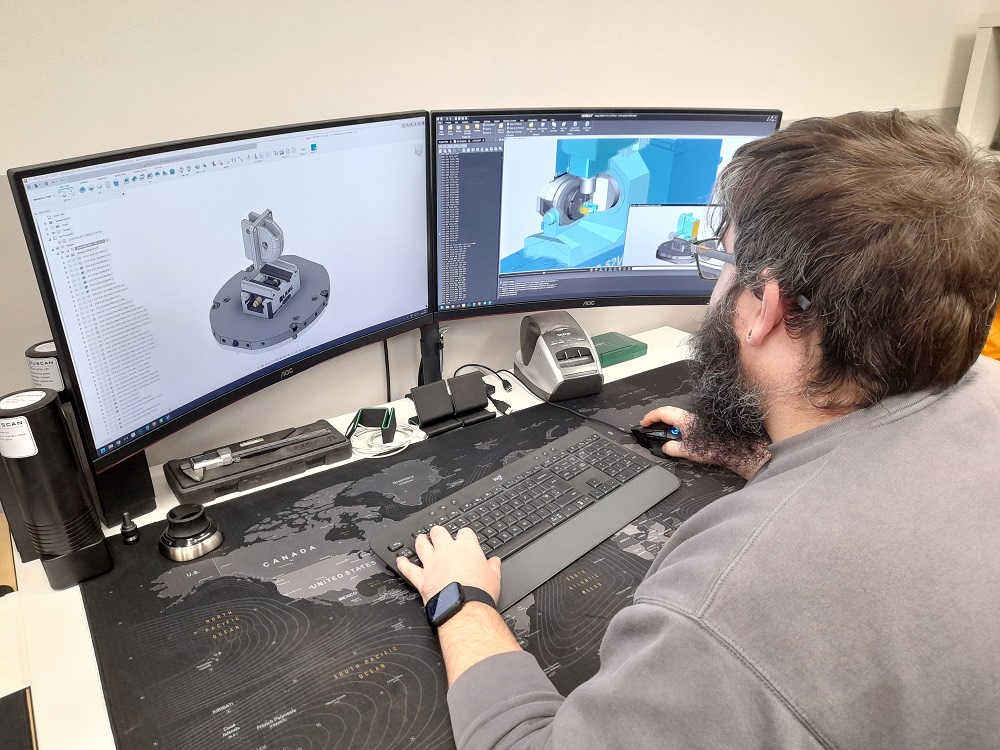
Every part programmed for the Matsuura using the company’s Autodesk Fusion 360
CADCAM software is run through Vericut. The Fusion 360 cascading post-processor
integrates with Vericut to transfer manufacturing data, a capability that allows users to
simulate and optimise NC programs in Vericut while continuing to work in Fusion 360.
“The whole process is seamless and Vericut simulation is a great asset,” he says. “Fusion 360
has simulation, but it’s a pre-post process and takes twice the time of Vericut. Moreover,
while Fusion will flag up potential collisions, there’s no tolerance-setting option. It won’t
send an alert if the tool or spindle gets within 5 mm of the table, for example. In contrast,
Vericut will let me know if we get within whatever tolerance I set. I can subsequently refine
the gap as confidence grows.”
The value of Vericut’s ability to avoid collisions on expensive machine tools should not be
underestimated. Repairs to hardware such as spindles are extremely costly, as is machine
downtime. Furthermore, a company like Rigging Projects would be forced to create new
programs for other machines while waiting for the repair. Avoiding just one collision will
likely more than cover the cost of Vericut.
“We’ve already had an incident when Vericut saved the day,” reveals Foss. “We
encountered an isolated issue with the Matsuura post-processor where it failed to pick up
the work co-ordinates after a homing routine to re-orient the table. It used the machine co-
ordinates instead, which means it would have tried to machine itself! Thankfully, Vericut
picked it up and we rectified the issue. It saved a lot of money that day and avoided a
potentially dangerous situation.”

Another valuable use of Vericut at Rigging Projects is AUTO-DIFF. Applied after simulation,
AUTO-DIFF makes sure the CNC programmers do not miss any features and avoid major
gouging or excess stock on the model that should be finished. The company also takes
advantage of Vericut’s X-Caliper measuring tool, clicking on critical features to ensure that
the programming of mid-limit tolerances meets with expectations, for example.
Concludes Foss: “With such a large, fast, five-axis machine like our Matsuura, Vericut is an
insurance policy. Moreover, with its pallet-change capability, we often leave the machine
running overnight. Knowing we have Vericut as a safety net provides real peace of mind.”
More information https://vericut.com/en-gb/
ITC showcases latest micro-tool portfolio

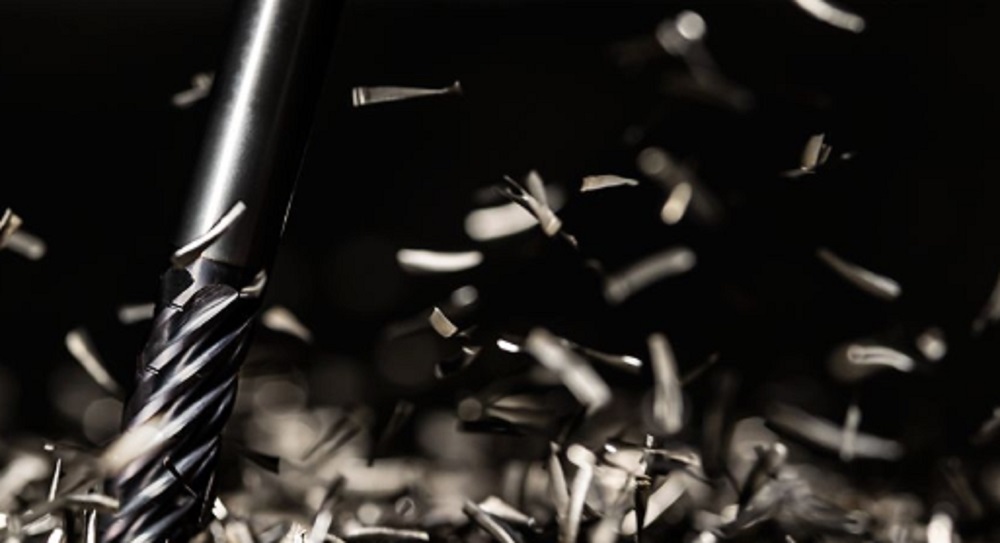
At the Advanced Engineering exhibition in Birmingham towards the end of last year, highlights on the stand of cutting tool manufacturer ITC included a new catalogue outlining micro-tools from Karnasch. The range starts at 0.05 mm and reaches 6 mm in diameter, with the latest coatings applied. Karnasch micro-tools target various material groups, including aluminium, steel, hardened steels, exotic materials and composites. 

Milling geometries include tools with sharp corners, radiused corners and ball noses. All geometries have exacting tolerances designed for high-value mould and die applications. A new range of micro-drills and micro thread mills also feature. The thread-mill sizes start at M0.6 and continue up to M3, with suitability for both ferrous and non-ferrous materials. A diamond-coated range for composites and graphite is also available. 


Three drilling ranges, including through coolant, extend from 0.8 mm to 2.95 mm diameter, in different lengths. Also available is a solid series from 0.1 to 3 mm diameter, again with differing length dimensions. A range of pilot drills supports the new Karnasch micro-tool range. 

In addition, the new catalogue includes micro concave corner rounding cutters, starting at a radius of 0.1 mm and going up to 3 mm, and a range of 250° lollipop cutters from 1 to 8 mm diameter ball. 

Also on display was ITC and Widia products mounted on Big Daishowa Mega Micro chucks. ITC used the show to stress Big Daishowa’s advantages during machining operations.

More information www.itc-ltd.co.uk

Haimer shows benefits of tool management

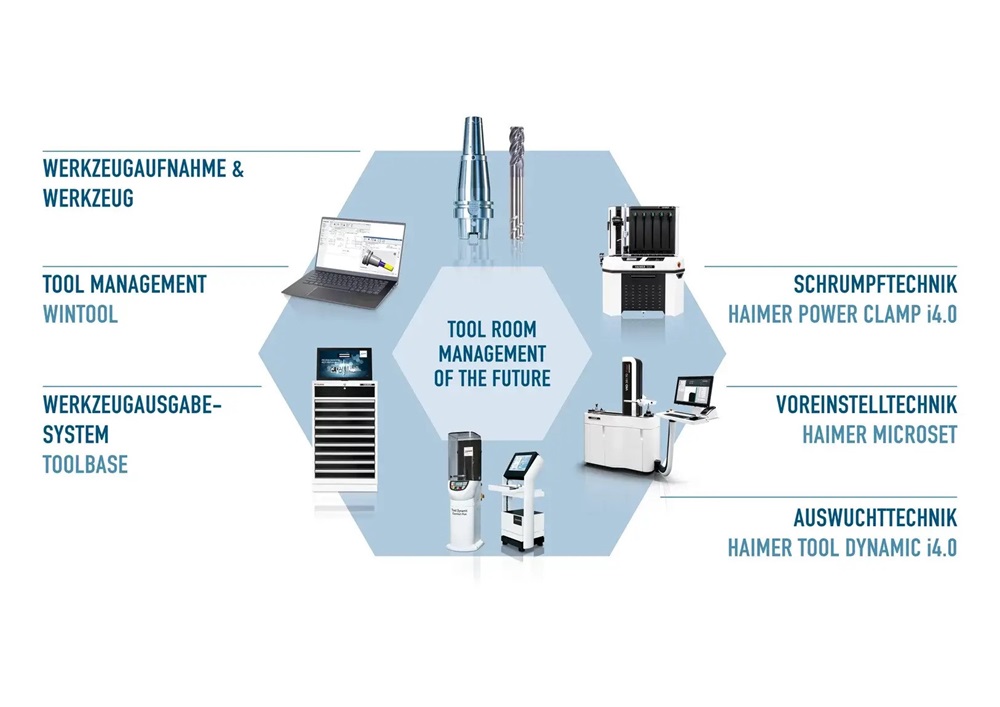
At the AMB exhibition in Stuttgart towards the end of last year, Haimer showed how modern tool management works: with high-quality, process-reliable components and end-to-end digitisation, through to fully automated tool presetting and secure transmission of digital tool data to the machine. A striking highlight of the Haimer stand was the fully digitised toolroom.

Tool management must be made as easy as possible for manufacturing companies – whether small or large. End-to-end digitisation and automation play a decisive role.

“We offer our customers the analogue and digital tool set-up process from a single source,” emphasises Andreas Haimer, president of the Haimer Group. “Starting from our tool holders and tools, as well as Toolbase dispensing systems, the data is managed digitally by WinTool software, right through to transmission to the machine tool control. Our Haimer Power Clamp, Tool Dynamic and Microset machines are available for the analogue set-up process. That’s unique.”

The WinTool data hub, which enables the management of tools, operating resources, machine programs, processes and master data, plays a central role in the overall process.

He adds: “In order to provide our customers with a proven, high-performance, digital offering, we acquired a 25% share in WinTool AG at the beginning of 2024 and agreed a strategic partnership with the TCM Group. Since then, the WinTool and Toolbase product lines have been part of the Haimer range.”

To ensure that the digital processes in tool management work reliably, the tools and their chucks should be identified as uniquely as possible. Haimer therefore supplies all tool holders with a unique ID – in the form of a laser-engraved, unique data matrix code that prevents any mix-ups.

More information www.haimer.com

Chip-splitter inserts support process control

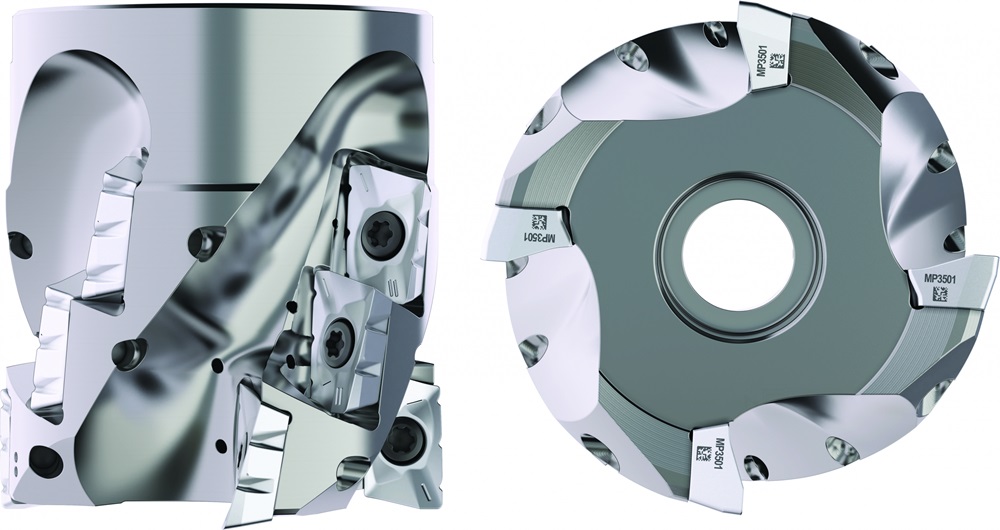
Seco has introduced two chip-splitter milling inserts that lower the stress on both the machine and cutting tool for improved milling process stability. The Turbo 12 and 18 chip-splitter inserts for the company’s Turbo cutters – available in five grades for both square shoulder and helical milling cutters – reduce chatter, vibration and stress on manufacturing equipment.

Turbo 12 and 18 chip-splitter inserts incorporate grooves on both of their cutting edges to minimise chip size and lower cutting forces without reducing cutting data or depth of cut. By keeping chips as small as possible, shops lessen the risk of chip jamming, improving process security and supporting the more effective machining of deep pockets.

Product managers Magnus Engdahl and Michael Davies work in tandem and spearhead the team who developed the inserts. “The Turbo 12 and 18 chip-splitter milling inserts apply to various machining applications and materials,” says Engdahl.

Davies adds: “The versatility of the inserts makes them suitable for a wide range of industry segments and materials, providing customers with a flexibility.”

Hard-to-reach part features can pose challenges, and even the most robust combinations of machine and tool can struggle with long overhangs. Seco says its chip-splitter inserts overcome these challenges by evacuating chips from deep pockets for improved chip flow. Plus, Turbo 12 and 18 chip-splitter inserts reduce chatter commonly associated with long-reach applications, resulting in longer tool life and better surface finish.

Thanks to their stability and ability to reduce cutting forces, Turbo 12 and 18 chip-splitter inserts give shops the much needed process security and reliability required for effective unattended machining operations. As a result, shops increase output while also minimising stress on the machine and tool.

More information www.secotools.com

Automatically adjustable tools with four edges

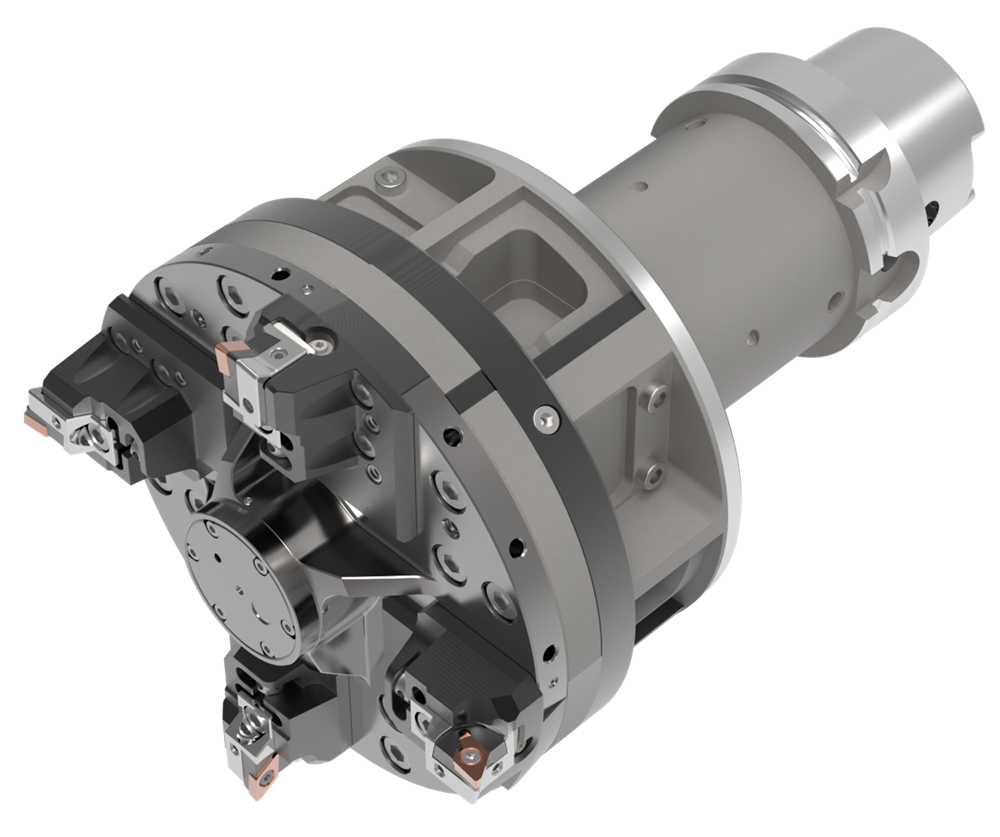
LMT says that one of its principal strengths is the custom design of complex tool solutions. Providing testimony to this statement is the company’s development of four-edged automatically adjustable tools that are said to provide maximum performance, precision, flexibility and process reliability.

Automatically adjustable tools feature movable cutting edges that can be controlled via a drawbar in the tool and slides. They enable the machining of complex component geometries in a single clamping operation and primarily see use in the automotive industry.

The tool system has four cutting edges, a stable, centrifugal force-resistant design and high-precision, complex tool/insert components, allowing high cutting speeds with high precision and surface quality. This capability leads to a reduction in cycle times, resulting in cost savings, reports LMT.

It is possible to adjust the four cutting edges continuously, highly accurately and evenly in the micron range (transmission ratio 1:4), ensuring the precise machining of a wide range of contours and diameters with just one tool. Controllable cutting edges also allow quick and easy tool wear compensation via the machining centre’s control. Manual adjustment is no longer necessary, reducing downtime and increasing productivity.

Depending on application conditions and the workpiece material, the cutters can employ indexable inserts with different cutting materials and geometries. For example, inserts with wiper geometry ensure the best surfaces, while PCD-tipped inserts guarantee maximum performance when machining engine components and aluminium housings.

Users can set three parameters on the clamping holder – diameter, length and angle -contributing to better surface finish. The four-edged automatically adjustable tools feature a central channel that directs the coolant specifically to each cutting edge, helping to optimise chip removal, increase productivity and maximise process reliability.More information www.lmt-tools.com