HP releases disruptive polymer material

At the annual AM Forum Conference in Berlin earlier this year, HP showcased 3D printed parts using a new material qualified for the company’s industrial 3D polymers solutions. Developed with Arkema, HP says the new PA 12 S material sets the standard for surface aesthetics, while reducing costs for customers using the company’s Jet Fusion 5200 and 5600 series 3D printing solutions.

“From design to parts production and post processing, HP is committed to delivering a broad range of innovative materials and programmes for more sustainable production,” says Francois Minec, global head of 3D polymers at HP. “We’re thrilled to join our colleagues across the industry at AMUG as we collectively look to accelerate scale and adoption of additive manufacturing.” 

The introduction of PA 12 S is set to boost the industry by reducing variable costs per part and significantly lowering the total cost of ownership. In conjunction with HP Multi Jet Fusion technology, the material offers an optimised production process that streamlines post-processing steps, saving time and further reducing costs.

According to HP, its PA 12 S material also has the highest reusability ratio versus other PA 12 materials on the market. In fact, up to 85% reusability ratio, minimising waste.  

The newly launched material is being used by customers including Accel Digital Solutions, Decathlon, Erpro Group and Materialise for aesthetic parts with enhanced surface finishes and lower production costs. 

“Working with HP, as a beta customer for PA 12 S, is an important element in our strategy to make additive manufacturing more accessible through an extended industrial grade materials offering,” says Pieter Vos, marketing and product director at Materialise. “PA 12 S has proven its processability, delivering consistent parts with a great surface quality.”

More information www.hp.com

Next-generation AM machine has cast base

A new additive manufacturing (AM) machine, the third generation of the LaserTec 30 SLM, is now available from DMG Mori. The company says that the selective laser melting (SLM) platform has been completely redesigned to combine robustness and repeatability with thermal stability. It features a fully overlapping quad-laser working area and a build volume of 325 x 325 x 400 mm.

The latest LaserTec 30 SLM builds on the strengths of previous versions, while accommodating suggestions from customers in an ever-changing AM market. A notable feature is – unusually in the field of AM – a rigid cast structure based on the material and design principles of the majority of DMG Mori’s milling and turning machines.

Unlike with metal-cutting machine tools, there are no appreciable forces transmitted to the structure of the LaserTec 30 SLM from movement of the axes. The rationale for using a casting in this latest AM machine is to resist thermal expansion due to unavoidable temperature changes. DMG Mori has many years of experience in minimising the effect of, and compensating for, temperature changes within its products.

Care has been taken to ensure that the process chamber is an isolated unit within the machine and free to expand and contract in all directions as the temperature varies. In contrast, the optics are mounted on the rigid cast frame. The distance between the optics and the surface layer of the powder bed remains constant by calibrating the bi-directional re-coater and actively compensating for any displacement in the Z axis.


To reduce the time delay between successive builds and to increase flexibility, DMG Mori’s rePLUG units simplify and speed the changing of materials.

More information www.dmgmori.com

Post-processing system streamlines workflows

Stratasys is collaborating with AM Solutions, a brand of the Rösler Group, to launch Stratasys PowderEase TI, a 3-in-1 post-processing solution for the Stratasys H350 SAF powder-bed printer. The new post-processing system drives towards important customer milestones, including shorter time to finished parts, more efficient powder use, and the ability to handle the outcome of multiple printers at one time with a single T1 system. Manufacturing of the PowderEase T1 will take place at the German location of AM Solutions.

PowderEase T1 combines multiple post-processing steps into a single, streamlined unit, simplifying workflows, reducing operational costs and improving overall productivity for users. Advantages include: 3-in-1 functionality (automated powder breakout, retrieval and dosing); scalable efficiency (a single system can serve up to six H350 printers); time savings (up to 50 minutes of time savings per build compared with manual processes); powder utilisation (maximises powder retrieval and efficiency); and consistent and ready to use parts with each build.

“Working with AM Solutions, we’re poised to deliver significant advancements that will benefit our customers and simplify work routines on the production floor,” says Birk Ploennigs, director of SAF product management at Stratasys. “This solution will allow customers to use Selective Absorption Fusion technology for the manufacture of parts, taking production efficiency to a new level.”

David Soldan, head of AM Solutions, adds: “The key focus of the partnership between Stratasys and AM Solutions is the delivery of maximum value and to establish additive manufacturing as a primary production technology. Automated post-processing, which ensures cost-effective, high-quality, consistent results, is crucial to this objective.”

More information www.stratasys.com

The best of both manufacturing worlds

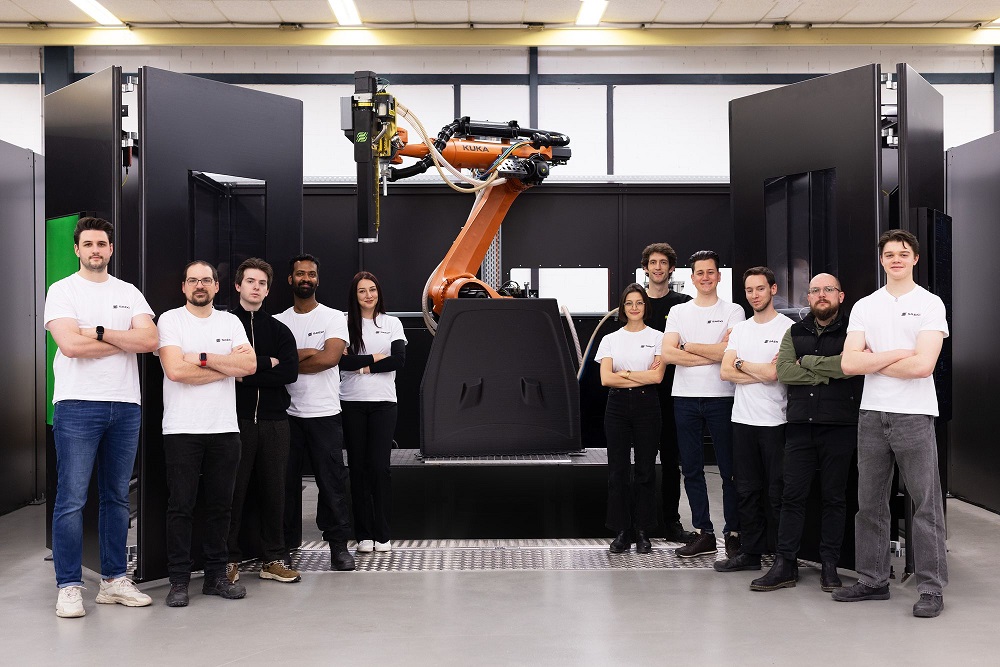
A UK 3D-printing specialist is targeting a £3m opportunity after launching a new CNC milling tool that will offer manufacturers the best of both worlds. Rapid Fusion, which employs eight people at its recently opened Exeter R&D centre, has created a high-performance electro-spindle that will provide the precision milling and post-processing of polymer 3D prints.

Eight months in gestation, the breakthrough technology will be fitted to the company’s future Zeus 3D robotic systems, providing clients with the opportunity to enjoy the speed of additive manufacturing with the precision of subtractive machining – all in a single 6 x 6 m cell. The tool is suitable for use on high-quality moulds across a range of industries.

“This CNC milling tool has the potential to be a real game changer for manufacturers and has been designed in partnership with a number of end users to ensure we deliver exactly what they need,” explains Martin Jewell, R&D director at Rapid Fusion. “3D printing can give unrivalled speed and creates moulds near net shape, within 3 to 4 mm. Certain applications need even greater precision and this is where you can call in a CNC milling tool to remove the excess material. Going forward, we’ll be able to offer this as a single turnkey solution.”

He adds: “The advantages are huge. We know we can deliver repeatable quality and, in a trial project, we reduced the lead time for a mould tool from six to eight weeks to just five days.”

The CNC milling tool comes equipped with a tool changer, allowing users to swap between it and the 3D printing pellet extruder on a robot set-up. It can also handle engineering-grade materials, such as glass- and carbon-filled PEI and PEEK polymers.

More information www.rapidfusion.co.uk

Atlas Copco buys PPS

Atlas Copco UK Holdings Ltd has acquired 100% ownership of Pennine Pneumatic Services Limited (PPS). PPS has been an Atlas Copco premier distributor for many years and will continue to offer the same products and services, alongside an extended product offering as part of Atlas Copco Compressors UK’s business operations. It will continue to operate as a stand-alone company within Atlas Copco Compressors UK, under the Pennine Pneumatic Services brand name, for the foreseeable future. PPS has five branches across the north of England and over 90 team members.

More information www.pps-ltd.co.uk