

LNS keeps developing e-Connect

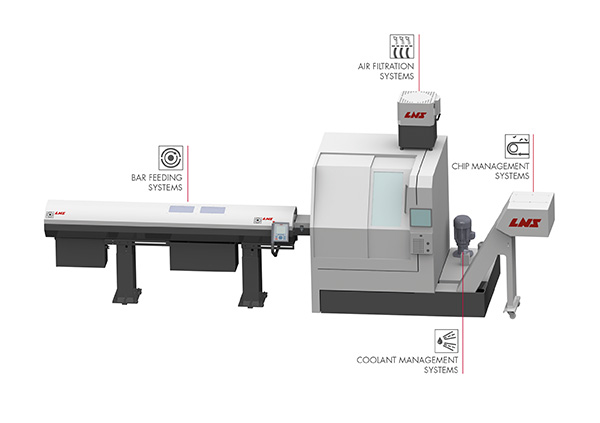
The LNS Group says that it is implementing e-Connect solutions to integrate its products, particularly barfeeds, into customer ERP and MES systems. “This will allow LNS customers to get full machining transparency at a glance, including the workload of each machine, cycle times and expected production completion,” explains Carlos Muniz, global product manager barfeed at the LNS Group.
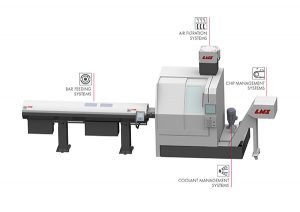
LNS has been pushing innovation in the field of connectivity for more than 10 years. Together with major machine manufacturers, the connection between the peripheral and the machine tool was developed. A second major innovation was the connection between the LNS product and the humans controlling it. Monitoring production remotely from mobile devices saves time by knowing when the machining process will stop for a changeover, thus anticipating downtime in production planning. Thanks to e-mail or GSM notifications, overall production processes are more efficient. Additionally, the connection to internal or external technical support ensures downtime reduction.
While the e-Connect solutions to the machine and people are essential, another major step is the integration into customer ERP, MES and quality control operations.
“Until now, such systems and the machines were not efficiently connected, missing transparency,” says Muniz. “LNS is developing software drivers that will gather relevant information from the peripheral and, through middleware, feed it to applications or systems such as ERP, MES or quality control. These solutions are tailor-made for each customer software platform. The real-time monitoring of all processes will help clients to save time and resources.”
For further information www.lns-group.com
Heavy-duty turning centres lighten the load

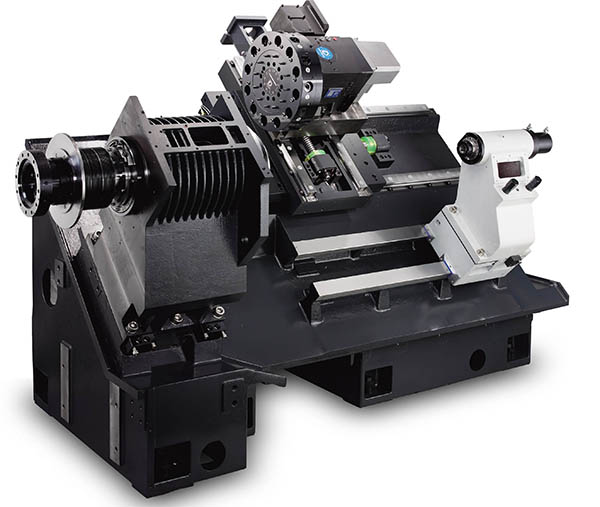
Now available in the UK and Ireland from official importer, sales distributor and sales agent, TDT Technology, is the Feeler range of FTC turning centres and slant-bed CNC turning centres. Aimed at machine shops tasked with heavy-duty machining operations, the machines are designed to offer a competitive cost-to-performance ratio.

The Feeler FTC range comprises three models, the FTC-10, FTC-20 and FTC-30. Between them, the machines cover a swing-over-bed of 520 to 600 mm diameter, a standard turning diameter of 180 to 310 mm, a maximum turning diameter of 240 to 450 mm, and a maximum turning length of 255 to 621 mm. All three feature a spindle equipped with precision, dual-direction, angular-contact thrust ball bearings, while a special heat-dissipation headstock design eliminates elevated temperatures from the spindle bearings, prolonging life and promoting reliability.
TDT says that machines in the Feeler FTC series of slant-bed CNC turning centres are designed for rigidity, efficiency and versatility. Kicking off the range is the FTC-300, which features a 6000 rpm spindle, 6” chuck and 52 mm diameter bar capacity. Moving up, the FTC-350, 350L, 350XL, 350LY (Y axis) and 350SLY (twin spindle) offer a 4500 rpm spindle, 8” chuck and 52 mm diameter bar capacity (66 mm option). All feature a 30° slant bed.
For an even more robust structure, the FTC-450 and 450MC (C axis and driven tools) provide a 45° slant bed, a maximum turning diameter of 450 mm and a maximum turning length of 650 mm. Finally, for the range’s highest power and rigidity, the FTC-640 and 640L again feature a 45° slant bed, which is matched with a 15” hydraulic chuck, 117.5 mm bar capacity, 22/26 kW spindle motor and A2-11 heavy-duty spindle.
For further information www.tdt-technology.co.uk

Latest Y-axis, sub-spindle turning centre

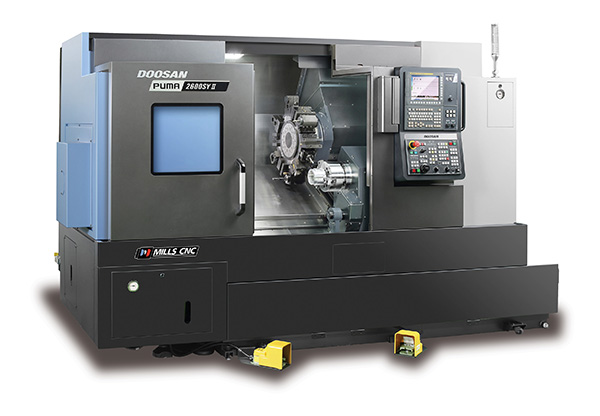
The next-generation Y-axis, sub-spindle Doosan Puma 2600SY Mk II turning centre series is now available from Mills CNC. Although the new machines are equipped with a 10” chuck, unlike Puma 2600SY Mk I models, they have a larger 81 mm bar diameter capacity. The machines are also supplied with built-in type spindles (as opposed to belt-driven spindles), which generate less vibration during cutting operations.

Further innovations include six strategically positioned heat sensors that automatically monitor and compensate for any thermal displacement during machining operations. In addition, the spindles feature a reconfigured bearing structure comprising two angular-contact bearings and two taper roller bearings to improve C-axis positional accuracy and spindle runout (less than 6 µm).
The Puma 2600SY Mk II uses high-performance NTN material (as opposed to Turcite) on its box-guideway axes, a move that is said to result in improved and more responsive movement, and reduced wear. Other performance improvements include a revised design of milling turret that incorporates a Curvic coupling piston structure delivering up to 12% additional clamping force; improved durability of the Y-axis carriageway; and a spindle air-purge function that helps prevent chip and coolant ingress.
The machine was exhibited for the first time in the UK at the recent Mills CNC open house, which took place in October.
For further information www.millscnc.co.uk

Attendance climbs

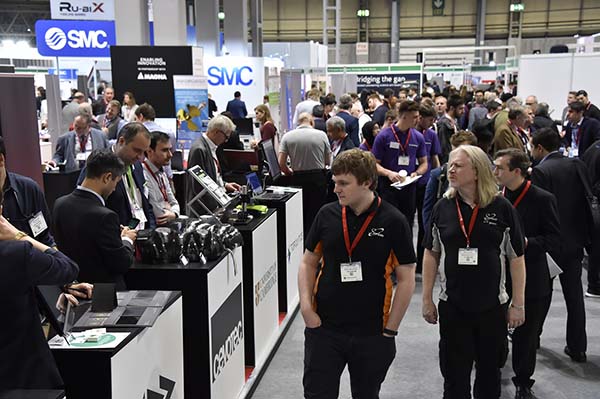
The organisers of Advanced Engineering 2017, which was held at the Birmingham NEC last month say that the exhibition’s final attendance figure was 15% higher than in 2016.

Furthermore, success at the show has sparked a booking frenzy for the 2018 edition, with stand reservations 35% higher than at the same point the year before. The show consisted of five co-locating zones: Aero Engineering; Composites Engineering; Automotive Engineering; Performance Metals Engineering; and Connected Manufacturing. These will be joined by Nuclear Engineering at the 2018 exhibition (31 Oct to 1 Nov).
For further information www.advancedengineeringuk.com

AM collaboration

Schaeffler Technologies, which manufactures roller bearings and owns the INA and FAG brands, has entered into a co-operation agreement on additive manufacturing with machine tool manufacturer DMG Mori.

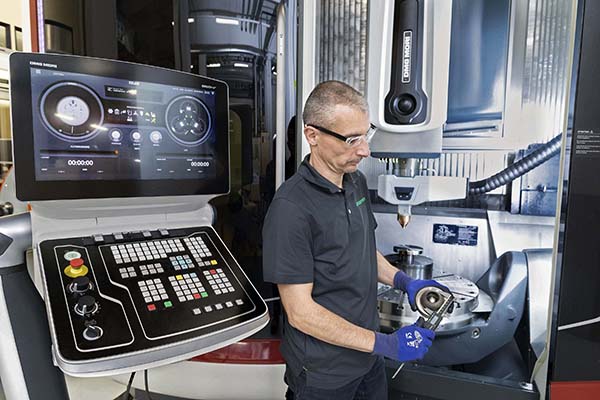
Schaeffler is now using a DMG Mori Lasertec 65 3D hybrid machine to produce one-offs and small batches of bearing components, as well as spare parts in metallic functionally graded materials (FGM) to finished-part quality. The one-hit process combines the flexibility of additive manufacturing by laser deposition with five-axis subtractive milling.
For further information www.dmgmori.com