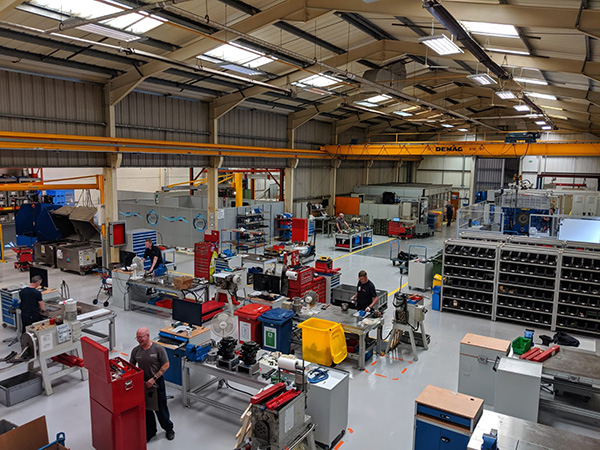
When Pinstructure opened its doors for business in 1982, the business was little more than an ‘industrial shack’ producing clevis pins and dowels. However, investment in sliding-head turning centres from Tornos has helped the company to enter new market segments, manufacture new product lines and fulfil the potential of its current 28,000 sq ft factory.

Nowadays, the Redditch-based company manufactures and distributes keys, pins, clamps, fixings, springs, circlips, dowels and washers of all types in a huge variety of sizes and material types. With the increasing advent of bespoke customer requirements and increasingly complex product lines, the company invested in a second-hand sliding-head turning centre in the late 1990s. With the machine approaching the end of its service life almost 10 years ago, the company investigated the available options and opted for the Delta 20/4 turning centre from Tornos UK.
Commenting upon the purchase of the Tornos machine, Pinstructure’s technical director Mathew Tracey says: “We investigated numerous sliding-head suppliers, but Tornos stood head and shoulders above the rest. The quality, capability and value for money were the perfect match for what we needed. We got our guys trained on the Tornos and were instantly flying. The machine was initially used for machining dowels and taper pins in quantities from 100-off up to 10,000. We then started to produce clevis pins of all sizes and the machine afforded us the facility to offer our own range of product lines.”

Running alongside an existing and ageing sliding-head machine from a Japanese machine-tool manufacturer, the Worcestershire manufacturer realised the long-standing workhorse was coming to the end of its service life. This led Pinstructure to once again turn to Tornos for a viable solution.
Tracey recalls: “When we were looking for a second sliding-head turning centre, we went straight to Tornos. We wanted something that offered a quick and easy platform for programming and setting, like the Tornos Delta 20/4 with interchangeable tooling and collet configurations. Above all, the Tornos Delta 20/4 had been an extremely reliable and productive machine with great back up from the Tornos UK office for both service and applications; we didn’t see the need to look anywhere else.”
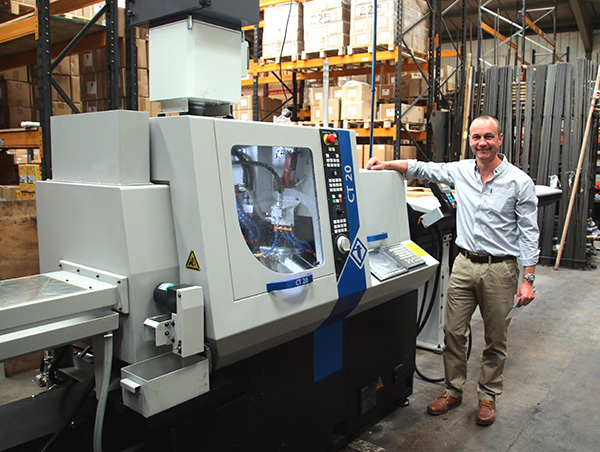
Pinstructure decided to invest in a Tornos CT20 turning centre.
“Our business was growing and the Delta machine was running around the clock,” says Tracey. “Unfortunately, our old machine wasn’t reliable and we knew its time was up. Some weeks, the Delta would be running 24/7 producing pins and relying on an old machine with reliability issues wasn’t feasible for a growing business. The arrival of the Tornos CT20 in 2018 gave us the absolute flexibility to make very small batch sizes, while also giving us the option to select the most suitable Tornos machine for each individual job.”

With upward of 1400 product lines, the 30-employee business manufactures vast ranges of fasteners, fixings and pins for the automotive and aerospace industries, mostly from materials such as stainless, hardened steels and exotic alloys.
“Although the Delta 20/4 machine initially gave us the reliability and productivity to move parts from an ageing machine, the new CT20 has not only provided added capacity, it has given us the flexibility to move small batch work from our manual machining section. This has really boosted productivity, precision, consistency and reduced our manual workload.
“As a business, we have grown by an average of 10% year-on-year for the past 5-6 years and the Tornos Delta has played a considerable role in this growth and diversification,” continues Tracey. “What the CT20 has done is protected our company from losing business, while also winning new orders from Europe, India and Asia. This influx of new work is the result of us being able to offer more competitive prices at significantly reduced lead times when compared to overseas competitors.”
From a programming perspective, the family-run business is utilising the Tornos TISIS programming platform extremely effectively.
“We have an apprentice learning the ropes with the TISIS package and his work is being confirmed by our skilled programmer,” says Tracey. “The TISIS system is very easy to use and we are continually building a portfolio of component programmes. Using the TISIS library feature where we can save repetitive and complex operations to use in new or existing programs helps to speed up the programming times of both simple and more complex parts. Ultimately, once we have a comprehensive library it will be a case of just downloading programs to the machines ‘as and when’ repeat orders arrive. As our business moves forward, we’ll be investigating the many avenues of opportunity that lie within the Tornos TISIS suite.

“Looking to the future, Pinstructure has enthusiastic employees that are supported by a young and forward-thinking management structure,” he concludes. “With an energetic and innovative team from shop floor to top floor, we have ambitious expansion plans in place with opportunities for significant growth. Who knows, we may not stop at two
Tornos machines.”
For further information www.tornos.com