
Hirschmann presents solutions for precise manufacturing

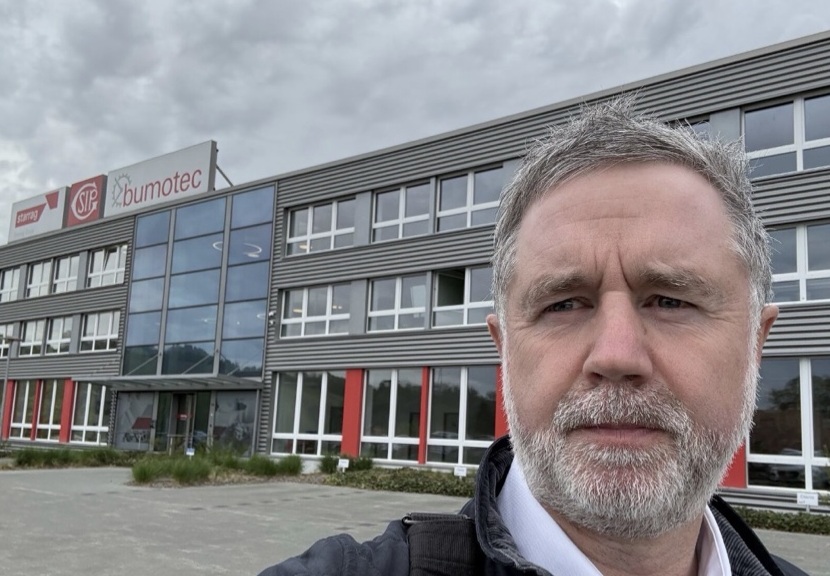
At the 3rd Berlin-Brandenburg Technology Day held recently at the Technical University of Applied Sciences in Wildau, Carl Hirschmann GmbH presented its solutions for precise and efficient manufacturing processes in industrial production. The event once again developed into an important industry gathering for companies from the plastics technology, tool and mould making, and injection moulding sectors in the Berlin-Brandenburg region.

Area sales manager Franz Wiemker represented the company at the event and presented Carl Hirschmann’s technologies. The focus was on rotary tables and clamping systems, which play a central role in automated manufacturing processes in terms of precision, process reliability and productivity.

The Technology Day provided an excellent opportunity to engage in direct dialogue with trade visitors from industry, development and production. Numerous discussions allowed for the exchange of ideas on current challenges in modern machining, automation and series production, as well as the establishment of new contacts with companies from Berlin, Brandenburg and northern Germany. This also led to initial approaches for future joint projects.

Franz Wiemker, regional sales manager at Carl Hirschmann said: “The Technology Day offered an excellent opportunity to talk directly with users and industry experts. The open exchange about challenges and solutions relating to rotary tables and clamping systems was particularly valuable for us.”

Special thanks go to organiser KB Peter Kesterke GmbH for the excellent organisation and successful execution of the Technology Day. The event once again demonstrated the importance of regional technology events in Berlin-Brandenburg for innovation, knowledge transfer and networking in mechanical engineering.

Carl Hirschmann GmbH now looks forward to continuing the discussions it has started with customers, partners and interested parties.

More information www.carlhirschmann.de/en

Magnetic clamp has force display and interchangeable poles

Roemheld’s recently released R-MAG magnetic clamping system has already received strong feedback from users in plastics processing and sheet metal forming, reflecting demand for faster, more reliable die changeovers. The electro-permanent system combines a low plate thickness with features rarely seen together on the market, including an integrated clamping force indicator and replaceable magnetic poles, both developed in response to user requirements.

Designed to clamp dies of varying sizes and geometries automatically and without distortion, R-MAG delivers a uniform magnetic surface that distributes clamping forces evenly. This capability ensures secure holding, even in the event of a power failure, while removing the need for die standardisation. A modern 8-inch colour touchscreen with remote maintenance capability via VPN or Wi-Fi further supports ease of use and system oversight.

Process reliability is enhanced through an optional clamping force display and a suite of integrated sensors, including temperature, position and flux monitoring. Together, these provide continuous system feedback, helping to maintain consistent performance and secure die clamping during operation.

Maintenance has also been simplified. Replaceable magnetic poles allow on-site servicing without taking the entire system offline, reducing downtime and improving overall equipment availability.

Suitable for injection moulding machines and sheet metal forming presses, R-MAG systems are typically designed for plate thicknesses of 55 mm and operating temperatures up to 150°C, with a slimmer 38 mm option available for smaller machines. Systems are configured to customer specifications.

“In a recent project, the customer reduced changeover times and improved process stability without standardising dies,” says Benedikt Niklas, area manager at Roemheld. “The combination of high clamping force, low profile and maintenance-friendly design is proving particularly valuable.”

More information www.roemheld.co.uk

Strengthens technology transfer for humanoid robotics

At the German Robotics Conference 2026 in Cologne, Schunk and the German Aerospace Centre (DLR) agreed to further expand their co-operation in the field of humanoid robotics. The co-operation aims to accelerate the transfer of technology to industry and advance the fine motor capabilities of humanoid robot hands for new automation applications.

Schunk and the DLR harbour the joint aim of translating research results more quickly into robust, industry-ready solutions. DLR’s Institute of Robotics and Mechatronics offers extensive experience in developing robotic solutions and has already been working with Schunk for around 20 years. With the expanded co-operation, both sides build on this success and combine their technological expertise.

DLR technology is set to be implemented in Schunk’s new modular humanoid robot hands and further developed for industrial applications. The move will enable the targeted enhancement of human-like dexterity, especially fine motor manipulation skills, for demanding automation tasks.

“We’re focusing on strong partnerships to unlock opportunities in robotics and consistently translate them into real-world applications, with speed and focus,” says Timo Gessmann, CTO of Schunk. “Bringing together our decades of mechanical expertise with cutting-edge robotics research and new AI technologies unlocks enormous innovation potential.”

The German Robotics Conference, organised by the Robotics Institute Germany (RIG) brings together leading representatives from politics, academia, industry and start-ups to strengthen the link between research, innovation and technology transfer. On site, Dorothee Bär, Federal Minister for Research, Technology and Space, got an impression of the current state of robotics and, among other things, exchanged views with Schunk on the role that collaboration and openness to technology play in strengthening Germany’s innovation capacity in robotics and AI.

More information www.schunk.com

Raising precision and efficiency in medical part production

A new workpiece clamping system that secures four components at a time for machining, intended primarily for the economical manufacture of medical components such as bone nails and other small-diameter orthopaedic implants, has been introduced by the German company Simon Nann GmbH. It is available to manufacturers in the UK and Ireland through sole sales agent Gewefa UK.

Equipped with four draw-back collets that are opened and closed by a single clamping/unclamping screw, the adaptable 349E offers a robust holding force and high accuracy for retaining sensitive components during demanding machining processes. The clamping fixture has been engineered to withstand exacting conditions and is suited to complex applications where the highest standards of repeatability and quality are imperative. 

By integrating the Erowa pallet system, the fixture is optimised for automated environments, allowing rapid workpiece changeovers via a zero-point clamping system to boost production efficiency. The standard interface is suitable for use in metal and plastic machining centres as well as in measuring stations, ensuring concentricity is maintained between the production and metrology departments. 

Likewise, the in-situ components can visit other stations, either manually or automatically, for additional operations like welding, assembly and laser marking before release from their collets. Straightforward integration into existing manufacturing systems helps to reduce set-up times.

In an industry where choosing the correct work-holding arrangement is a strategic decision affecting long-term cost-efficiency and stability, Nann’s expertise provides the robustness and precision required for reliable production. The 349E fixture addresses manufacturing difficulties, including material biocompatibility issues and complex component geometries, by offering a stable, user-friendly platform that minimises downtime and increases production output. 

More information www.gewefa.co.uk

Hainbuch milestone: 75 years of work-holding technology

When Wilhelm Hainbuch laid the foundation for his company on 1 March 1951 with a lathe and an idea, no one could have guessed it would one day become a global manufacturer of work-holding technology. 75 years later, Hainbuch stands for inventive spirit, down-to-earth attitude and the determination to do things better than before – shaped by people who not only develop technology but live it with passion.

It became clear early on that Hainbuch is not about copying what already exists, but about creating something new. The small company received a decisive boost in the 1970s from Gerhard Rall, son-in-law of the company founder and long-standing managing director. With passion, spirit and a firm belief in his own ideas, he developed the Spanntop chuck in 1977, an innovation that caught on worldwide and transformed Hainbuch from a small business to a major manufacturer of work-holding technology.

“We would rather fail with an innovation than succeed with a copy.” This credo continues to shape the company today. It explains why Hainbuch has repeatedly set technological standards: from intelligent clamping devices with sensor technology to ultra-light carbon clamping devices and solutions for automated and networked production.

The fact that strength in innovation is not just history but also a living reality is underlined by the company’s recent award of the TOP 100 seal.

Despite its international presence with around 800 employees worldwide, Hainbuch remains a family business. Now in its third generation of owner management, the company offers short decision-making processes and a culture that embodies responsibility, trust and long-term thinking. Many employees have been with the company for decades, working passionately every day to turn technology into a real advantage for customers.

More information www.hainbuch.com