


AkzoNobel offers top-sustainability powder coatings

AkzoNobel has introduced Eco+, a new designation that brings together its most sustainable powder coating solutions from the Interpon and Resicoat portfolios under a single, clearly defined framework. The Eco+ portfolio is designed to help customers more easily identify coating technologies that deliver measurable sustainability benefits while maintaining high performance.

Eco+ products are powder coatings that provide verified improvements in key sustainability areas while also supporting operational efficiency. The solutions are designed to reduce energy consumption, minimise waste and lower carbon emissions, while extending product lifespan and improving process productivity. By consolidating these technologies under one designation, AkzoNobel aims to provide greater transparency and confidence when selecting sustainable coating solutions.

To qualify for Eco+ status, each product must demonstrate measurable sustainability performance against clearly defined, data-backed criteria. Every product included in the portfolio delivers at least one of six recognised sustainability benefits. These include reduced energy consumption through lower curing temperatures and faster curing cycles, increased productivity through single-layer systems and fewer processing steps, and reduced waste during manufacturing and application.

Additional benefits include lower material consumption through improved coverage and right-first-time performance, extended product lifespan through highly durable coatings, and reduced carbon footprint through smarter raw material selection, including bio-attributed resins.

According to AkzoNobel, powder coatings are already among the most sustainable coating technologies available. With Eco+, the company aims to make it easier for customers to understand where sustainability can deliver tangible value, whether through improved efficiency, reduced energy use or longer service life.

The Eco+ portfolio spans multiple industries, including architecture, automotive, domestic appliances and general industrial manufacturing, providing solutions such as low-temperature curing coatings, enhanced corrosion protection and highly durable finishes.

More information www.bit.ly/3OYj8kf
Parts-washing specialist shares thoughts on year ahead

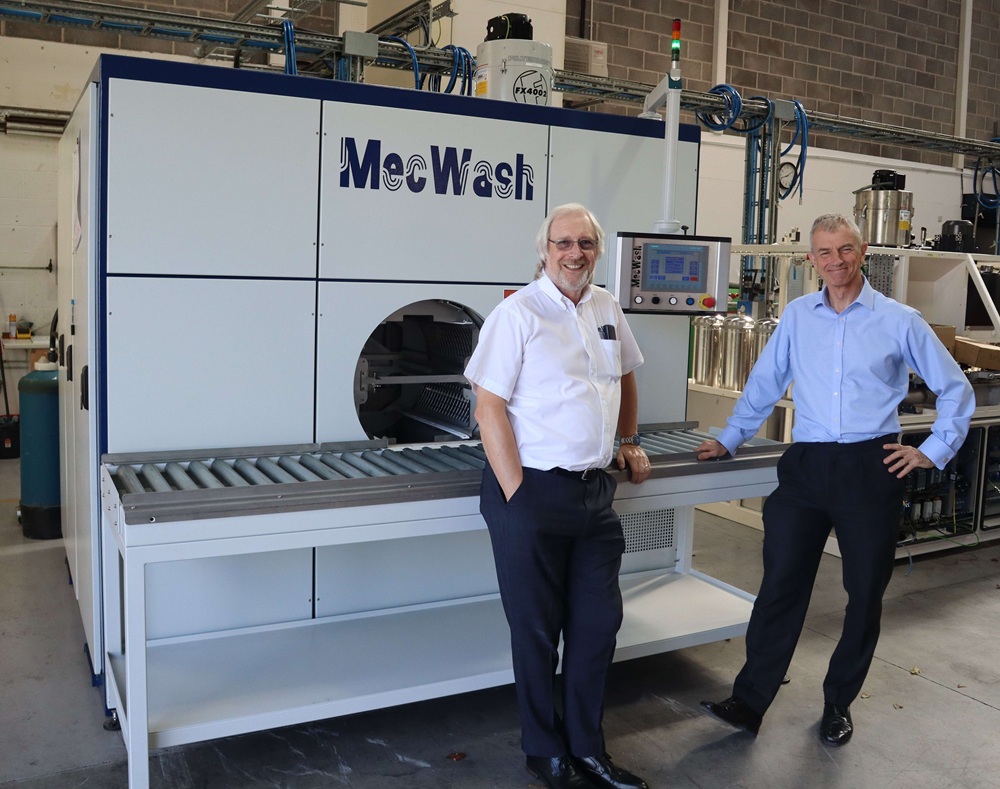
With MACH 2026 approaching, the UK manufacturing sector is entering the year with renewed optimism. According to John Pattison, managing director of MecWash Systems, the industry is seeing encouraging momentum across several key sectors, alongside increasing focus on efficiency and reliability in production processes.

Pattison notes that 2025 proved to be a positive year for MecWash, with strong demand for the company’s industrial component cleaning systems. While the automotive sector has faced challenges in recent years, defence and aerospace remain particularly strong markets, supported by high global demand and the specialist expertise of UK manufacturers. The medical sector also continues to represent a significant area of activity for MecWash.

Strict regulatory requirements across many sectors mean that manufacturers must meet extremely high standards of cleanliness and process control, areas where the company’s component cleaning systems are well established. In addition, MecWash has seen growing interest from companies involved in additive manufacturing.

A key aspect of MecWash’s approach is designing tailored cleaning solutions for each customer application. By analysing the specific contamination challenges involved, the company develops a bespoke combination of process, chemistry and equipment to ensure optimal results.

Looking ahead, Pattison expects manufacturers to place even greater emphasis on efficiency as energy costs remain high. Reducing downtime and maintaining productivity will be critical priorities, which is driving demand for reliable equipment with remote diagnostics and robust service support.

MecWash continues to invest in innovation, system development and customer service, while demand for fully refurbished machines has also increased in recent years. With a positive outlook for manufacturing, the company is looking forward to showcasing its latest developments at MACH 2026 (NEC Birmingham, 20-24 April).

More information www.mecwash.com

Automatic inline de-flashing of injection-moulded parts

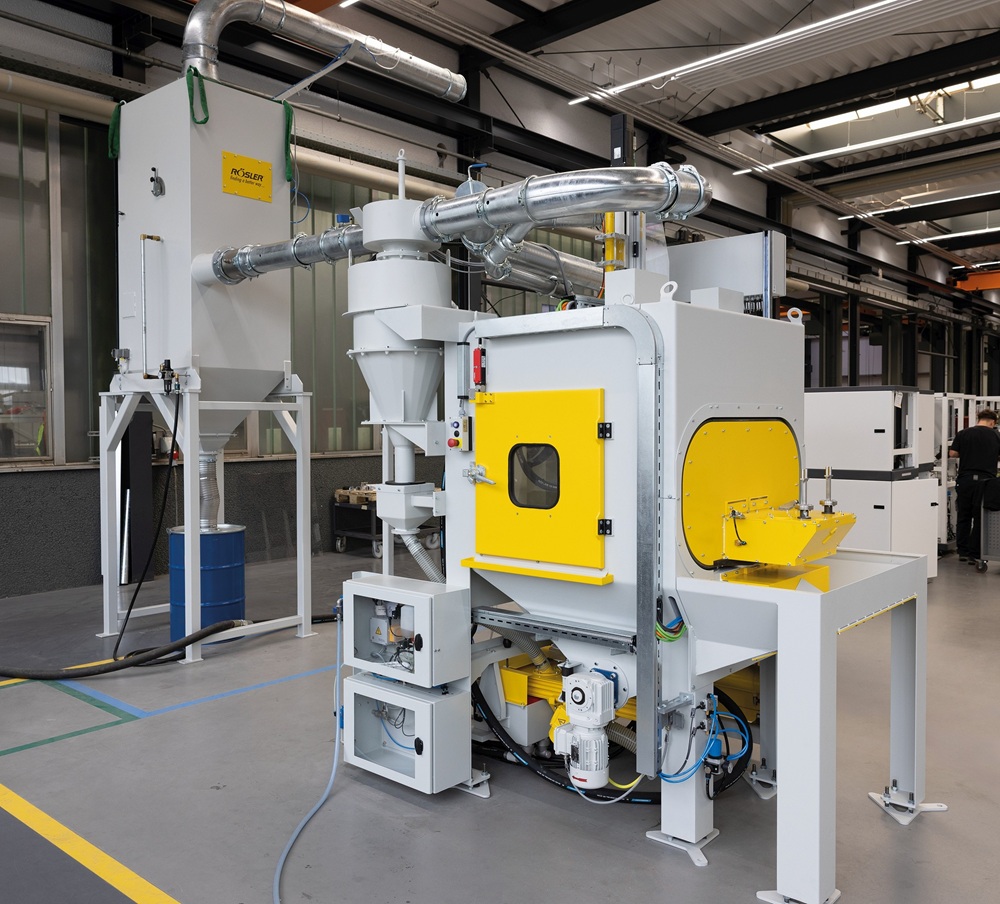
A global manufacturer of garden implements and motorised tools has invested in an automated plastic injection moulding and finishing solution for its US production facility to ensure consistent quality for critical engine components. Geometrically complex parts are now de-flashed using a Röslerswing blast chamber, which is fully integrated into the manufacturing line to enable continuous, automated processing.

The German-headquartered company produces its tools and equipment at facilities worldwide and is recognised for the high quality and reliability of its products used in forestry, landscaping and construction. However, two thermoset engine components previously sourced from external suppliers for the US plant did not consistently meet the required quality specifications.

To address this issue, the manufacturer decided to bring production of these parts in-house, including the removal of moulding flash generated during injection moulding. Drawing on positive experience with Rösler technologies in Europe, the project team worked with the company’s US subsidiary to develop an automated de-flashing solution.

The resulting system is based on the RWS 1200 swing chamber machine, specifically designed for the gentle processing of thermoset and highly filled thermoplastic components. The compact RWS 1200-I4-SAT2 machine features two chambers, each equipped with rotating satellite stations that securely hold the components during blasting. This dual-chamber configuration allows loading and unloading to take place in one chamber while de-flashing occurs in the other, effectively eliminating non-productive downtime.

Robotic handling ensures precise placement of the components on dedicated fixtures, while multiple blast nozzles accelerate non-abrasive media on to the rotating parts to remove flash and contaminants. The system achieves a cycle time approximately 15 seconds faster than the 60 seconds specified, reducing energy consumption and operating costs while ensuring reliable, high-quality component finishing.

More information www.rosler.com

Improved paint finish with innovative rotating nozzle

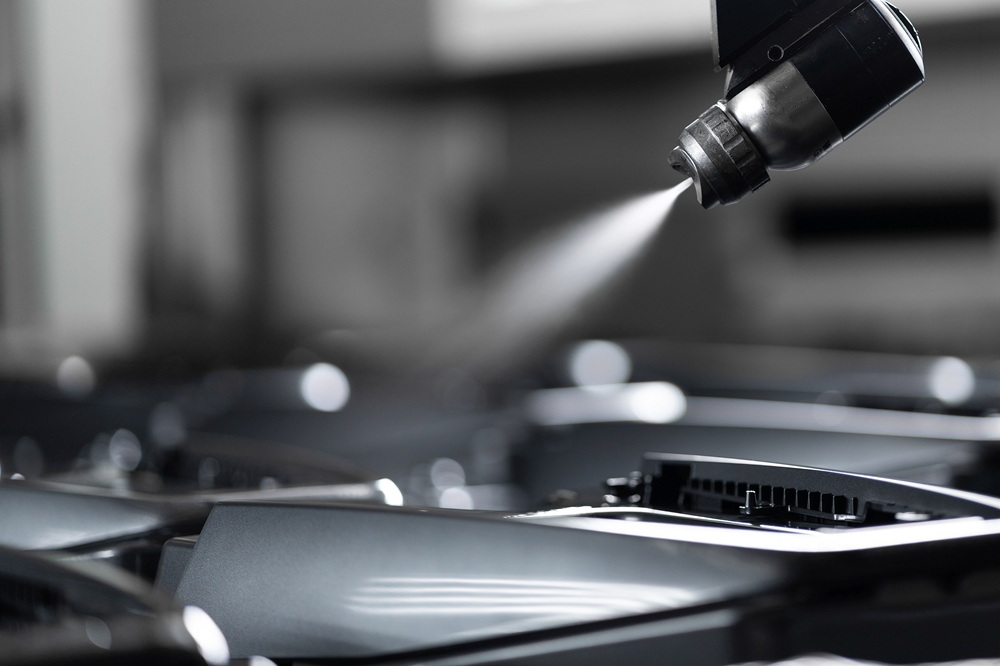
Snow-jet cleaning has become a state-of-the-art solution for preparing plastic components prior to coating. To enhance cleaning quality and paint finish even further, automotive components specialist KTX has upgraded the snow-jet cleaning systems integrated into its automated paint shops by replacing conventional nozzles with an innovative rotary system.

Headquartered in Weissenburg, Bavaria, KTX produces interior and exterior trim components for the automotive industry, covering the entire production chain from design to final assembly. The company manufactures its parts using injection moulding machines with clamping forces ranging from 80 to 3200 T and operates advanced paint shops for finishing high-quality trim components.

Clean surfaces are critical to achieving flawless coatings, particularly for high-gloss finishes, such as piano black. Even the smallest dust particles or fibres can lead to surface defects and rejected parts. For this reason, KTX sought ways to further optimise its paint shop cleaning processes.

Working with ACP Systems AG, a specialist in snow-jet cleaning technology, KTX evaluated an alternative cleaning concept. The QuattroClean system uses recycled liquid carbon dioxide that expands through a specialised nozzle to form fine CO₂ snow. Accelerated by compressed air to supersonic speed, the jet removes particulate and filmic contamination, leaving surfaces dry and residue-free.

Tests demonstrated that an array equipped with multiple nozzles would deliver improved paint finishes compared with the existing configuration. As a result, the partners developed a rotary nozzle system that could be integrated into the existing cleaning module. The new rotary unit features three nozzles mounted on the cleaning module’s linear system.

According to KTX, the technology has significantly improved process stability and coating quality while also delivering economic benefits, and the company is now considering deploying the solution in additional paint shops.

More information www.acp-systems.com

New Quickparts solutions for high-performance plastics

Quickparts, a global provider of advanced manufacturing solutions that scale from prototype to production, has introduced two new high-performance plastic materials – DuraKor and ThermaKor, along with vapour smoothing as a core surface-finishing capability. Together, these additions expand the company’s ability to support customers across multiple stages of product development, enabling engineers to validate designs, refine surface quality and transition smoothly from prototype to full-scale production.

Engineering teams often encounter challenges as products move from concept to market, particularly when changing materials, processes or suppliers. The introduction of DuraKor, ThermaKor and vapour smoothing is designed to reduce these discontinuities by offering performance-capable materials and finishing processes that support design validation and production scaling within a single manufacturing ecosystem.

According to Quickparts, the transition from validation to production is one of the most complex stages in manufacturing. The new materials and finishing capabilities provide engineers with greater continuity throughout the development journey, helping maintain performance, quality and speed to market.

DuraKor is a high-performance engineering plastic with mechanical characteristics similar to polypropylene, offering high impact resistance, excellent chemical resistance and low permeability. These properties make it suitable for demanding functional and end-use applications, including fluid-handling components, enclosures and ruggedised housings. When combined with vapour smoothing, DuraKor parts achieve improved sealing performance and a refined surface finish.

ThermaKor, meanwhile, is a high-temperature nanocomposite material designed for tooling and manufacturing aids that require dimensional stability and thermal resistance. Typical applications include wind tunnel models, composite lay-up tools, mould inserts and test fixtures.

With the addition of vapour smoothing, Quickparts further enhances the performance and appearance of additively manufactured and cast plastic parts, delivering improved surface quality, reduced porosity and production-ready finishes.

More information www.quickparts.com