Mills CNC has recently supplied Aberlink – the largest UK-owned manufacturer of co-ordinate measuring machines (CMMs), vision systems and 3D measurement software – with two DN Solutions machine tools as part of a strategic investment in its in-house manufacturing capability.
The machines, a large-capacity DN Solutions DNM 6700XL three-axis vertical machining centre and a compact DN Solutions Lynx 2100LSYB multi-tasking lathe, arrived simultaneously in March 2025 at Aberlink’s recently revamped machine shop in Stroud, Gloucestershire. Their arrival marks a significant milestone in the company’s ongoing drive to improve productivity, eliminate bottlenecks and futureproof its production operations.
Since commissioning, both machines have been put through their paces machining a wide range of high-precision components that are integral to every Aberlink CMM. These include bridge beams and rails of varying lengths and widths, air bearings, racks, plates, pinions and housings. Typically produced in relatively small batches of up to 50-off, these components are machined from extruded aluminium alloys, aluminium billet and bar stock, as well as steel, brass and selected engineering plastics.
Despite modest batch sizes, the technical demands are high. Tight geometric tolerances and excellent surface finishes are essential to ensure the positional accuracy and repeatability that define Aberlink’s CMM performance. Consistency from part to part is critical, as even minor deviations can influence overall machine accuracy.
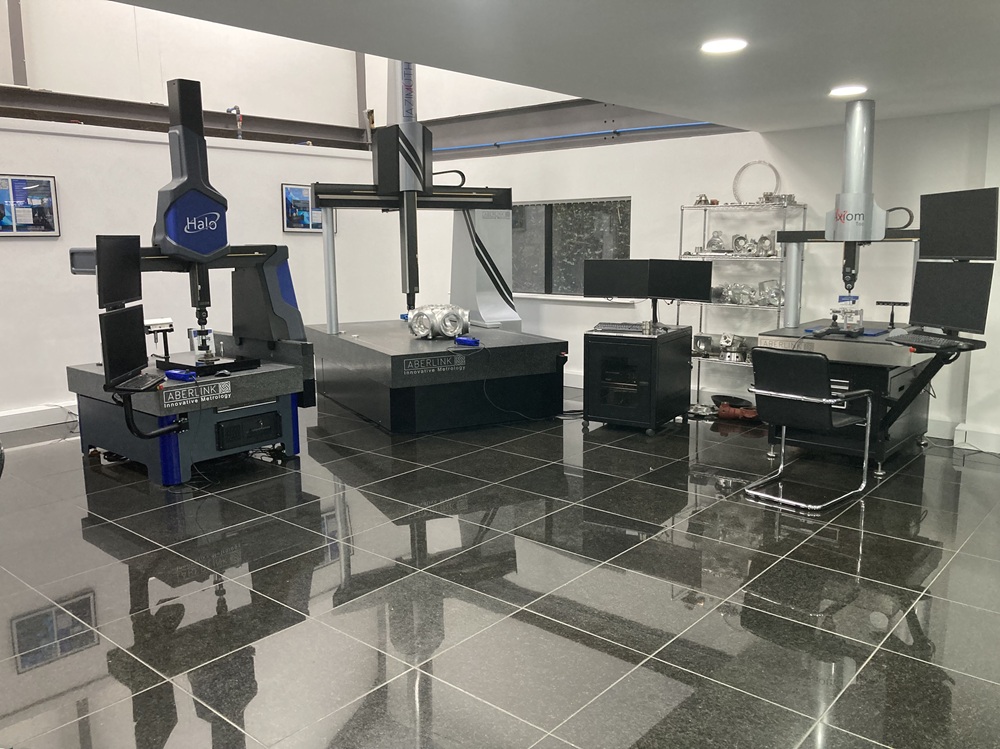
Aberlink’s CMM portfolio is both broad and continually evolving. The range includes compact shop-floor systems such as the Fulcrum and Extol, designed to sit alongside CNC machine tools in production environments, as well as larger bridge-type machines like the Axiom, Halo, Horizon and Azimuth, typically installed in dedicated, temperature-controlled inspection rooms. Across the board – whether manual or CNC-controlled, Cartesian or non-Cartesian – Aberlink says its CMMs are recognised globally for their rigidity, speed, reliability and ease of use.
In 2024, the company received a King’s Award for Enterprise for the design innovation and error mapping capabilities incorporated into its Extol CNC CMM. This accolade further cemented Aberlink’s reputation as a technology-led manufacturer committed to continuous improvement.
Affordability is another important differentiator. In addition to robust build quality and proprietary 3D measurement software, Aberlink provides free software upgrades and does not charge annual maintenance fees – a policy that resonates strongly with customers wary of hidden lifecycle costs. As a result, the company’s CMMs are widely specified by precision component and mould tool manufacturers serving the aerospace, automotive, motorsport, medical, oil and gas, and energy sectors, both in the UK and internationally.
All design and assembly operations are centred at Aberlink’s Eastcombe manufacturing facility. The site incorporates a visitor showroom, expanded assembly areas and dedicated software development, applications and customer service departments. At the heart of the operation, however, lies the machine shop – divided into discrete milling and turning sections and equipped with a mix of CNC and manual machines, including several long-serving legacy platforms installed in the late 1990s and early 2000s.
“In the early days, before our first Windows-based CMM was launched, we actually operated as a precision subcontract machining business,” explains Marcus Eales, owner and director. “As demand for our CMMs increased, the machine shop expanded in tandem. It has always been, and remains, a vital cog in our growth and success.”
With demand continuing to rise, particularly from overseas markets such as China, Aberlink undertook a comprehensive machine shop audit in 2024 as part of a company-wide continuous improvement initiative. The objective was to benchmark performance, identify pinch points and ensure that production capacity aligned with sales growth.
“Our machine shop produces a high volume of precision components,” says Eales. “There can be up to 150 different parts in our best-selling Axiom CMM alone. Meeting tight delivery schedules means our machining processes must be efficient, reliable and capable.”
The audit highlighted inefficiencies in the milling of extruded aluminium beams and rails on an ageing Cincinnati FTV-640 machining centre. Although the machine remained accurate, slower spindle speeds and feed rates were extending cycle times and constraining throughput. Replacing it with a modern, faster and more powerful vertical machining centre was identified as a priority.
At the same time, the review exposed limitations in the turning department. Existing two-axis, single-spindle lathes were capable of basic turning, facing, drilling and boring operations, but lacked Y-axis capability, driven tooling and sub-spindles. Complex components requiring off-centre features or secondary milling operations demanded multiple set-ups and manual intervention, creating bottlenecks and placing additional pressure on milling resources.
“Single-spindle, single-turret lathes have inherent limitations,” explains director Ian Rhodes. “Without Y-axis or sub-spindle capability, you’re forced into multiple operations. That affects cycle times, labour input and overall efficiency.”
Aberlink therefore developed a detailed ‘needs and wants’ specification covering both milling and turning requirements before approaching the market. Although the company had not previously invested in equipment from Mills CNC, its reputation for supplying high-performance, competitively priced DN Solutions machines – backed by strong aftersales support – quickly brought it into contention.
“Mills CNC has a good standing in the marketplace, and many of our customers are familiar with DN Solutions machines,” says managing director Rachel Cook. “Their cutting performance, long-term precision and reliability, combined with Mills’ service support, made them a compelling choice.”
The DN Solutions DNM 6700XL selected offers generous axis travels, rapid traverse rates and an 18.5 kW, 15,000 rpm spindle, supported by a 40-tool automatic toolchanger. Equipped with a FANUC 0iM control and Renishaw probing, the machine delivers improved cycle times and productivity compared with its predecessor, particularly during the heavy-duty roughing of aluminium extrusions.
“The DNM 6700XL is faster, more powerful and more flexible,” says Rhodes. “It comfortably handles everything we throw at it, from roughing long beams to finishing precision components.”
Complementing this machine, the DN Solutions Lynx 2100LSYB multi-tasking lathe features an 8” chuck, 65 mm bar capacity, sub-spindle, Y-axis travel and driven tooling up to 6000 rpm. Supplied with a FANUC 0iT control, quick-change collet chucks and a Hydrafeed short magazine bar loader, the machine enables complete machining of complex, high-precision parts in a single set-up and can operate unattended for extended periods.
“Being able to machine parts in one hit has transformed our turning operations,” says Eales. “The addition of the bar loader has released capacity, reduced labour input and improved consistency. We’ve seen tangible gains in productivity and cost control.”
For Aberlink, whose CMMs depend on uncompromising mechanical accuracy, strengthening in-house manufacturing capability is fundamental. The twin investment in advanced milling and multi-tasking turning technology not only eliminates previous bottlenecks but also provides headroom for future growth.
“We’re delighted with the two DN Solutions machines acquired from Mills CNC,” concludes Cook. “They were proactive and easy to work with, and installation was handled smoothly with minimal disruption. This investment reinforces our commitment to quality, efficiency and continued innovation.”
More information www.millscnc.co.uk