


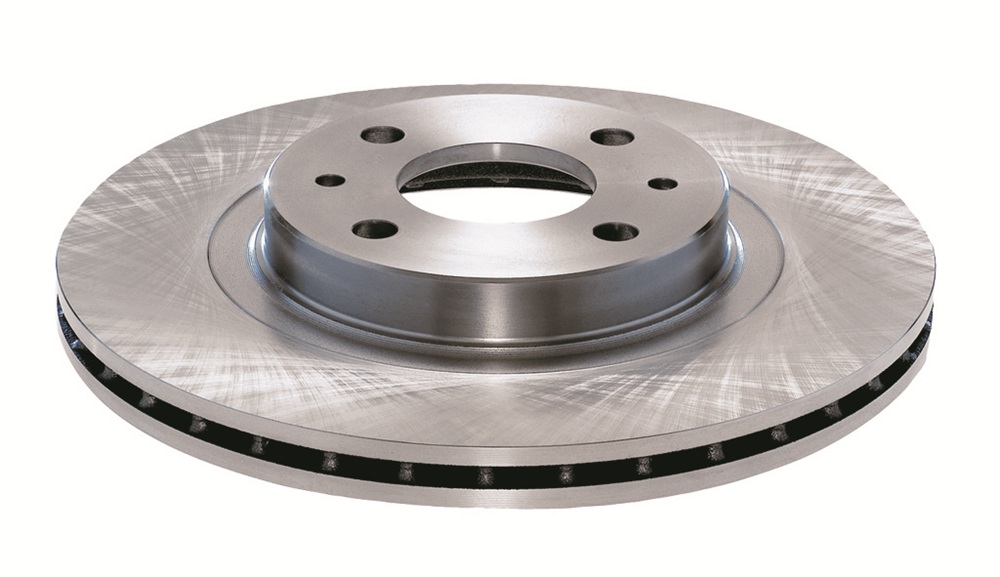
The car brake disc of the future is coated as it is the only way to meet the stricter particulate matter limits of the Euro 7 standard. The braking surface is also protected against corrosion and wear. But which machining process can guarantee this quality can be achieved reliably and in large quantities? With its VLC 450 DG machine and the combination of laser cladding and subsequent double-sided face-grinding, EMAG says it has the answer.
Jannik Röttger, head of grinding technology at EMAG, says: “Our laser cladding in particular opens up many possibilities: matrix material and hard material carbide are fed into a laser tool and welded to the preheated surface. In this way, first an adhesive layer and then the overlying wear protection layer are applied – at least in the case of so-called two-layer systems. There are also developers who rely on a one-layer solution, such as for the rear axles in compact vehicles.”
He continues: “Our USP is that, on one hand we can control and influence the turning process and the entire laser welding process on EMAG machines if the customer so wishes. On the other hand, we keep an eye on the subsequent grinding process right from the start. After all, the turning process and central coating parameters should be configured in such a way that the surface produced results in the shortest possible grinding cycle times and low grinding wheel wear with the highest component quality. Isolated solutions for just one of the two processes generate problematic performance figures.”
The VLC 450 DG grinding machine is a special solution for brake discs that has been designed for the respective coating system and desired production process.
More information www.emag.com